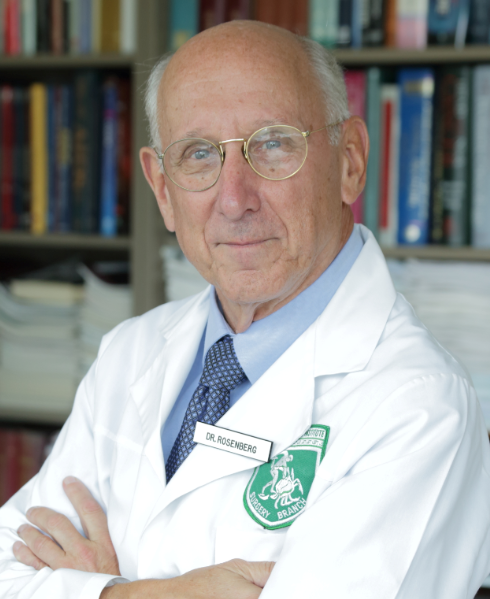
Origins of Cancer Immunotherapy, ft. Dr. Steven Rosenberg
In the premiere episode of The ImmunoVerse, host Dr. Patrick Hwu sits down with pioneering physician-scientist Dr. Steven A. Rosenberg, Chief of Surgery Branch at the National Cancer Institute. Together, they explore the roots of Dr. Rosenberg’s fascination with the immune system, tracing his remarkable journey from early scientific curiosity to the groundbreaking immunology discoveries that have reshaped cancer treatment.
Podcast Transcript
Patrick Hwu, MD
Welcome to The ImmunoVerse, a podcast that brings the ever-expanding universe of immunotherapy to life through the voices of those advancing this groundbreaking field. I'm Dr. Patrick Hwu, President and CEO of Moffitt Cancer Center and a career immunologist. In each episode, I sit down with pioneering experts who have shaped the past, present, and future of immunotherapy, uncovering breakthroughs, challenges, and the science driving this life-saving innovation.
Today, we have with us Dr. Steven Rosenberg, Senior Investigator and Chief of the Surgery Branch at the National Cancer Institute. Dr. Rosenberg is known for his pioneering work in the development of cancer immunotherapy, resulting in the first effective immunotherapies for patients with advanced cancers. His work on interleukin-2, tumor-infiltrating lymphocytes, auto- and CAR T-cell therapy has led to life-changing treatments, offering patients long-term survival and even cures.
And his contributions continue to shape the future of cancer care. Dr. Rosenberg was my personal mentor and has served as a mentor for countless other leaders in the field, playing an important role in shaping the next generation. He has published over 1,200 papers in peer-reviewed literature and is one of the most cited physician-scientists in the world.
Welcome to The ImmunoVerse, Dr. Rosenberg.
Steven Rosenberg, MD, PhD
Delighted to be here.
Patrick Hwu, MD
You’ve done so much in the field. Tell us, how did you first get interested in science and in immunology?
Steven Rosenberg
You know, I remember wanting to be a cowboy when I was about five or six years old, but as soon as I got past that, I knew I wanted to be a doctor. I was born in 1940, and when I was five or six years old, the information about the Holocaust was coming out—and the horrors of it.
And I couldn’t understand how people could be so evil toward one another. And I decided at age six or seven that I wanted to be a doctor. I wanted to help people who needed help. And I’ve never wavered. From the very earliest of my education, I saw exactly where I wanted to go. I wanted to be a doctor.
I wanted to take care of people. I wanted to do research. I didn’t simply want to practice the medicine of today—I wanted to help create the medicine of tomorrow. And it’s something that’s stuck with me from those earliest days.
Patrick Hwu
I remember you telling me stories of your summers. Sometimes you would work in your father’s deli, right? You’d make the hamburgers.
Steven Rosenberg
Oh yeah. Every afternoon in high school, after school, I would go down and work in my dad’s luncheonette. He had a small luncheonette in downtown Manhattan. And I would relieve him. He would start work at about six in the morning, and I would show up at about four and spend a few hours closing up the store. I worked there summers as well.
I made more egg creams—probably made 10,000 of them in my youth.
Patrick Hwu
What do you think you learned from that experience?
Steven Rosenberg
Well, one thing I learned is that I didn’t want to work in a luncheonette. I wanted to do something that was a little more creative. But it gave me an understanding of what life was like for so many people. My dad’s luncheonette was in the garment district, and I ran into a lot of people. For me, it was a personal education about what life was like for most people.
Patrick Hwu
When did you start getting interested in immunology?
Steven Rosenberg
So I went to Johns Hopkins for undergraduate work and medical school, and then began a residency in surgery at the Brigham Hospital. But immediately after my internship, I took off four years to get a PhD in biophysics. And it was during my time as a medical student and as a surgical resident that the horrors of cancer became quite apparent to me.
We would operate on patients. We would think we had taken out all the tumor, but most often we hadn’t. And they would go on and progress with their cancer. And so it was watching people who were innocent, who were suffering terribly, had families standing by impotent to help them. In a sense, cancer became a holocaust for me. And it was something that I wanted to address.
Patrick Hwu
I think what you've accomplished, Steve, has been extraordinary. You've really taken immunotherapy and shown that it can cure patients. I think you’ve really advanced the field with what you’ve done with TILs. How did you get into this field in the beginning? What inspired you?
Steven Rosenberg
Well, when I finished my clinical training in surgery, I wanted to do research. It was right after the first description of the immune system and how it might play a role in cancer. So, I decided to start a lab and explore that. It was pretty lonely at the time—there were very few people interested in cancer immunology. But I was fascinated by the idea that the immune system could be harnessed to fight cancer.
Patrick Hwu
You were a real pioneer. I think back then, the field was very skeptical about whether the immune system could really do much against solid tumors.
Steven Rosenberg
Yes, very much so. People believed that the immune system couldn’t recognize tumors because they arise from self-tissues. But we now know that mutations in tumors can make them recognizable as foreign. That’s been a huge shift in thinking.
Patrick Hwu
Absolutely. And you've shown that not only can T cells recognize those mutations, but if you grow enough of them and get them into the patient the right way, they can actually eliminate the cancer. That was revolutionary.
Steven Rosenberg
The first patient we treated successfully with TILs had widespread melanoma. When she had a complete regression, that was a landmark moment. I remember we kept looking at the scans, wondering if it could really be gone. And now, decades later, she’s still alive and disease-free.
Patrick Hwu
That’s incredible. And now there are dozens of patients like that. I think what’s exciting is how you kept refining the approach—using lymphodepletion, IL-2, better selection of T cells. You never gave up.
Steven Rosenberg
Well, science is incremental. Each step builds on the one before. And you’ve contributed a lot, too, Patrick. Your work on translating these findings into clinical trials and new technologies has helped move the whole field forward.
Patrick Hwu
Thank you, Steve. It’s been an honor to collaborate with you and learn from you. What do you see as the next big challenge in immunotherapy?
Steven Rosenberg
I think the future is in individualized therapy. We need to identify unique mutations in each patient’s tumor and find T cells that target them. We’re developing new methods to do this more efficiently. It’s still early, but the potential is enormous.
Patrick Hwu
I agree. It’s a precision approach—tailoring the therapy to each patient’s unique cancer. And I think combining that with other treatments, like checkpoint inhibitors, could be very powerful.
Steven Rosenberg
Absolutely. Combination therapies will be key. And we’re also learning more about how the tumor microenvironment affects T cell function. Overcoming those barriers is another frontier.
Patrick Hwu
It’s an exciting time. You’ve really paved the way for so many of us, Steve. Thank you for everything you’ve done—and are still doing—for the field and for patients.
Steven Rosenberg
Thank you, Patrick. And thank you for your leadership and vision. It’s been a privilege to work alongside you.