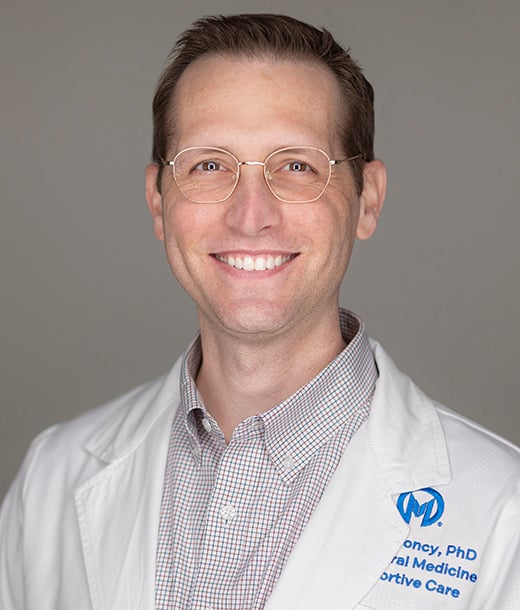
Dr. Poncy's Story
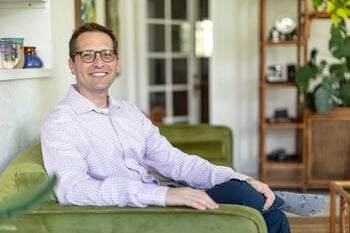
Dr. Poncy
Neuroendocrine Carcinoma | Mental Health & Cancer
“I introduce myself as a psychologist at Moffitt and that I also have another role here, which is as a patient.”
Every morning, before he steps into Moffitt Cancer Center’s Supportive Care Medicine clinic, clinical psychologist Jordie Poncy, PhD, sits quietly with a cup of coffee. It’s a habit he never had before cancer — a deliberate pause that helps him center himself for the emotional work ahead.
“I used to be someone who set the alarm with just enough time to get ready and get out the door,” he said. “Now, I set it extremely early to give myself time to just sit and center myself.”
His days are filled with intake evaluations, follow-ups and conversations that often include fear, grief or exhaustion. But Jordie begins each one with openness.
“I introduce myself as a psychologist at Moffitt and that I also have another role here, which is as a patient,” he said.
That moment often brings relief. People relax. Someone finally understands without needing everything explained.
“They tend to be very glad that they’re working with someone who they feel can understand aspects of the experience,” he said.
When the cancer caregiver becomes the patient
In August 2022, Jordie was preparing to start his new job at Moffitt — a place with special meaning, where his father had once received lifesaving bladder cancer care. But instead of beginning his role, he found himself calling his future employer from a hospital bed.
“I told them I couldn’t start in a week,” he said. “I’m at the hospital, and they have just found cancer.”
He had gone to the emergency room for stomach pain that began as a dull ache and steadily worsened. A scan showed tumors in his liver and lymph nodes.
“I really thought it would be nothing,” he said.
At first, doctors believed it was colorectal cancer. Treatment was scheduled. But two days before chemotherapy was set to begin, Jordie received a different pathology result, one that changed everything.
“It wasn’t what they thought,” he said. “It was neuroendocrine carcinoma, which is rarer and can be more aggressive. We needed a whole new plan.”
At only 39, a new psychologist transitioning into oncology work, Jordie suddenly became a patient facing a rare diagnosis at the same institution where he hoped to support others.
Moffitt held his job until he could return.
The End of Cancer Begins Here®
Find a Clinical TrialFinding perspective in a rare cancer diagnosis
Working with neuroendocrine carcinoma specialist Jonathan Strosberg, MD, Jordie learned quickly about the seriousness of his disease and about the individualized care it requires.
“What Jordie has is a poorly differentiated neuroendocrine carcinoma, which is an extremely aggressive type of cancer,” Strosberg explained. “Fortunately, he’s done very well and has responded well to treatment.”
Treatment required cycles of chemotherapy, time at Moffitt infusion centers and days wearing a portable pump. Over time, it became part of his routine.
“You adjust,” Jordie said. “You find ways to work it into your life.”
He eventually started his professional role at Moffitt five months later, bringing with him something no training program could teach: the lived experience of being a cancer patient.
Shared Experience Creates Connection
Within the clinic, Jordie’s dual role reshaped how he understands therapeutic relationships.
“I’ll tell clients I’m also a patient,” he said. “And I can see a shift. There’s less explaining they feel like they have to do.”
He doesn’t practice old-school neutrality. Instead, he draws from a model grounded in mutual empathy, shared presence, respect and humanity.
“That kind of shared understanding makes a big difference,” he explained. “Knowing we’re kind of in it together and figuring it out together has really built that sense of mutual caring and empathy.”
One patient connection, in particular, left a lasting impact. After she passed away, her family asked Jordie to speak at her memorial service.
“That was hard and sad,” he remembered, “but also such a major honor.”
The moment reminded him that cancer care is not just treatment, it’s relationship.
Art, reflection and healing
Creativity became an unexpected part of Jordie’s healing. He found comfort in paper-cutting art, slowly trimming and layering colorful pieces that now hang throughout his home.
One piece, made shortly after diagnosis, shows three figures: a person, a patient and a provider.
“I was thinking about the different parts of myself,” he said. “The professional, the patient and then just me, who I’ve always been.”
He also shares reflections on Instagram, not documenting symptoms, but exploring coping, grief and emotional resilience.
“I am not trying to be inspirational,” he said. “It’s more about saying, ‘Hey, if you’re feeling this, too, that makes sense.’”
His social media has reached people facing cancer and others simply navigating life’s difficult moments.
“I think there’s value in saying it out loud,” he said. “Even if it is just on Instagram.”
What cancer patient support really means
Jordie knows firsthand the power of showing up — something his own friends and family did again and again.
“I’ve had friends fly in just to hang out or distract me for a weekend,” he said. “It means everything.”
That kind of unwavering presence is something he brings into every patient session.
“I know what it means to have someone sit with you in it,” he said. “Not to rush you. Not to need you to feel better. Just be there.”
As he continues treatment, Jordie says cancer has changed him — but it has also deepened his compassion, sharpened his clarity and strengthened his belief in connection.
“There’s so much we can’t control,” he said. “But there’s also a lot of beauty in showing up for each other. That’s what I keep coming back to.”