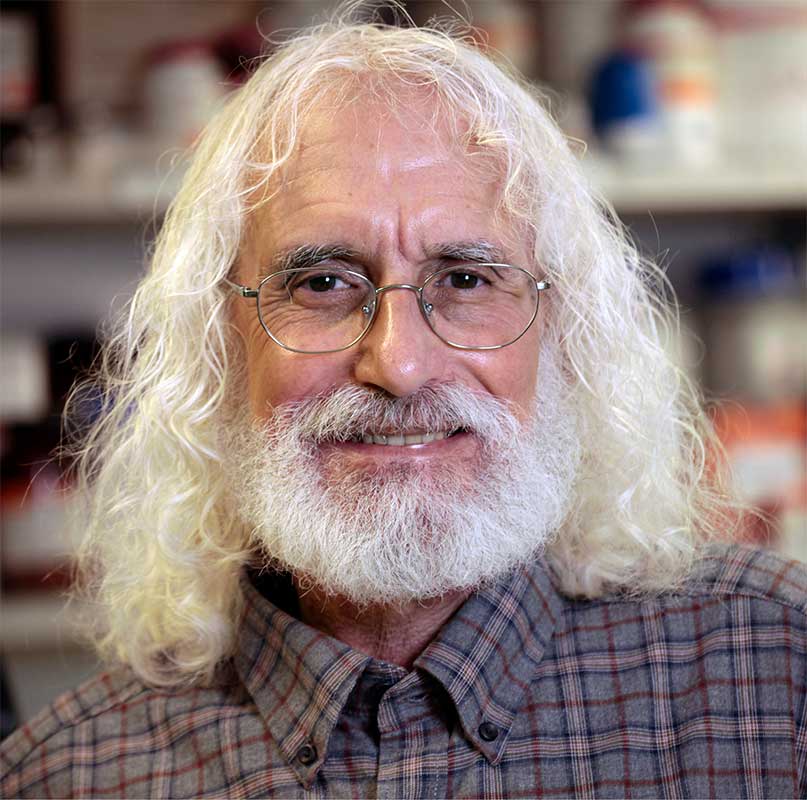
The T-Cell Transformation, ft. Dr. Philip Greenberg
Host Dr. Patrick Hwu sits down with trailblazing immunologist Dr. Phil Greenberg of Fred Hutchinson Cancer Center to explore how engineered T cells are revolutionizing cancer treatment. From early experiments in synthetic biology to today's clinical breakthroughs, Dr. Greenberg shares his decades-long journey to harness and rewire the immune system, turning obstacles into opportunities and transforming science fiction into standard of care.
Podcast Transcript
Patrick Hwu, MD
Welcome to The ImmunoVerse, a podcast that brings the ever-expanding universe of immunotherapy to life through the voices of those advancing this groundbreaking field. I’m Dr. Patrick Hwu, president and CEO of Moffitt Cancer Center and a career immunologist. In each episode, I sit down with pioneering experts who have shaped the past, present and future of immunotherapy, uncovering breakthroughs, challenges and the science driving this lifesaving innovation.
Today, we have with us Dr. Phil Greenberg, head of the Program in Immunology at Fred Hutchinson Cancer Center and a Professor of Medicine and Immunology at the University of Washington. Dr. Greenberg is a true pioneer in the field of T-cell therapy, particularly in developing engineered T cells to treat cancer. His work has set the stage for many of the adoptive T-cell therapies we see today, including strategies for targeting solid tumors. With decades of groundbreaking discoveries, Dr. Greenberg has helped transform the promise of cellular immunotherapy into clinical reality. His research continues to drive innovation at the intersection of immunology, gene therapy and cancer treatment. Welcome to The ImmunoVerse, Dr. Greenberg.
Philip Greenberg, MD
Thanks very much, Patrick. Pleasure to be here.
Patrick Hwu
Great. Well, you’ve been in the field for many years, and you’re such a visionary always. I remember being a young fellow, going to international conferences and seeing you just knock it out of the park with incredible vision of T-cell therapy, engineering with new molecules—really amazing to me, you were always a role model for me, Phil.
So tell me, how did you get involved with immunology? And when did you first come to the realization that the immune system could help fight cancer?
Philip Greenberg
Yeah, I got into immunology—we’re often kind of influenced by the people that are near us—and I was finishing my medical training in San Diego. I took several years out to study immunogenetics, which was just emerging at the time as a subdiscipline of immunology.
The one group in the country that was pursuing immunology in the context of cancer was in Seattle. Don Thomas was doing bone marrow transplants, and they had just realized that the efficacy they were seeing in patient in this small subset that were benefiting from transplants at that time—much better now, for sure—were people who were getting something called graft-versus-leukemia effect. The immune cells were mediating the anti-leukemia effect rather than the high-dose therapy they were giving. And that made me think, well, if you can do it with nonspecific cells, we can do better than that. From that time, I was committed that we were going to make immune cells to specifically target cancer.
I thought it would be a much shorter process than it has proved to be. But I certainly believe we’re there now. We are seeing that there are still obstacles to be addressed, but they’re all addressable with what we now call synthetic biology—with the ability to piece together different parts of proteins to change the way cells work. It’s all possible.
Patrick Hwu
It’s really interesting. So you’ve treated patients with bone marrow transplantation. Initially, that therapy was, “Let’s preserve the bone marrow so we can give even higher doses of chemotherapy.” But it turns out bone marrow transplantation really works because the allo cells can recognize the cancer to a degree, it’s immunology.
Philip Greenberg
It was because of contamination in the bone marrow—the immune cells were in the bone marrow you were giving back. That was what was mediating the curative effect. When that became evident, it just opened up a whole world. We said, “Well obviously that means T cells can work. So how do they work? What do you do?” That was almost a 20-year journey to figure out how to change that from a laboratory exercise of learning into something that could be translated to people.
Patrick Hwu
I’ve always seen you take very basic science and translate it to patients. You’ve really had a great interface between basic science and the clinic. How did that creativity and merger develop?
Philip Greenberg
You’re right. In addition to my medical training, I was trained as a basic scientist. We were trying to understand how cells interpret what’s on the outside and convert that into a signal on the inside.
We started playing with genetics. It was at a time when you could take pieces of receptors and change how they signal and receive signals. We were interested then in trying to make a cell that wouldn’t need interleukin-2 provided. As you know, at the NCI, where you were, IL-2 was commonly being given to patients, and although it enhanced activity, it was also quite toxic. So were interested in, could we engineer a cell to find a way to use its own IL-2. We converted a molecule the cell was secreting into one that also delivered an IL-2 signal.
That was the beginning of our synthetic biology efforts to change how cells are wired. We’ve benefited from is the unbelievable science and technological advances made and shared by others. We can use that composite knowledge to move the field forward.
Patrick Hwu
What you started decades ago is now coming to fruition. It’s now commonplace for someone to take an immune cell, put genes on it, and then give it back. But it was a little bit crazy decades ago, right?
Philip Greenberg
Oh, it was. Our lab and Steve Rosenberg’s lab were very early into the idea that we could clone the T-cell receptor—the way a T cell sees the tumor—we could isolate that and we could put it into now a billion cells and give that back. It immediately made this immune response that was the largest immune response in the body, and that was exciting. But what we found was that when it got to the tumor, it was encountering a lot of obstacles that were preventing it from efficiently eradicating tumors.
So occasionally and particularly in diseases like melanoma the cells would persist and keep working, but in most solid tumors that wasn’t the case. And so we tried to understand why.
What we reasoned was, “Why block that receptor? Let’s rewire it.” So if you take for example that inhibitory signal that the T cell is destined to see when it’s in the tumor, rather than just block the negative symbol, change its wiring so now it delivers a positive signal. So now it’s actually taking advantage of these strategies that the tumor is putting up to inhibit the immune response and changing it into an activation signal for the T cell and that’s making enormous differences in the way the immune system can target a tumor.
Patrick Hwu
Those are so creative. I remember you also did that with the TGF-beta molecule, which in the tumor microenvironment can be very toxic to T cells. But you converted that negative TGF-beta signal into something positive—causing the T cells to proliferate.
Philip Greenberg
Exactly. We turned it into an IL-2 receptor signal. And again it has this enormous advantage, that there’s loads of TGF-beta in the tumor, and the tumor’s not going to stop making it. If you block TGF-beta globally with an antibody, it’s very toxic. But by studying what’s interfering with T cells and using technologies like single-cell sequencing and CRISPR, we can figure out what’s blocking the T cell’s ability to kill the tumor. Once you know that, you can change it. That’s what’s so powerful.
Patrick Hwu
That’s a really important point. There are a lot of drugs—cytokines, bispecific antibodies, checkpoint inhibitors—and they’re important. At the same time, the ability to engineer specific immune cells with precise genes, sometimes fusion genes that don’t exist in nature, and really being able to get it to work in the microenvironment. You’ll never be able to do that with a systemic agent. That’s a very novel thing you can do that will be specific, effective with low-toxicity, because it’s so precise.
Philip Greenberg
The wonderful thing is, now from a biopsy of a patient’s tumor, you can resolve everything that’s going on within that tumor that’s going to interfere with an immune response. And if you have the commitment to overcome those, you can—by cell engineering. A lot of it by synthetic biology, changing the way a signal is detected, changing the things that a T cell produces, changing its ability to sustain function – but all that’s doable.
Patrick Hwu
What do you tell people—especially from biotech, industry and investment—when they say, “Hey, this looks really good and fancy, but it’s really hard to do, very personalized, not scalable?”
Philip Greenberg
We try to remind them that this is what was all said before CAR T cells for B-cell leukemias and lymphomas came along. And now there’s probably what, 50 companies at least that are making CAR T cells all targeting the same things. It’s all B-cell targets. There’s a couple of other targets that have been tried, but none have worked as well with a CAR T cell.
That’s one of the reasons we’re much more enamored with TCRs than CARs. CARs use their antibody recognition structure; it has to see something that’s naturally placed on the tumor cell surface. But there aren’t many novel molecules on the tumor surface. So if you target that molecule, you’ll get rid of the tumor cell, but you also get rid of all the normal cells expressing it. In the case of B-cell leukemias and lymphomas, that means you lose all your normal B cells Which means you can’t make antibodies—which of course was a real problem during COVID. But for most tumor targets, the natural cell that expresses that, that the antibody would see, you can’t live without.
The difference with a T cell receptor is it sees proteins that come from inside the cell, and that’s where most of the proteins that are associated with making a cell malignant are.
So we now for example have a trial currently where we’re targeting a mutation in an oncogene which is a cancer-causing gene, called RAS – it’s the most common cancer-causing gene in humans – and we can recognize that mutation and we can engineer a cell to see it. And indeed, we’re doing that, and Steve Rosenberg’s lab has done that. We’ve gone several steps further. We’ve looked at how do we engineer this to overcome the obstacles it’s going to see when it gets into that kind of tumor. One of the things we’ve done is we’ve engineered to create a coordinated T-cell response between helper T cells (CD4s) and killer T cells (CD8s), using the same receptor. Then we add stimulatory signals by identifying what these T cells will encounter in the tumor and flipping those negative signals into positives.
The data is starting to look spectacular, and we think that these engineered cells are really the most efficient and least toxic way that that can happen.
Patrick Hwu
So what you’re saying is, using the natural T-cell receptor, you can recognize proteins from inside the cell, which is really where the majority of the weird proteins that cancers have are. You can really recognize those specifically and in your immune cells you’re going to have to put in not just the T cell receptor gene to help them recognize the cancer, but also many other genes to try to help them perform in the toxic microenvironment which is the tumor. And so if you make all those changes, then that’s how you get the precise medicine which is an engineered T cell killing the tumor without much toxicity.
And can you say we’re just getting started?
Philip Greenberg
Oh, we know we’re just getting started. That’s kind of the anxiety for those of us who’ve been doing this for a long time. It’s so compelling there’s no way to ever walk away from this. Each year now, the things we can do are things we know we couldn’t even think about doing a few years ago.
Some of these things, like CRISPR screens, where we can one by one knock out every gene in the genome and see whether or not it not being there makes the cell work better. Or we can activate individually each gene in the genome and ask whether or not that would make the cell work better. So, our understanding of how we want to engineer cells is changing exponentially.
It’s such an exciting time to be involved in biomedical science.
Patrick Hwu
Can you foresee a day when almost every cancer patient will have an engineered T-cell option?
Philip Greenberg
I would like to think that will be the case. I think we’re going to have to figure out how we can make the cost come down. There are now groups looking at ways that you can engineer the cell in the person’s body. So rather than take it out and expand it and put the gene in, you can inject the gene in a particle that targets it through a T cell and activate it in vivo. That will make an enormous difference and that will change the cost of goods. And I think those will become very specific therapies. So yeah, I do see this coming. I think the way we do it will change, but it will change for the better. It will get more efficient, less expensive and more attainable at multiple sites not just at academic centers/
Patrick Hwu
Well Phil, you’ve also mentored many leaders in the field and had great mentors yourself—like Alex Fefer. Do you want to share something about your mentorship philosophy?
Philip Greenberg
At Fred Hutch, I really had two wonderful mentors: Alex Fefer and Don Thomas. Don was was somebody who was committed to bone marrow transplantation and he believed that was going to be the solution and he did get a Nobel Prize for it. When I arrived, I told Don that I thought there was no reason for bone marrow transplantation, it was toxic and we could do away with it with T cell therapy. And Don still said “Well if you really think that, I’d like you to come join us.” And of course he ignored me fortunately for the next few decades so he did go on and get the Nobel Prize.
Alex at the time was already starting to look at manipulating T cells for therapy. Alex had trained at Stanford and then was at the NCI and was amongst the very first to show that he could get T cells in a mouse model to make a tumor go away. It was still very rudimentary work and the lab at that time didn’t really have a lot of depth in immunology to pursue it. So, when I joined the lab, Alex was incredibly supportive about us trying to get a better handle on what is it that T cells can do and why did they do it. He gave me great freedom to explore and that was a really important lesson I think that, you know, you try to bring bright people into your lab, but you don’t try to just direct them to your project. You give them the freedom to feel breadth, to feel innovative and creative themselves. I’ve tried to stick with that with the people in my lab, and I think we’re all somewhat resource-constrained, but I think the idea of letting people explore their ideas is what makes the lab gratifying for people and in many respects, what motivates people: pursuing novel ideas. Alex and Don for that matter, they were incredibly supportive that that’s what this lab experience is about. It’s not about you leaving this lab in my image, it’s about you leaving this lab with an image you have created for yourself.
Patrick Hwu
You’re a recent AACR past president, and when you were in that role, you emphasized to scientists that they should get out there and explain their science to the people, start podcasts, go out there and explain things. Tell me about how you feel that’s the role of the scientists.
Philip Greenberg
When I became president, obviously this was post-COVID, and it became painfully obvious that we as scientists have not communicated, not just inadequately but virtually not at all, what science is about, why we are so excited about what we’re doing and why should you be excited about what we’re doing. Why is it not just important to me, but this is potentially really important to you. And we don’t spend much time explaining that to people. I fear that we as scientists, over the years, started thinking of this almost as an entitlement. We were getting supported; we were doing things that we thought were for the good of society, and that was OK. And it turns out that’s just not adequate. People need to understand what it is and why it is. And you need to get them to get at least some of that same enthusiasm that we have, so that they will also help support it. We started several initiatives, but one of the critical things is getting people to leave their labs and go out and talk to people. And it turns out it’s something none of us ever got trained in. It was sort of like we went to medical school, then we did our science studies and then went back and became a faculty member at medical school and all of sudden we were teachers. We had never taken a single course on how to teach and so it was just about who were your role models as teachers and trying to emulate them as best we could. It was really learning on the job. Some of us got better at it and some of us didn’t actually. I think it’s the same with communicating to the outside. No one has told us how to do that or shown us how to do that. So some of us may be ok at it, and most of us aren’t, but all of us can be better at it. We can all do this much better, and we all have to do this much better. We need people to understand why it is that science is such a compelling area to support and why they will benefit from it as well as we will actually live the life that we so enjoy.
Patrick Hwu
That’s wonderful. It’s extremely important to communicate that because science is so inspirational and can be very impactful on society. As you pointed out we can continue to cut this death rate down from cancer using engineered T cells. So it’s really very important.
We want to thank our guest, Dr. Greenberg, for joining us today. And thank you for going on this journey with us through the ever-expanding universe of immunotherapy.
To hear more episodes of The ImmunoVerse, make sure to subscribe on your favorite podcast platforms.