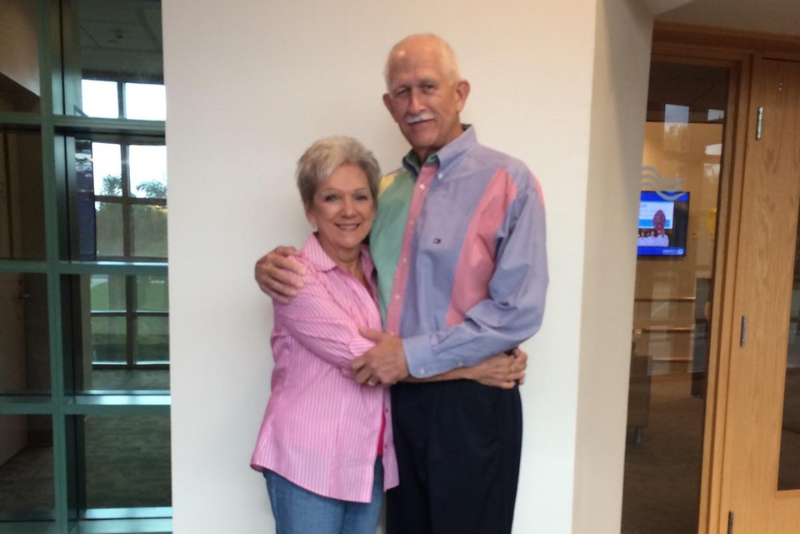
We Had a Love Story with Cathy Tack
Cathy Tack shares about the ups and downs of caring for her husband Ralph after he was diagnosed with pancreatic cancer. Cathy discusses the challenges of learning how to change bandages after surgery, the importance of asking questions, the joys of an impromptu concert and finding meaning after loss.
Thank you to our Guest: Cathy Tack
Host: Donna DiClementi
Production Team: Jackie Beaushaw, Randy Isaacson (Family Advisor), Donna DiClementi, Anne Bidelman, and Karen Caraballo
Music by: Lloyd Goldstein
For more stories, subscribe to "In It Together: A Podcast About Caregiving" wherever you get your podcasts.
Podcast Transcript
Donna: Welcome to In It Together: A Podcast About and for caregivers and the people they love. I’m Donna DiClementi, your host and manager of Outpatient Social Work at Moffitt Cancer Center. In each episode we’ll dive deep with a wide range of caregivers to better understand the highs and lows of caring for someone with cancer. You’ll meet the wives, husbands, partners, friends, children to hear what worked well and what didn’t work well as they became a caregiver for a loved one with cancer. Our hope is that by listening to caregiver stories, you will learn valuable information plus feel supported, encouraged, and renewed; after all, we are In It Together. Thanks for joining us.
I'm happy to welcome Cathy Tack to the podcast today. Cathy was a caregiver to her loving husband Ralph before he passed from pancreatic cancer. Cathy, I appreciate your willingness to share your experiences of being a caregiver with us today and I also want to thank you for all the ways that you care for patients and their loved ones at Moffitt as a Patient and Family Advisor. So thank you for joining me on In It Together.
Cathy: Thank you.
Donna: Cathy can you tell me about your life with Ralph before the cancer diagnosis?
Cathy: Well Ralph and I were together about 34 years. Total. 28 of those years were here in Florida. I've got to say they were for me the best years of my life and I would like to think they were for him as well. There wasn't much about life we didn't enjoy. We traveled a lot. We loved to cook together. Sometimes it would be more me cooking and him cleaning up and that was good. We made our own pizza. We traveled to Michigan. We cruised 17 times. Just… it was just… it was just a good… it was a good life. Did we argue? Sure because we were in a relationship and people argue when they're in relationships but never went to bed angry. So was it perfect? No but I would like to think it was about as close to perfect as it could get. It was just… he was just fun.
Donna: That’s terrific, that’s terrific. What a love story, right?
Cathy: Right. We had a love story.
Donna: Tell us a little bit about his fight with cancer. When did he learn that he had cancer and then describe that fight with cancer.
Cathy: OK well we had had company visiting in October of 12 and we actually we both retired on January 27th of 12 and then we just played all summer because we could. And we had company visiting they went home, and he said to me you know I've got this strange… he said “oh it's not a pain I don't really know what it is but it like goes from my back to my front but then it goes away” and I'm thinking OK probably gallbladder you need to call the doctor. Ralph was never one to not pursue his health. It was never… you know how they'll say some men just don't go to doctors? He wasn't one of those. He had had pancreatitis three times in his life. As recently as 2010. So he made the appointment and doctor sent him for CT scan and on November 1st we got the phone call from the doctor that said you have a mass in your pancreas. Well I kind of suspected what it was because of Patrick Swayze and Michael Landon and a few other very popular people who had the same battle. And the first reaction was his doctor set up an appointment. And we just let that sit for that Saturday but we went to church Saturday night and by that time, by the time we got to church, our pastor knew about it, there were several people on the care team that knew what we were up against although not 100% and that we had decided we were going to Moffitt I just had to figure out how to get into Moffitt and I wasn't really sure other than we had a friend who was part of the executive staff here but I couldn't get ahold of her. Of course, nothing happens fast enough when you've got your back up against the wall. And so there was a lot of prayer and a lot of… a lot of push. So there was a comfort there but the initial… for me? I just… I wanted to be sick. I mean it just scared me to no end. For Ralph? I don't know if it was a good front for me but he said “we got this bud, we got this. It'll be OK. It'll be OK.” And I thought yeah for you maybe but but anyway that's …that's… he was very positive about all of it. For me it's always in the back of your head you know I don't know how this is gonna work out short of a miracle. And now looking back on it and we said it even during the journey every day you can get up and get out of bed and put two feet on the floor and go get on a plane to take you to a cruise ship with inoperable pancreatic cancer is a miracle.
Donna: Mm-hmm.
Cathy: We had so many small miracles in that journey. Lots of them.
Donna: I really appreciate the way that you tell the story. You definitely can feel the love and the passion and the partnership and the fear when you tell the story. And I don't think enough caregivers have that opportunity to really… hear another person kind of live that journey and explain it in the way that you're explaining it. Did you feel alone in your caregiving journey?
Cathy: Did I feel alone? Let's put it this way. So as a caregiver I knew I had to do everything humanly possible I could so that there would be a good outcome. I also, and I've said this to people even as recently as last week, Ralph knew what was going on in his body. I did not. I would say so how does it feel? What do you mean how does it feel? How does… how does the infusion feel? I don’t know what you mean it just… you don't feel anything. So he's in control. I'm not and I am a control freak. I just… but that's part of it that you gotta let go. We had a lot of people from church but for the most part the focus is generally on the patient. So the caregiver takes kind of this backseat to all of it. I had a couple friends who would call and say,”how are you doing”… but when he's so upbeat about everything there's a part of you that doesn't wanna burst that bubble you know?
Donna: Mhmm.
Cathy: But yet there were other times I would just get in the shower and cry because I didn't want him to know that I was crying. Because he would say “bud if you cry, you're gonna get a headache you don't want a headache so don't cry. Oh OK. I'll just get in the shower and cry and you'll never know it right? So alone to the extent, no I knew I was walking with Jesus. I still have a great church family who has always come alongside of us. It's hard at night. Really hard. Especially when he had chemo to go and he was sleeping in the recliner in the great room and you know I'd get up and walk around the house and pat him on the head and he’d say don't do that cause you're scaring me and I’m thinking yeah but you're sleeping, I'm not. I'm not sleeping I'll just keep walking, walking.
Donna: And I think that's such an important piece for caregivers to understand is that sometimes this interrupts the way in which we take care of ourselves.
Cathy: Correct and the other thing… because he would do this if I couldn’t sleep. Just pat my head. Just pat my head. And he would. Just pat my head. And that would usually do it. And anymore it’s like you know what? There’s nobody to pat my head.
Donna: Can you conjure up that feeling?
Cathy: I think Donna because it's been seven years that I’ve gotten beyond that. But I can remember it. And at this stage of the grief journey the memories are what you can cling to. The good memories. And there were so many of them. I've even written things down because I don't wanna forget some of it. Some of the stuff… Oh my goodness anyway. Yeah.
Donna: That's great, that's great. You had mentioned earlier, you said something about being a control freak.
Cathy: Mhm.
Donna: So I would imagine that this diagnosis and everything that came along with it you had to really rein yourself in because you couldn't be in control of it all.
Cathy: Yeah it was very difficult in that regard. To reign myself in? Yeah it was like take a deep breath or you're gonna get a headache, bud. That’d be what he would say. “You're gonna get a headache.”
Donna: In some ways though it sounds like that strength also helped you. I think people, caregivers, get really nervous about what’s to come with taking care of their loved one. They don’t know how to do it. I imagine that you probably had some similar misgivings that you wouldn’t know how to do a lot of the stuff that was asked of you but somehow you got through. How did you get through?
Cathy: How did I get through it? Church. Jesus. And a sheer determination that I wasn't gonna let him down. I would do anything to help him live another day. One of the toughest things I think was when he had the G&J tube surgery and Doctor Pimiento was his surgeon. Dr. Pimiento who is still here today. Oh he is still the same. He made me crazy. But I told him he did. But when Ralph had that surgery and it was that care for seven weeks there was something to do every four hours. Every single day. For seven weeks straight. I used to set my alarm because by the time I got up and did what needed to be done and then cleaned up what needed to be cleaned up and did the tube feed stuff there were maybe two hours that I would get to sleep. It was exhausting but after he… when he came home, Dr. Pimiento called 8:00 on a Saturday night I think Ralph had been home a day. And I said just a minute let me get him he's in the other room. He said I don’t wanna talk to him, I wanna talk to you. Oh. Why? Why? He said I want to know how you're doing. I said you're making me crazy. I am exhausted. I’m afraid I’m not doing this right. He said it's common sense. You have common sense. Use your common sense. You can do this. Yeah he was… to this day you're in the best hands because there's nothing conventional about doctor Pimiento. Nothing. So he keeps you guessing. He and Ralph got along terrifically. I can remember one time, at that point he'd had home health coming in. And this bandage started leaking and it was like Oh my goodness …what am I gonna… we gotta do something with this. This is now Sunday. And he said well you can change it, you’ve watched them enough. I said I don't wanna do that. He said I don't think you have a choice. I said I don't wanna hurt you. He said you're not gonna hurt me. He said you've watched it enough. I said here's what I'm gonna do. I'm gonna walk around the kitchen and just pray and pray. I said you lay there in that bed and you pray. Got out all the instructions, laid them down, he said here's what we're going to do blah blah blah and we did it. But it was like holy cow are you kidding me? Thank you doctor Pimiento. Common sense, use your common sense, use your common sense.
Donna: I think that what I'm also kind of struck with is that nobody knows what the journey's gonna entail right? But you did like one step at a time. One step at a time. Because if somebody told you in the beginning that you know so much time in advance you were going to be doing this you you know no so it was 1 step at a time. And you had to learn that kind of medical journey. You're not gonna know what's happening two years from now, one year from now. It's… it's really one step at a time, one day at a time.
Cathy: I don't really wanna know how my life is gonna play out and I don't think God gives us that awareness or that knowledge because we'd be stinking overwhelmed with it. Terribly overwhelmed by what might happen tomorrow. We gotta stay in today. So yeah you can put things out there for hope or to plan a trip as something positive down the road. And it's something to do in the moment too, to do that planning.
Donna: Mm-hmm.
Cathy: But to actually know all this stuff about cancer? I would have told anybody there's no way I can do all that. I can't… I can't do that. And yet he did and I did. Would I have thought Ralph Tack would have ever lived almost four years with inoperable pancreatic? That was what I prayed for. Just give us four years Lord and that's pretty much what he did. Boy I should have changed that up. The way he battled was amazing.
Donna: And that seems to have really helped the way you did too.
Cathy: Yeah. He just made me… I was the go before. In any procedure. Don't talk to him about what you're doing. Don't tell him what you're doing. He doesn't need to know, I do, he does not. He will pass out. For a hockey player he did not like the sight of blood. And he didn't want to know or he would literally pass out. We didn't want to do that.
Donna: Well I think that's an important piece too for caregivers and patients to understand is that what the patient needs isn't always what the caregiver needs so you needed to know the details, he did not need to know the details. He was clear on that, you were clear on that, and so you got what you both needed whereas he didn't listen to the details he wasn't told the details, you were. On each procedure because that's what fed you.
Cathy: Yes.
Donna: That knowledge was important to you, it was not important to him. And it would have been detrimental to him.
Cathy: No, in fact we've developed a Ralph Tack e-mail blast out. Ralph Tack prayer warriors. There were about 300, well over 300 people on that. And after every trip to Moffitt… I took notes and I encourage anybody… take notes. Don't rely on your memory. You take notes. And fortunately I took short hand so I could write down everything. And if I didn't understand, or if I didn't hear, I would ask whoever to repeat it. And that was one thing for me. I had to step out of my comfort zone because, yeah I was an independent female, but Ralphs encouragement made me more aggressive because of him. Would I have ever said I can’t hear you or would you repeat… nuh-uh. But because it was related to him? I know there's no such thing as a dumb question. The only thing that's dumb about it is if you don't ask it. So I took notes, we'd come home, put it all in the e-mail. He chose the scripture. He liked doing that part of it, he was OK with that. And then we blast it out. That prayer warrior list also stopped a lot of phone calls and a lot of repetition because you get caught up in that?
Donna: Yes.
Cathy: And it would make me crazy.
Donna: That's a really good strategy. People would understand what's going on and it would eliminate the need to repeat the story again and again and again and again. Because we all understand how painful that could be and time consuming and you didn't have that time and energy.
Cathy: To me it was the right way to go. And like you said, the time that's consumed just in those phone calls so I was quick to say well you know as much as we do. End of story. There are very few people I would call. I think every caregiver needs a trusted friend. Somebody they can rely on to not run and tell everybody whatever whatever whatever because it… it is. It's a hard, hard journey. Did he aggravate me at times? Oh you bet he did. But then I know I aggravated him. But you need that outlet. Somebody say “he's driving me nuts today” you know “he wouldn't eat, he wouldn't do this, he didn't wanna drink the water, he didn’t blah blah blah blah blah. But you have to be careful about who you share information with.
Donna: You have to have a trusted source.
Cathy: Yeah.
Donna: Who will listen without judgment.
Cathy: Without judging. Exactly. Because people are quick to judge. And then you find out we can trust and who you can’t. In a short time.
Donna: And that certainly doesn't mean that the other wonderful people in your life aren't still fabulous right? But you just know who the one or two is that you can hold close to your heart and share things that you don't want to be spread around.
Cathy: Correct, correct. My daughter was one of them. And then I had two other friends who were really good about it. Other people, I mean it, it would just be good conversation with people but not sharing all the… Well and I didn't really wanna share de- Ralph and I typically, we were each other's best friends so this was a hard thing to do to say anything about him to anybody else. Because we didn’t do that.
Donna: How did you take care of yourself through all of this?
Cathy: How did I take care of myself? Massage. Massage therapy. I encourage anybody to do that.
Donna: Great.
Cathy: Nails, manicure, pedicure. I'm not a shopper so that really wasn't… I shopped if I needed to. And I didn't wanna leave him. He would go shopping, he go shopping with me. He liked to shop. I have pictures of him sitting amongst 3 mannequins at Dillard's posing with them.
Donna: That’s great.
Cathy: Yeah he was nuts. He really was. But mostly it was we, we could go for a walk. He had a Saturn sky. You know what a Saturn sky is?
Donna: I don't.
Cathy: Little two-seater. 2009 Saturn Sky – that was the car. He picked that out.
Donna: That’s great.
Cathy: Yeah it was. It was the convertible. Problem with it was, it was a manual top so it was OK when he was well and - or still healthy with the cancer even. We’d go for ride in the sky. Let me just go get in the car and [making car noises]. He’d drive, we’d have that top down, we’d have on the radio Margaritaville on and just have a blast. We could do that. In fact there was a - Jimmy Buffett was in town and I’d wanted to go but you know how do you plan something like that and the tickets were expensive. He was at whatever the Amphitheatre is off of I-4. He said so tell you what let's just get in the car and we’ll drive. We could listen to the concert on the radio, right? Listened to the whole buffet concert. I don't even know where we went but we ended up went to a McDonald's. We usually did not eat that stuff but we needed a cheeseburger for the cheeseburger in paradise. And then he timed it so that we were on I-4 going past the Amphitheatre while Buffett was playing. It was just… oh it was so much fun.
Donna: Oh that’s so fabulous.
Cathy: And this was with cancer. Sometimes you just have to put cancer in the back of your head. Does it come to the front? Oh real quick. Real quick. But you gotta have moments because I wouldn't have been able to share that with you all if we hadn't done it right?
Donna: Right that's great
Cathy: Yeah
Donna: Thank you for sharing that. I love that story. Were there any resources that you found helpful to you as you were living through this?
Cathy: We relied on the staff.
Donna: Mhmm.
Cathy: And I will tell people to this day you have questions about your health? You contact your clinic. Make friends. Know who your clinic people are. Know them by name and ask the questions. Now I guess they do everything or you can do things via e-mail. I’d write down questions in between treatments and I’d have my list of questions and doctor Kim would make sure – or whoever the PA.
Donna: Mm-hmm.
Cathy: Would answer all of them. Wait I have one more question. Wait come back here I have one more question. I tell people today don't let that doctor or PA walk out that door until you are comfortable with what you're doing. “Well yeah but they always seem like they're in a hurry” – tough.
Donna: Mhm
Cathy: Call them back – I’m not done yet.
Donna: OK so looking back at this time what did you learn the most about yourself and about caregiving?
Cathy: That I'm stronger than I ever thought I would be. That I could be strong and resilient. Because I had a purpose. The strength in that journey that I can do. I can do stuff I never thought I could do. Because there was a goal. I think there's a level of compassion - understanding for other people now that I've learned because of all this. Especially here at Moffitt. Because the journey these people are walking, and the fear that you can see on their faces is just… I think the ability, the ability to walk in a room and say hey I'm Cathy Tack I'm a volunteer here at Moffitt. I'm part of Moffitt's Patient Family Advisory group. How long have you been coming to Moffitt? I could never! I would have had no desire to do that ten years ago. Why would I do that? Ralph was the front person. So I've learned that I can be me… I can be me. Not that he ever tried to inhibit me from being me but I didn't need to - he all the talking… why would, I why would I need to?
Donna: Right.
Cathy: So I've learned to be me. And I’m stronger than I ever thought I'd be.
Donna: That's really beautiful. It's really beautiful, I hope that you know how really beautiful that is.
Cathy: Thank you. I wish you guys had known him.
Donna: I do too.
Cathy: Ralphs thing though was you know you gotta keep your head up. You gotta keep your head up. I watched him chuck a guy into the boards when he was skating one time. And I mean he's slammed this guy and I thought what. After the game i said what in the world? Why would you do that? “Eh, he put his head down” oh. He said “look you gotta keep your head up bud. You put your head down you're going into the boards. And I've often thought… that's the way you gotta live life. You gotta keep your head up, you keep your eyes focused on who’s important in your life right?
Donna: Yep.
Cathy: Or you’re going into the boards. The boards of life. And they’ll get you every time.
Donna: I love that story and that message and… leads me into, you know, as I’m listening to you talk about Ralph and keeping him alive and this wonderful team that you have of people in your life. And it seems like that has really helped you to cope with grief and loss over Ralph’s passing.
Cathy: Yes.
Donna: What other things Cathy? You know because caregivers are scared.
Cathy: Yes.
Donna: And so what kept you going?
Cathy: Counseling. I did, I started seeing my counselor… Ralph passed the end of September, I saw her the middle of November. So counseling I think is the biggest thing. And a trusted friend. Although sometimes friends can be… as soon as someone says “I think you need to” I don't care what you think. It doesn't really matter. It's what's going on in my head and in my heart. Or “don't you think” - this the other thing people will do to you. “So with the whole grief thing, how long do you think you're gonna go through this?” Oh probably the rest of my life.
Donna: Exactly.
Cathy: It…
Donna: It changes.
Cathy: It never goes away.
Donna: It doesn’t go away, it changes.
Cathy: It changes. Does it get any easier? No it gets different.
Donna: Mhm. And then some days it's really, really hard.
Cathy: Oh yeah where you just want to fall apart.
Donna: And then some days it's different
Cathy: Yeah. With the cataract surgery I thought maybe I shouldn't cry. So I’ve tried not to. I’m thinking, well that's really stupid. But yeah sometimes just… just sit down and cry. But don't cry too long because you might get a headache bud.
Donna: I think Cathy, after listening to you I think what really comes forth is that there is hope. And if this cancer journey of your loved one turns into your loved ones passing you are living proof that there is life.
Cathy: There is. It's… it's life not in any way shape or form that you… I have EVER imagined it would be. I never thought I would live seven years without him. Ever. And yet here I am. So there's a purpose and I think this is one of them.
Donna: Mhm.
Cathy: It's not easy but living alone isn't easy you know? You assume all different kinds of responsibilities. Right down to taking out the garbage. You know, it just… all of that. I never had to do that. And I still don't like taking out the garbage.
Donna: Right but you do it.
Cathy: Oh I do it, yeah.
Donna: And you’re successful.
Cathy: It irritates me. Doggone you Ralph Tack. How could you leave me here like this? But he didn't, he never would have. He never would have left me here on purpose. So I hate cancer. Forever. I hate what it does to people. I hate that it destroys bodies. I can remember, we had somebody from church over serving communion. He said “just look at me. I'll look in the mirror and I don't even know who I am.” because by that time… it's probably about a month, six weeks, before he passed. But he lost down to like 130 lbs. This is somebody who weighed 210 lbs right? And if he wanted to lose a few pounds he quit eating cookies. And he would drop 5 lbs and he would be good with it. Yeah… but yeah that… when he said that I thought… Oh my goodness yeah.
Donna: I think that you have gained so much knowledge and strength about your own ability to live life based on, you know, not only the experience you went through caring for Ralph but because of the relationship with you had with Ralph right?
Cathy: Yes.
Donna: Is there anything that we haven't discussed that you think would be essential for caregivers to know?
Cathy: Just keep going, don't give up on yourself. Take care of yourself.
Donna: As I listen to you I just rejoice really over the opportunity that the two of you had to… to meet each other and to be with each other and you know how sorry I am that it wasn't as long as you had wanted. I really appreciate you coming today.
Donna: Thank you for listening to In It Together: A Podcast About Caregiving. In It Together is brought to you by Moffitt Cancer Center's Patient Library and Welcome Center, in collaboration with our Social Work department. Special thanks to Lloyd Goldstein, Musician in Residence here at Moffitt Cancer Center's Arts and Medicine program for our music. And thanks goes to our producer, Jackie Beaushaw, Patient Library Supervisor, and Randy Isaacson, Family Advisor. For more information about the services mentioned in this episode, please view the show notes or visit the In It Together page on Moffitt.org. Thank you for spending time listening and we hope that it was useful. Have a great da