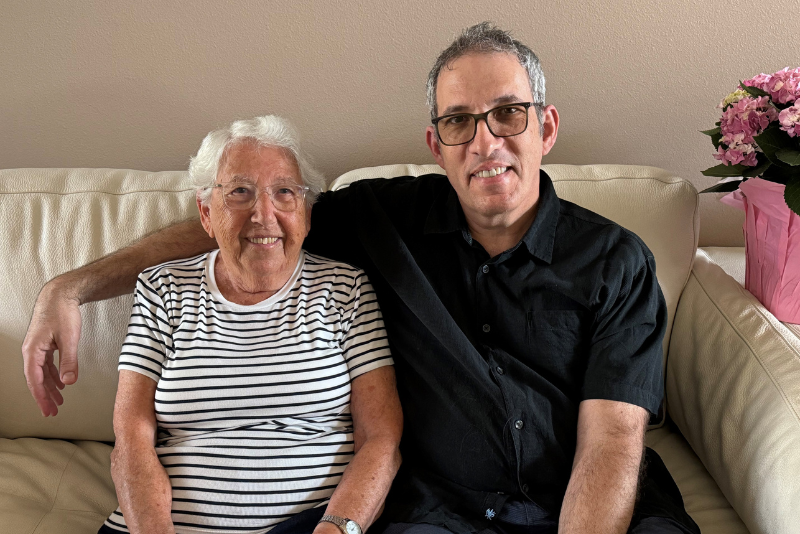
Providing Advice and Not Making Decisions with David Dauman
David Dauman describes the challenges of advocating for his mother’s wishes when she was diagnosed with cancer, co-caregiving with a sibling, and the importance of advance care planning.
Thank you to our Guest: David Dauman
Host: Donna DiClementi
Production Team: Jackie Beaushaw, Randy Isaacson (Family Advisor), Donna DiClementi, Anne Bidelman, and Karen Caraballo
Music by: Lloyd Goldstein
For more stories, subscribe to "In It Together: A Podcast About Caregiving" wherever you get your podcasts.
Podcast Transcript
Donna: Welcome to In It Together, a podcast about and for caregivers and the people they love. I'm Donna DiClementi, your host and Manager of Outpatient Social Work at Moffitt Cancer Center. In each episode, we'll dive deep with a wide range of caregivers to better understand the highs and lows of caring about someone with cancer. You'll meet the wives, husbands, partners, friends, and children to hear what worked well and what didn't work well as they became a caregiver for their loved one with cancer. Our hope is that by listening to caregiver stories, you will learn valuable information, plus feel supported, encouraged and renewed. After all, we are In It Together. Thanks for joining us.
Donna: So I'm very excited to welcome David Dauman today to our episode of In It Together. David owns his own training and consulting business. He's married, he has children. And today he's going to be talking about caregiving for his mom through two cancer diagnoses. David also has his own cancer diagnosis that he was treated for here at Moffitt. David is co-chair of our Patient Family Advisory Council at Moffitt. And so he's very familiar with all things Moffitt. So welcome, David, to the podcast.
David: Thanks for having me. This is a great honor.
Donna: So let's just get right into it. David, tell us about you and your family and especially your mom, who you became a caregiver for during her cancer experience.
David: Uh, spoiler alert, my mom just celebrated her 95th birthday on Saturday.
Donna: That's amazing.
David: She's doing great. You may detect from my accent I'm a New Yorker. I've been here about 25 years. What else can I say? I have an older sister, so she is still in New York. And, uh, I suppose being the first cancer patient in the family put me in the driver's seat to become the caregiver. That, and my mother was living here in Florida at the time of her diagnosis, which was about five years ago.
Donna: Can you tell us a little bit about the cancers that your mom, um, lived with?
David: So when I talk about my mother prior to her cancer diagnosis, the last time she was in hospital was in 1962, when I was born. Other than taking care of my father. So, she was never the patient, always the caregiver. And, uh, she started having some intestinal problems. She finally went to an E.R. where they did a CAT scan, and they were looking for GI blockage, but actually found a, uh, small tumor in her lung. So, uh, the fact that she was living in this region, we quickly were able to get her an appointment, and then, uh, signing up to become a Moffitt patient, first in the, uh, lung or Thoracic clinic. Her concern was, rightfully so at her age at the time, 89 was why go through this? And we talked very much about, well, mom, your cancer journey is different than mine. You're an 89-year-old widow who's led a full, wonderful life. You have the option to make your choices. When I was first diagnosed, I had a one and a three-year-old and a wife, and didn't feel I had perhaps the luxury of being less aggressive in my care. So, we went back and forth on that. We found through the amazing knowledge and thoroughness of the providers here, a course of action that was not that invasive, but still was able to knock her lung cancer back to a state where we all hope that the tumor outlives her. And at 95, since it hasn't moved in five years, we think unless this tumor lives to 200, I think we'll be fine. Uh, a few months after that, she continued to have, um, abdominal issues. She went back to the same regional hospital, and that's when they saw a tumor on the outside of her large intestine. So we quickly almost felt like this was rinse and repeat. Let's transfer her from the local hospital to Moffitt. Uh, knowing that Moffitt being nationally recognized and the experiences we had for her and me, there was no doubt this was the place to be. In this case, we had to go with a surgical procedure, and she got through it relatively well. Uh, was inpatient for about three days in recovery, and then she was able to be discharged. And she has just been released as a patient from the GI clinic, but we still will be going to the lung team, about once a year for the rest of her life, which I hope is 20 years. So and that's my mother's cancer journey.
Donna: I think to your story about the fact that the last time she really needed significant medical care was at your birth, and then she has a cancer diagnosis at the age of 89. What was it like for you to see your mom be in that role as somebody who needed care, because you really had never experienced that.
David: Well, that's an interesting question. I think if, uh, it was another family member who was my age, it would have been more of a shock for me to become the caregiver, because I would have never had been placed in that role before. The fact that she was 89, a widow for about 15 years. At that point, I was her financial caregiver, looking over her affairs. I have a background in that. I would drive down regularly to another county in the state to visit with her. I was her driver, her mechanic, to the extent I could. So, caregiving was part of that equation. But the fact that it was life and death, not to be dramatic, but it was. And medical and legal and some complications involved. It definitely was something that I was not accustomed to, but quickly had to become accustomed with.
Donna: What was complex about that role for you?
David: So, if this were, um… less dramatic. There would be issues of medicine. But here when we're talking about do you elect, uh, care or not, then you have life and death issues. There are estate planning issues. There are legal issues. And you really do become a financial and legal proxy. So, having had finance and estate planning in my background, I was able to put on maybe it was a coping mechanism, the hat or the mantle of a professional advisor, and saw her more as my client than my mother. And that also helped me understand that the interest I was defending and advocating for were hers and not mine. So I put my role as a son in the background and was really almost detached and tried to be her advisor and coach and not decision maker. But, uh, I think consultant and advisor are the two terms that I think best fit the role I tried to assume.
Donna: Yeah. I love how you describe that. Um, because it was her wishes that you were advocating for, not your own wishes as her son, which sometimes a lot of emotions come into play in that. What are some things that you think around those legal issues, around advance directives that you would want other caregivers to know about?
David: Well, for certain, those advance directives and legal documents are like air bags. I think that you need them in the car before the accident occurs. So, if it's possible to be that present of mind to have it done well in advance, because no one, no one predicts the day or can schedule the day they'll get a diagnosis or an accident or anything like that. So those are absolutely essential in our modern-day society that every adult has that whether they're 89 or 19. Uh, so I've always been a strong advocate for those types of directives. The other thing that we did, and perhaps it was my own cancer that facilitated this or precipitated this, it was the idea of having those conversations in advance. What is it that you want to do? As an 89-year-old, um, the idea of her passing at any time was not an abstract thought. So we talked about her burial desires and her funeral plans and the things that don't necessarily go in a will. But you as the de facto executor, need to understand. Because you can't ask your loved one when they're gone. Where? How? Why? Who do you want there? What do you want done? So I tried to have all that in a mental folder in my head well in advance. While everyone had the emotional strength and legal capacity to have that conversation.
Donna: Okay. Was that an emotional conversation that you ended up having with your mom?
David: Uh I think we were all very pragmatic about it. The fact that my mother was a widow for so long and has never remarried. She's lived in the post death phase of her life, of my father leaving for a decade or more. So the idea - not that she's maudlin about it or wants to pass away sooner, but she understands that's a fact of life. Her mother was also very healthy. She died at 88. My uncle, her brother, died at 88. So she thought when cancer first came – “Well here it is. It's a year late, but it's my turn.” So she was very pragmatic about it. Uh, luckily, she was wrong. And, you know, seven years later, six years later. But, uh, so it was her life experience and, her circumstances that prepared her for some pretty heavy decisions. So, I guess we were fortunate in that way.
Donna: Yeah. Absolutely. Absolutely. Thank you for sharing all of that. Here at Moffitt Cancer Center, people can, certainly use their financial planner, their attorney, to look at advanced directives. But you can also talk about that with social workers, with chaplaincy care. So it's always a good opportunity to talk about those wishes and to put them in, in writing, as you said. So it sounds like there wasn't much of a changing relationship that you had with your mom because you became her caregiver, because you had, as you explained, for over ten years, you were, um, some concrete caregiving with mechanics, what's going on where she lives, with her finances. Did her having a potentially life altering diagnosis change your relationship in any way with her?
David: Well, um. It did, uh, on a number of levels. I needed to make sure that I was providing advice and not making decisions. And that, I think, threw us into a little bit of a confused state, because in the past, she sought advice and I gave it without reservation. And here I perhaps I was a bit ambivalent about trying to offer as much clear advice as possible, and still not trying to arm twist, or persuade.
Donna: And you said earlier which I think is so important to underscore is that it's mom's decision.
David: Mhm.
Donna: And I think so often after talking and working with many caregivers, they get, rightly so, a little confused, and they try and convince a patient to do a specific thing versus “what is it that you want to do?” Because of course you have a vested interest in this.
David: Sometimes you find that you parent your parent. I think that's natural, especially when they reach their late 80s and 90s. But I had to be very conscious to realize I was, uh, I was an adult in the equation, but I was not the parent in the equation. So I had to redefine or recalibrate back to saying “you're an adult. You are the patient. I'm giving you advice and clarifying and explaining, but it's on you” and in some cases. There were times where I felt like she was pushing the decision on me, and I wouldn't accept it. It was one of the few things, well not few, but one of the areas I was proud of when I look back on my caregiver journey, was I didn't default to make decisions to make her life easier. I thought that would have been irresponsible and I was cognizant of that.
Donna: I have a feeling that people who are listening are going to rewind this and hear that again and again and again, because I couldn't have said it any better than the way you just said it. You had talked about the fact that you have, um, a sibling who lives out of state. Can you talk about how you and your, um, sister managed caregiving for your mom?
David: So I do have an older sister who lives in New York. We knew that my mother was the person we were both, uh, caring for. That we had different points of view. My sister, uh, is friends with people who are providers, hospital administrators. So, we would, I would share information with her. She wasn't down here all the time, only during the large procedures. And what was a little frustrating was, you do as a caregiver, especially to an older parent. You know, this is your chance. So, you know, “step back. Mom, I'm going to be a hero. You've done everything for me my entire life. Now I get to be a superhero. I get to be your surrogate everything.” Then when you make a decision, and in the best interests of my mother, my sister was running that information by her group of advisors, her medical council. And they were coming back with different decisions. There was a little bit of a frustration, a little bit of whiplash. Like, well, we made a decision and you’re satelliting in information, all in the best interests of my mother. There wasn't any malice in there, but it was a bit frustrating. And then sometimes she would, like the seagull fly in... uh, affect the situation. I'm being polite. And fly away. That's why you're a remote caregiver partner sometimes, which I guess is the right term for her - my caregiving partner. Uh, it felt like that. This is not about my frustration with my caregiving partner. This is the challenge of caregiving for my mother. So, I imagine if you spoke to my sister, you’d probably hear the same thing, that he was local. He wasn't perhaps communicating as much. And, uh, but at the end, I think it all worked out for the best because my mother's care turned out fantastic. And in hindsight, there wasn't any decision we would have made differently, which gives us all peace of mind. And the fact that we celebrated her birthday on Saturday was a good afterward to the whole story.
Donna: Yeah, absolutely. Thanks for sharing that. I think it is very common that we have a caregiving team that lives all over the place. And it's, unfortunately, it's natural that the one who is local bears the brunt of the burden. And then those who live farther away. It's not that they love mom less. But they're not readily available. So, it's natural that the one who's closer develops a different kind of a relationship with the patient, and then the one who's farther away. They love the patient, but they just can't be here. Physically, they can't be here. They can't, they can't do it.
David: I think it, and this is all in hindsight, but I do think it requires a little bit of empathy between the caregiving team. I probably could have done a better job understanding her frustrations of not being here even more than she was, because she's an incredibly devoted daughter. And perhaps she could have understood my frustration of being second guessed, even if it was with the best of intentions.
Donna: Yeah. It's complicated. It's complicated. And again, I think you did a great job explaining that for, um, the listener. So I appreciate that. How did your own cancer journey help or maybe even hinder the caregiving that you had with your mom?
David: One, I knew where everything was. I knew what the diamond on the floor next to the elevators were, I knew where the snack bar and the cafeteria were. I knew where to get Starbucks and all, and I knew the area. So there was a comfort that spending about a year here helped me and my sister, who was here again as my caregiving team. I also think I had the confidence to deal with providers and nurses and Moffitt as an institution, having asked questions and digested information prior. I think being a cancer patient or caregiver is not easy, and it's intellectually challenging as well as physically demanding. I think I had a little bit of a dry run as a patient that allowed me to be a better informed and a better consultative caregiver than I might have been had I never been inside of a cancer institute before.
Donna: So given, um, your own experience, do you have suggestions for caregivers who have never been inside a cancer institution before? And here they are with their loved one and the whole thing is brand new. So, what advice would you give them?
David: Yeah, I like that question. I would say, first of all, that Moffitt has incredible resources to, for lack of a better term, onboard patients and families. So the patient family orientation program, that's given, I think, weekly now. And now I think it's also virtual, uh, or, you know, on video. That is a great place to start. Understand that it's going to be a little confusing and frustrating, especially now there are buildings, not just floors. So, you might be going to McKinley one day in Magnolia the other day. And wherever you are, uh, ask for help. There are a lot of great volunteers out there. Moffitt also, I think, is an incredibly hospitable place. The first time you're here ask for help. Anyone with a name badge is really here to help you. They may be going off to treat another patient, but they're here for you or to treat another family. I think that's all really good advice. The other thing is, perhaps it's a sad state of our world these days, but cancer is not that far from other people in your life. Ask for help. Ask for advice. I would say put a bit of a wall up around your brain or your heart, because sometimes that advice can be overwhelming, though well-intended. And, uh, it could be a little confusing. But definitely if people have been to Moffitt before, that'd be a great place to also get your due diligence and to learn the way of the flow here.
Donna: Good. Thank you so much for those those suggestions - all very helpful. You know, we have a really robust web page that people can spend some time on. And then, of course, like you said, there's fabulous volunteers and patient family advisors and there's the social work team, there's the patient library, there's a lot of resources, uh, to help patients and caregivers acclimate to the institution. In your caregiving, how did you continue to be an active spouse and active dad to, you know, two growing children?
David: Having been a cancer patient, I think forced me to, uh, rely on my spouse more than I would have if I didn't deal with, uh, a life-threatening illness. Trying to do the math. About three years, four years into our marriage. So, uh, we quickly learned that marriage is a partnership. So there are times where my wife said “you need to be with your mom. I got the kids.” I have an amazing group of business partners and clients who were worried about my mom because it affected me. So they said, you know, we got you. So if you need to do this or take this meeting. It was only a few years ago, so, uh, I was able to run a lot of my business from my lap in the waiting rooms and coffee shops around here. The other thing I did was, I, being a cancer patient, I always think about legacy. And I thought, this is my opportunity. Maybe this a self-interested, but I want to show my children what is it like to take care of your parent. That I wanted to put her first and let my children see. They were old enough to know that their grandmother was sick. Um, and they got to see that the family sprung into action to protect her and advise her and love her. And that was, I hope, a memory that they'll take with them.
Donna: Yeah. That's beautiful. Really beautiful. Thank you. Who supported you besides your wife?
David: I have to say I was very, uh, maybe this was a defense mechanism. I was very pragmatic, almost stoic about the whole experience in the moment. I knew there were decisions to be made. There were visits to attend, notes to take, questions to ask. And I was very systematic about it and emotionally detached. The fact that my mom was old, and she was, um, wasn't my first parent, that possibly would have been lost. I was very calm with the fact that this may not work out well. And my fear was, uh. And this is something maybe all of us as caregivers deal with. I wasn't concerned so much about her living or dying. I was really concerned and had sleepless nights about screwing up the job of caregiver. So, I wanted to make sure that if it was God's plan or whatever you think, uh, causes life or death, that, uh, we did the best we could to make her final journey the best one possible. So I wasn't as concerned. I wasn't dealing with the loss of my mother prematurely. I was making sure that, uh, I wasn't causing it. Maybe that's a bit overstated or hyperbolic, but I was, I was trying to be in the moment and not be reckless or be emotional or careless or dramatic. I was trying to be very levelheaded. And then perhaps, like every other emotional experience, deal with it after the fact. And that was because it was such a great turnout. There wasn't much post-traumatic stress because while it was a scary experience, it all worked out for the best. So, we were lucky that way.
Donna: Good, good. Yeah. So, we're getting near the end of the podcast. So tell me, uh, what are some things that we didn't talk about that you think are essential for caregivers to, to hear?
David: That's a good question. Um, let me think. Put the patient first. Caregiving is an emotional, difficult job, but the patient comes first. Uh, their needs, their wants, their desires, their intentions need to come first. You need to be very intentional about it. You need to understand your emotions are going to come into play. Uh, understand your role. And it is as advocate. It's, uh, it's their cancer journey, not yours. You're a major part of it, but it's not your cancer experience. Communicate with the patient, your loved one, uh, the other caregiving team, your, network. Don't bottle things up. Uh, a little bit of that, uh, I did, so in hindsight, I could have done more reflecting and communicating in the time. Be very flexible because a cancer journey is not a straight line. There'll be days where you think things are going great and you get bad news. There will be other times where you're expecting the worst and something great happens. Be patient with the patient. Uh, one of the things that was frustrating was my mom would say, “I don't want any chemo. I don't want any treatment. I just want this to go away.” And we talked about it, and then she we agreed on it. And the first moment we would sit with the provider, she would say, “well, what can we do about this?” So understand that as functioning adults, they could change their mind. Your patient is dealing with their life and death, so they can't be totally stable and rational all the time. So be loving. Uh, focus on what you can control. Know that love is driving your caregiving job, but don't be too sensitive about it. There's time for that later. And last one is, don't bring your baggage with you. Whatever happened with your parents or your sisters or your brothers or your aunts or uncles or whomever you're caring for, or dealing with on your caregiving team, that was the past. You're dealing in the present and helping your loved one move into the future. So put all the baggage outside in the parking lot and don't bring it in the building with you.
Donna: Oh, that's a hard one. That's complicated. It's um, wise. Absolutely wise. And if we all could do that, that would be… that would be amazing. Do you have any thoughts about how to achieve that, leaving your baggage outside?
David: One, I think, uh. And this is easier said than done. A good amount of self-awareness goes a long way. Knowing when you're getting emotional. Understanding, when it's the filters that you're seeing the situation are yours and not more objective. I think that is one way to do it. Two, probably a sense of humor. If you start feeling your emotions coming up or feeling like you might be scoring a point from a previous argument from a long time ago. Laugh at yourself. Know you're human. And then maybe, uh, whether it's a cup of tea or a glass of wine or whatever helps you, uh, feel like you're punctuating a rough day. Go do that. And, uh, you know, love yourself as much as you love the person you're caregiving for. Because it's a rough journey. And, uh, forgive yourself. Everyone tries to do the best they can, and no one's can do it perfectly as much as they try.
Donna: Such great advice, such great advice, and I love how you said it. “Any way you want to punctuate the day.” And you know, sometimes that might be for some caregivers, you know, relying on, um, a trusted friend or, um, getting into counseling and to be able to manage those long-ago issues so that they don't get in the way of current.
David: As you say that there's one other piece of advice, perhaps, and one of the hardest challenges of being a caregiver is that you have so many facets of your life. But those different facets, I think, could also be your release valve. So, in dealing with the stress of being my mother's caregiver, I had a company to run and I had children to raise, and I had a wife who had her needs and, uh, desires and, uh, things. So I was able to put on different hats. And I think that, uh, respite from being a caregiver, why I focused on different things, uh, maybe made it less intense of an experience because I wasn't a caregiver 24/7. I didn't have that luxury.
Donna: Such great advice as well, because we need to have rich, full lives in addition to our caregiving role. So to be able to pay attention to those other parts of our lives, it sounds like, without guilt. To be able to go ahead and do the other pieces of our lives and put caregiving over here. To the side while I take care of this. And to be able to do it well and lose yourself in it without guilt.
David: And that is great advice, and probably not one that I experienced in the moment. So the fact that I realized retrospectively that putting my caregiver job on hold for a little while was helpful. I did feel guilty about it at the time, but in hindsight, I realize that challenge was actually my relief at the same time.
Donna: Yeah, right. Anything else that you want to add?
David: No. I really appreciate the time. Caregivers who are listening, you are the unsung heroes. I'll speak now as a patient or one who represents lots of patients. We can't do this without you. The doctors and the nurses treat the patient, but you're the ones that get them through. So whatever you're able to do for your loved one will be greatly appreciated. Whether they're alive or they don't make the journey with you, know that you've done the best you can. And, know that you are paying back the love that you received from the patient. And that's all you can do at the end. Be a caregiver with your heart, and it will be everything you need to do.
Donna: Thank you so much, David. It was such a pleasure to have you on the podcast today.
David: My pleasure.
Donna: Thank you for listening to In It Together: A Podcast About Caregiving. In It Together is brought to you by Moffitt Cancer Center's Patient Library and Welcome Center, in collaboration with our Social Work department. Special thanks to Lloyd Goldstein, Musician in Residence here at Moffitt Cancer Center's Arts and Medicine program for our music. And thanks goes to our producer, Jackie Beaushaw, Patient Library Supervisor, and Randy Isaacson, Family Advisor. For more information about the services mentioned in this episode, please view the show notes or visit the In It Together page on Moffitt.org. Thank you for spending time listening and we hope that it was useful. Have a great day.