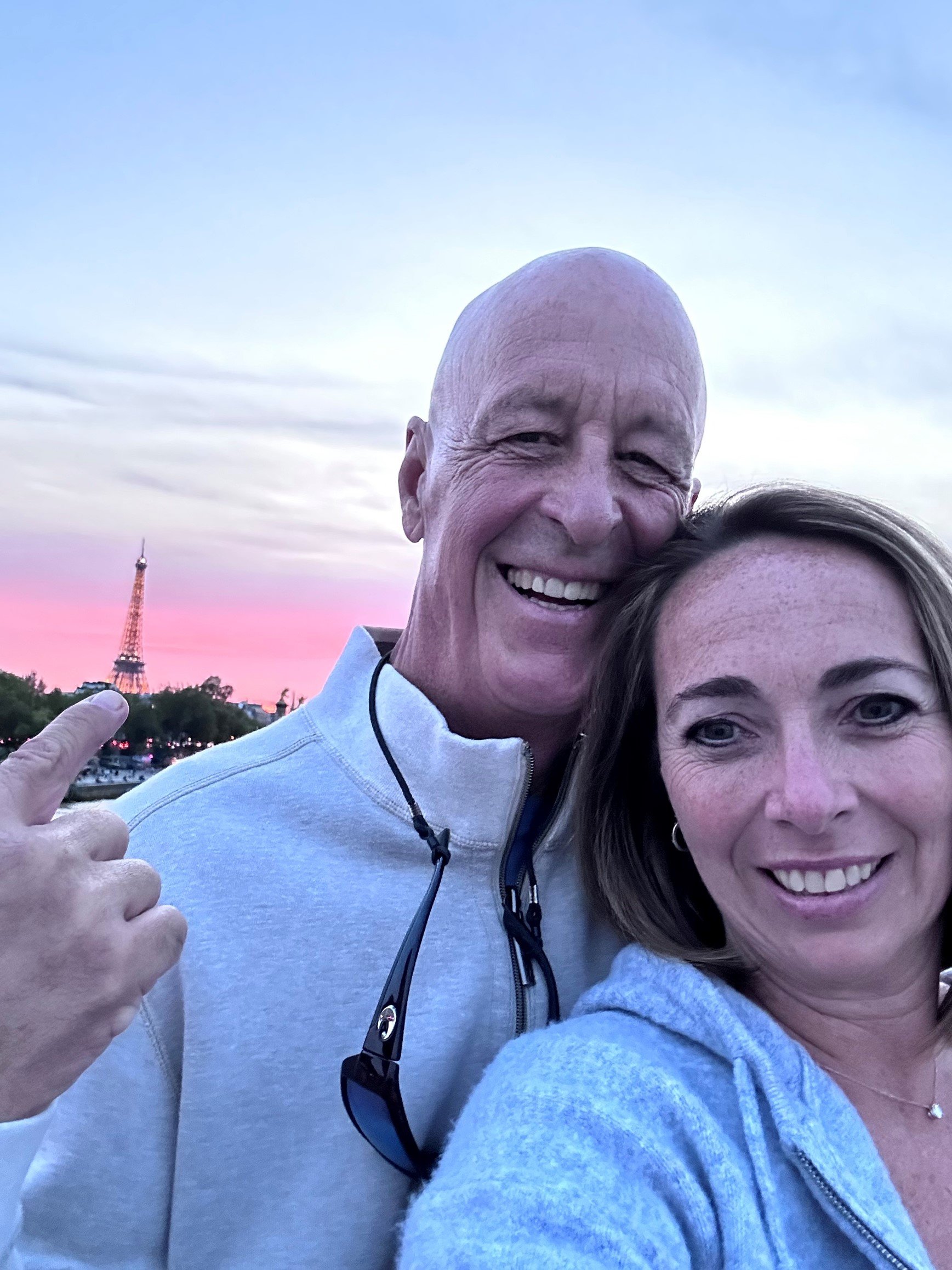
UPDATE: Facing Cancer as a Family with Mike Gallagher
This episode is being re-released with a special update from Mike at the end, sharing how he and his family are doing now.
Mike Gallagher never thought his healthy wife Danni would be diagnosed with stage four colorectal cancer. Mike discusses how they shared this news with their teenage children. He also shares the struggles of trying to remain positive and strong while avoiding toxic positivity and the unexpected support they received from friends, family and acquaintances.
What you’ll learn from Mike:
- You may not call yourself a “caregiver,” but caregiving often happens naturally when a loved one needs you.
- Being honest and age-appropriate with children about a parent’s cancer can help them cope.
- Why sharing the caregiving load across family, friends, colleagues, and community makes the journey sustainable.
- How to balance realistic emotions with offering strength and hope to the person who is ill.
- Caregiving is mentally exhausting, and caring for your own well-being matters.
- Cancer caregiving can change family relationships and deepen bonds in unexpected ways.
Thank you to our Guest: Mike Gallagher
Host: Donna DiClementi
Production Team: Jackie Beaushaw, Randy Isaacson (Family Advisor), Donna DiClementi, Anne Bidelman, and Karen Caraballo
Music by: Lloyd Goldstein
For more stories, subscribe to "In It Together: A Podcast About Caregiving" wherever you get your podcasts.
Podcast Transcript
The heart of the story
- A husband is blindsided when his active, younger wife is diagnosed with stage IV colorectal cancer.
- Their children, then teens, are told the truth because pretending or hiding would cause more fear.
- A “circle of caregivers” emerges: immediate family, extended family, and friends who rally with meals, company, and emotional support.
- The experience reshapes Mike’s view of love, family, and resilience.
- Mike wants caregivers to know: you are not alone, accept help, and offer hope and let loved ones know the family will stay strong no matter the outcome.
Donna: Welcome to In It Together, a podcast about and for caregivers and the people they love. I'm Donna DiClementi, your host and Manager of Outpatient Social Work at Moffitt Cancer Center. In each episode, we'll dive deep with a wide range of caregivers to better understand the highs and lows of caring about someone with cancer. You'll meet the wives, husbands, partners, friends, and children to hear what worked well and what didn't work well as they became a caregiver for their loved one with cancer. Our hope is that by listening to caregiver stories, you will learn valuable information, plus feel supported, encouraged and renewed. After all, we are In It Together. Thanks for joining us.
Donna: I'm excited to welcome Mike Gallagher to the podcast today. Mike is a husband and a parent and a recently retired employee. I appreciate your interest and willingness to share your experiences on being a caregiver for a loved one with cancer, and in this case, it was your wife. So, thanks for joining us today, Mike. And welcome to the podcast.
Mike: Thanks for having me.
Donna: So, Mike, tell us about your family and how you became a caregiver for your wife.
Mike: Okay, so my family consists of Danni, my wife. Danni is 51 years old, diagnosed with stage four colorectal cancer in 2020. In August of 2020, um, she was 47 at the time. My son is Zach and he's 20 years old, so he was 16, 17 at the time. He's now a junior at UT. And my daughter is Sophia. She's 17 and was 13 at the time of the diagnosis. We also had Danni's mom and dad living with us, Danielle and Pete. And how I became a caregiver was basically when we found out Danni had cancer. I mean, I didn't really consider, you know… formally… that I would be a caregiver, but, uh, that's just what happened, you know.
Donna: Right? Yeah. So how did you find out that Danni had cancer?
Mike: So she was suffering from what we thought was just general pains and so forth. So, she went for a regular visit to her physician and then took some tests and found out that indeed it was… it was colorectal cancer. And that cancer apparently happens in older folks, most generally. And there was a little bit of a surprise to see that she'd gotten already to stage four.
Donna: Sure. Gosh.
Mike: By the time…
Donna: Yeah.
Mike: They found out…
Donna: What was that initial… weeks, months like?
Mike: Yeah, it was hard. Um, of course. It's hard for anybody when you find out. The hardest part was, was… was kind of wrapping your head around the fact that, I'm a little bit older than her, so I thought, you know, I would be the one that probably would get sick first, or, you know, have something bad happen first. Frankly. I never thought it would be her. She's always been a go getter. Strong, very active, uh, person. So when it happened to her, it was just a surprise to us all, you know? So just to… just to wrap your head around the fact that you have a disease that could eventually, maybe possibly kill you. Um, it's just something that was hard to consider. It's hard to… hard to be... Um, hard to be… you know, super positive and everything about it. But with that said, we talked about it, and she was the one that said, don't worry.
Donna: Yeah. I could see that… that brings up some emotion for you and...
Mike: Yeah..
Donna: I think…
Mike: Yeah, it was hard. It was hard. Um, when we talked about it, of course, Danni found out first. She was, uh, she was away working somewhere else, and she works nationally, so she's… she travels quite a bit. She was away working. I happened to be here at the time, but I was at a job site, and, um, when she told me, you know, when you get that news, it's just, bam, hits you right in the face. I had to pull over, kind of gather myself and… and just… Trying to believe what she was telling me was tough, you know? Um, so the first thing we did was talk about. “So who knows about it?”
Donna: Mhm.
Mike: You know, “well the doctors obviously and, and you and I and.” “Okay. So how are we going to tell the kids?” Well, we're going to tell. We're going to do what we've always done with the kids and be as straightforward… First of all, so they're 13 and 17, right? Or 13 or 16. We felt like they were old enough and they've been through, uh, not anything traumatic like that necessarily. I mean they've seen their grandfather pass away on my side and they've been… they've experienced some... Bit of people being sick in their lives. But when it's so close to you we were like, well, what are we... so what we did was we said, look, we're just going to be honest with them. We're going to let them feel, uh, how they want to feel, but we're just going to be straight up and honest with them. When we tell them that they're going to understand everything that we understand. And that's kind of how we've always dealt with them. So they were pretty good about it. I mean, it affected them. I mean, clearly, you know, you're 13 years old. You think you're going to lose your mom.
Donna: Right.
Mike: That's… that was tough. Um, my son probably acted like, more of a, um, kind of a… Macho kind of demeanor. Took on kind of the dad, you know, be strong kind of that kind of role. But, I think one of the reasons… it's funny because he… so he went to school at Tampa Prep, and Tampa Prep was directly across the street from University of Tampa. And I thought my son would be the first one to go “bye” and “see you later” and “I'm off to school”. And “I’m going to…”
Donna: When it was time for college?
Mike: Yes, when it was time for college. But he stuck around here and he stuck around here… he never has told me this. He stuck around here because his mom. But, um, uh, as many times as I've said that, I still get emotional about that. But, um, you know, he's never said I wanted to stay in Tampa because mom. Because mom was sick. But he did. So. But we're through that now, so that's good. That's a good thing.
Donna: Thank you for sharing all of that with me. I really appreciate it. And I really think that the people listening to the podcast are going to appreciate it as well, because a lot of people do have children when they're diagnosed with cancer, and they wonder, what do we do with that? How do we...
Mike: Yeah.
Donna: How do we tell them? How do we help them make sense of it as we're trying to make sense of it?
Mike: Right. So I think I think if they were younger, frankly, we may have taken a different approach and maybe held back some things because I feel like when we talked about it, you know, are they old enough to actually understand? You know, some kids, maybe at a younger age may not be able to understand that, you know.
Donna: Yeah.
Mike: So maybe we have taken a different approach because of that. But we felt like that they were mature enough and able to handle it. So, um, and it was a lesson, um, you know, it was a lesson for us.
Donna: Yes. You know, every parent is an expert on their own children.
Mike: Yeah.
Donna: And we want to make sure that the information we're giving to our children is age appropriate. And it sounded like at 13 and 16, what you gave your children was age appropriate, and they were old enough to absorb that information and be of help, but also talk about how it was impacting them. So…
Mike: Yeah
Donna: It sounds like you both made the right decision.
Mike: Yeah, I'm glad we did it that way. I think had we done it a different way. The other thing is, you know, it's just… it's not something when you're dealing with that. It's not something that you can hide from people. I mean, she was, even though I said earlier that she was a strong and is a strong woman, um, that going through that treatment, as aggressive as it was… We found out in August of 2020 that she had stage four colorectal, and because of her age, they decided to be very, very aggressive with the treatment. Moffitt did - the doctors here. And told her, “we're going to give you as much as you can handle” and “are you okay with that?” And of course, she said, “absolutely. Let's do it.” So, because of that, it really knocked her out. Like she was wiped out a lot because of the treatment. And you know, with the kids being in the house, they're going to see that, of course.
Donna: Right. And it's hard for children to see a parent like that if they've never seen their parent ill before.
Mike: Right.
Donna: But I think that it's important for everybody to understand that in the absence of the truth, children are going to make things up. And sometimes what they make up is far more frightening than the truth.
Mike: Right. That's true. Yeah, that's a great point, because, frankly, um, when we told them about it and we basically said, “look, mom's going to fight this and she's going to be strong, and she” you “you already know her, you know, so you know what she's capable of handling. So just be prepared. Cause like I said, it's going to wipe her out a lot.” And man, it did. But from, you know, I don't want to give up the ending too much, you know, from August to February of the next year, she had finished her treatments. February of the next year. So, five months? Five months of treatment. She was done and was ringing the bell. So…
Donna: Congratulations.
Mike: Thanks.
Donna: Yeah. That's amazing. That's amazing. What was caregiving like for you? Tell us, you know, but what are the things that you did? And…
Mike: Oh, yeah, I want to clarify that. So I never really… I never really thought of myself as quote unquote “caregiver.” Right? And until I've started thinking about it with this, this podcast and you guys coming to me, uh, I never really thought about it like that as much. Um, I know that there are situations that other people have where they need to bring in, quote unquote, caregivers to help and things like that. But I always thought of it as just kind of a family rallying around one of their loved ones, you know? And so because of that, there was five of us in the house. That were caregivers and, and… I wasn't the... I never considered myself the primary caregiver. Her mother was there or her father was there. You know, our kids were there, and everybody helped. And I have this, and we talked about it. Previously, I had this whole circle of caregivers, things that I've kind of come to realize. So the first circle is the people that are living in the house, right? Who's our family? And then the second circle was our extended family that live in Buffalo and Tulsa and those folks would drop anything if we said we need you.
Donna: Mhm.
Mike: Right? So, that was kind of the second layer of caregivers. They would do anything, any time too, if we needed it. So we had that and our close friends, that was this. The second that they're in circle two as well that we have a lot of close friends. We have a very active social life. And those folks would, you know, if I was worried about what, what we were going to have for dinner or whether Danni needed someone to talk to other than her husband at some point in time. They would be at the doorstep, you know, I mean, I'd open the front door and there's a pile of food there, you know. So our close friends and our family, our extended family was in that circle two. In the circle three would have been all of Danni's associates where she works and extended friends that don't necessarily live in Tampa anymore. But, you know, throughout our lives where we've lived, we still have friends. Those people also showed up. With, uh, you know, encouraging notes, letters, calls. You know, similarly, any time we needed anything, please ask. That kind of stuff. So it was really… I don't want to say it was easy being a caregiver, but it was… But because of all that, layers of people wanting to help. Um, it sure did make it easier. And that's one thing I would say to anybody that that feels like they're going through this. You're not alone. You have friends, you have family. Um, man. And those people will do anything to help you.
Donna: It sounds like, And it sounds like you know this, how fortunate you are that you have all of these people.
Mike: Yes. So fortunate. So fortunate. I mean, I can't imagine if it was just me trying to do it. It would have been such a bigger task or undertaking. I don't want to say burden necessarily, because I never felt like it was a burden. I always felt like this is just this is just something that was put in the road in front of us, and we got to go past it, you know?
Donna: So, what was the most surprising thing to you about being part of that caregiving team? What was the most surprising thing to YOU?
Mike: Mmm... the way everybody rallied? That was surprising. That was surprising. I mean, I knew. I knew our friends loved us. I knew our family loved us. But the way everyone rallied and always came up with stuff. Like her business associates made this big PowerPoint thing and gave it front of front of all the people and all of her work. And it was that was just so cool. And the way people would just show up from out of town. People would take parts of their vacation to come and rally with us. You know, I guess I wouldn't be so surprised about that, but I was like, I was kind of blown away by it.
Donna: Sure. Sounds like, almost overwhelmed by everyone’s generosity.
Mike: Yeah, right. It is. And it wasn't. I never considered it too much, you know? I mean, I think some people want to… Some people may want to make this journey a little bit more privately, but we didn’t… we didn't go that route. It was pretty public with everything, you know, I mean, we didn't go announcing it but you know word gets around.
Donna: Mhm. And like you said other people might want to do it differently, but for your family it was open and…
Mike: Yeah.
Donna: You talked about it.
Mike: Yep.
Donna: And all of these people came. Being part of a caregiving team, that could be tiring.
Mike: Yeah.
Donna: So how did that impact you?
Mike: Physically it was tough. I mean, it was… I think mentally it was the most… it was the hardest. But I mean, when you're tired mentally, you get tired physically as well. So by kind of passing the baton between us. We’re able to do things outside. And by that, I mean. So maybe I wanted to go ride my bike or I wanted to go… I played a lot of disc golf. I wanted to go do that. Then Danni's mom would step in, or Danni's dad would step in, or the kids would step in. And so we were all able to kind of just kind of recharge a little bit by somebody, by handing the baton off to someone else a little bit, you know? So that allowed us to be as normal as we could be as well.
Donna: So you mentioned that it was exhausting mentally.
Mike: Yeah.
Donna: What did that look like for you?
Mike: Well, the mental part was just trying to… the mental part was trying to be as positive as we could be. And it's hard, very hard to do that when somebody is suffering like that. That's the hardest thing to do. And you don't want to be overly bubbly and everything's fine and you know, you don't want to… You don't want to be that way either. But you do want to convey strength and being positive. And we wanted to do that so that was, you know, when you walk in and you see somebody just suffering. It's really hard to be positive and not be annoying, you know? So it was more like, uh, you know, I'm here, we're here, we're taking care of you. You just you just get through this and we'll do whatever we can. Do you need anything? What can we do? You know, that kind of stuff without being too terribly annoying to them. You know, um, everybody's been… everybody has been sick before. And you just like, sometimes you’re just like, “I just want to lay here in the bed, put the covers over my head and just get through this.” And so you have to respect that as well.
Donna: And did you ever feel that way that, you know, you wanted to just go. Lay in the bed and throw the covers over your head and, uh…
Mike: Yeah. Uh, absolutely. Because…
Donna: Take a break?
Mike: Yeah. Sure did. But, uh, and I'm not saying I didn't. There's probably times when I did. Um, but, uh, like I said, because of the big help group that we had, it wasn't. Wasn’t something that I couldn't do you know.
Donna: Mhm. Yeah. Absolutely. Good. Yeah. Good. How's Danni doing now?
Mike: She's great. Um, so she rang the bell in February. And in August, uh, the 14th was her NED Day. No evidence of disease.
Donna: Uh huh.
Mike: And we celebrate that as much as we can. This this year I was not here to do that, but, uh, she's great. And everything has been… Everything has been good. We're really lucky. I know not everybody is, but we really are.
Donna: That's such great news. For your family, for Danni, for you. Amazing.
Mike: Yep. It is. Our journey through this? It ended happily. I guess it hasn't ended, but it's been happy. It's been a good one. And the other thing is, I wanted to mention this, um. You know, we got married because we were in love. I didn't realize… I didn't realize the depth. The depth of that love until we went through this. So. It's so odd to say this, but cancer brought us closer.
Donna: Mhm.
Mike: So… you…you value every moment. You celebrate life. Small things you see. You see vibrancy in things that you didn't before.
Donna: Uh huh.
Mike: So. It's odd to say it, but it brought us closer, you know. It strengthened our bond. It's strengthened our family. And that's kind of odd. Maybe. Maybe it's not. But it did. It did for us. You know. So. Maybe that's the gold and the silver lining. You know, the golden pot of gold or whatever. At the end of the rainbow. You go through something so hard, so, so traumatic. You come out the other side with a whole different look. And like I said, I don't want it. I don't want it to sound like we weren’t in love before, we were. But to come out through that, through something life threatening like that, through something that you could lose somebody and you come out on the other side. It's pretty good.
Donna: That's really profound wisdom. I appreciate you sharing that.
Mike: I don't think she and I have actually verbalized that. But we know it, you know?
Donna: So you're going to go home and tell her today?
[Laughing together]
Mike: Yeah. Probably will. She… She doesn't need to be surprised by this. I, I like I said, I think we both know that, you know. I just got back from a, from a two week hike in the woods and, and it was so good to be back and see her and my family, you know. The whole time, you know, you're hiking in the woods and you're with yourself a lot. You're in your own head a lot. The only thing I could think about was getting back here, you know. Although I had a lot of fun on it. But, uh, that's. That was, um. Yes. That was that was a big eye opener with the whole cancer thing.
Donna: Thank you. Thanks for sharing that. I really appreciate it. Is there anything, Mike, that we haven't discussed that you really wanted to mention and share on the podcast?
Mike: Yeah. If you're a caregiver, you have to… I feel like … this is my personal experience. You always have to offer hope. But you don't. You know. If you feel hopeless. And helpless. So will they. If you feel like that, there's hope and that you can see a path forward. So will they. So that was important to us. And that's something that we talked about. Uh, as a family.
Donna: Mhm.
Mike: Um, not necessarily between. Between Danni and the rest of us, but the rest of us.
Donna: Mhm.
Mike: So, you know, as much as you, uh, as much as your heart hurts, you gotta… you’ve got to be the strong one. I mean, maybe I'm not putting that very well, but I think that…. she needed to know that her family was going to be okay. And she needed to understand. That we were. And that wasn't going to. Wasn't going to break us. You know, I mean, that sounds kind of contrived, but, you know, if… just that we're a family and we're going to… we're going to get through this. And she needed to know that. So basically, that's what I would say to everybody else. If you're a caregiver, offer the person you're taking care of hope and strength because they'll feed off that.
Donna: Good. And what I'm hearing is two different things. And you correct me if I'm wrong. Is offer hope. And strength. Because they'll feed off of that and that'll be helpful to them.
Mike: Yeah.
Donna: And the second thing I heard is it's also going to be helpful for them to know that if the journey does not end... In continued health and life. That the family. Will be certainly grieving and quite upset. But that strength will see them through that as well.
Mike: Right. I think that I'm putting myself in her shoes. If I could even for a second. I would want to know that the family… That it's not going to break… break anything apart, you know? I mean, as strong as we try to be, if was me, I would want to know that my family is okay. Um, if I was gone.
Donna: Mhm.
Mike: So and I know that she felt the same way.
Donna: Okay. Well, thank you for sharing that. Thank you. It has been, you know, an immense honor and pleasure to sit here and witness your journey. And for you to share this really important information. Concrete information, I think emotional information, with our listeners. It's, you know, really been essential. So thank you so much.
Mike: You're welcome. Thank you. Thanks for having me. I hope this helps. I, uh, again, like I said, I was part of a team, and… you know, if I was going to wrap it all up, just understand that you're not you're not by yourself going through this. There’s people who care. Somewhere out there for you. So let them help you.
Donna: Thank you.
Mike: You're welcome.
Donna: Thank you for listening to In It Together: A Podcast About Caregiving. In It Together is brought to you by Moffitt Cancer Center's Patient Library and Welcome Center, in collaboration with our Social Work department. Special thanks to Lloyd Goldstein, Musician in Residence here at Moffitt Cancer Center's Arts and Medicine program for our music. And thanks goes to our producer, Jackie Beaushaw, Patient Library Supervisor, and Randy Isaacson, Family Advisor. For more information about the services mentioned in this episode, please view the show notes or visit the In It Together page on Moffitt.org. Thank you for spending time listening and we hope that it was useful. Have a great day.