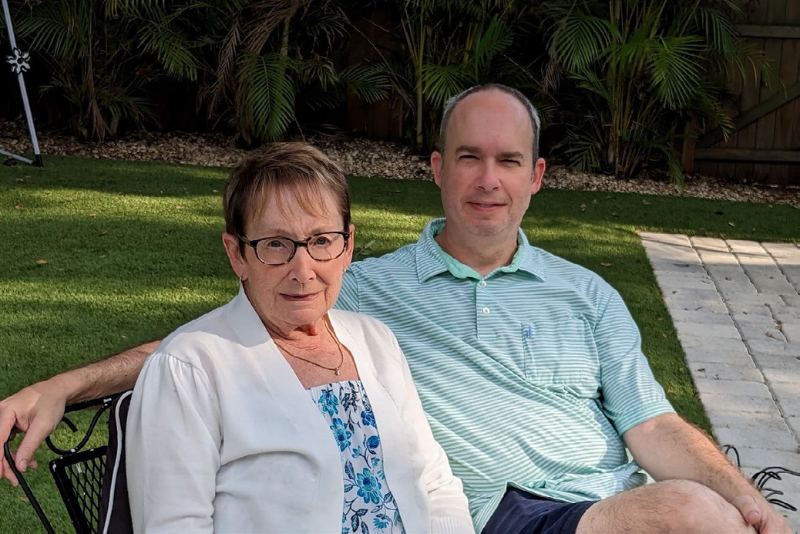
Mom, I Have Cancer with Susan Brill
Being a two-time cancer survivor never prepared Susan Brill for hearing her son say the words “Mom, I have cancer.” Susan shares about the roles her family took in caring for her only son Jonathan. She discusses the dangers of “Doctor Google,” the importance of seeking mental health support, and the difference that can be made when you simply listen.
Thank you to our Guest: Susan Brill
Production Team: Jackie Beaushaw, Randy Isaacson (Family Advisor), Donna DiClementi, Anne Bidelman, and Karen Caraballo
Music by: Lloyd Goldstein
For more stories, subscribe to "In It Together: A Podcast About Caregiving" wherever you get your podcasts.
Podcast Transcript
Donna: Welcome to In It Together, a podcast about and for caregivers and the people they love. I'm Donna DiClementi, your host and Manager of Outpatient Social Work at Moffitt Cancer Center. In each episode, we'll dive deep with a wide range of caregivers to better understand the highs and lows of caring about someone with cancer. You'll meet the wives, husbands, partners, friends, and children to hear what worked well and what didn't work well as they became a caregiver for their loved one with cancer. Our hope is that by listening to caregiver stories, you will learn valuable information, plus feel supported, encouraged and renewed. After all, we are In It Together. Thanks for joining us.
Donna: Today we have the pleasure of having a retired career woman. A spouse, a mom, a grandmother, a cancer survivor. Today, we're welcoming Susan Brill to the podcast. Susan is a member of the caregiving team for her adult son. Susan, I really appreciate your willingness to come on to the podcast today and share your experiences of being a caregiver. And thanks for joining me on In It Together.
Susan: Thank you. I'm really honored to be here. Um, you covered some things about who I am. Um, you know, 43 years in education. Retired as an elementary principal. So, um, stayed busy, you know, and, uh, married 53 years.
Donna: It's really an honor to have you here on the podcast. Can you start, Susan, by telling us a little bit about you and your family before you became part of your adult son’s caregiving team?
Susan: Sure. I have one son and he has a lovely wife, and he has two of the very most handsome grandchildren you could ask for. Uh, one is a sophomore at Ole Miss and the other is a senior at Robinson IB. And we are a very close-knit family. We're a small family. Um, he has no brothers or sisters. I have a very small family. I only have two sisters. So, um, they're really our core family here in in Tampa. My sisters are in Ohio, so, um, you know, we're it.
Donna: Okay. So, before your son's cancer diagnosis, when you say you’re a close family, were you always together and helping each other?
Susan: Always. Always together. You know, dinner at least once a week together. We helped out a lot with our grandsons, you know, dropping them off at school, picking them up at school. So, we just had a lot of things that that we would do, you know, with our grandsons. And, you know, we were always there for our son and daughter in law. I feel like we have a have, and had a very, you know, close relationship. You know, she was the daughter that I never had.
Donna: Sure.
Susan: So that's the way I like to put it, you know, she’s the daughter I never had.
Donna: That's great. It really sounds lovely.
Susan: It is
Donna: So tell us a little bit about when your son was diagnosed with cancer and what those, you know, initial few months were like for you.
Susan: Sure. Well, it really kind of evolved over time because he always had severe acid reflux and really couldn't get it under control with medication. And so that acid reflux then turned into what we call Barrett's esophagus. And he would, you know, go for your yearly checkups and have endoscopies. And, um, the endoscopy that he had showed that there was something there more than the Barrett's and, um, that his gastroenterologist at that time suggested that he come to Moffitt. He came to Moffitt. Met with Doctor Dom in the GI department. We were concerned. So, when he had his appointment here at Moffitt, mom and dad tagged along. And, um, we knew after that endoscopy, when we got called to the back that it was not good news. Um, both my son and daughter in law were in tears, visibly upset. Doctor Dom was very honest and open with them. Um, he recommended a procedure. He would take a layer of the tumor and keep taking a layer until the margins were clear. And, um, so my, my husband and my daughter in law and son, um, traveled to this hospital where the procedure was done. I stayed home and took care of the grandkids, and, um, unfortunately, the, uh, procedure was not successful. So, he was back here at Moffitt, met Doctor Pimiento, who was a fabulous surgeon. I can't say enough about him. Um, and his. I guess he was lucky in the fact that the tumor was in the lower part of the esophagus, which meant that they could go in and take that section of the esophagus out and then pull the stomach back up and reattach and, and things like that. Um, it was a very rough surgery. It was done with robotics. A very long surgery. But successful.
Donna: Great.
Susan: And then, of course, chemotherapy and immunotherapy after that. But while this is all going on, you know, I think we became even closer as a family. You know, my husband would be the one who would, you know, take care of things around the house for them that needed taken care of. My daughter in law has a small business herself. So she had her business. And actually, it was during Covid. So both boys were home from school. So we made sure that they were taken care of.
Donna: Mhm.
Susan: The things that they remembered were… made me kind of chuckle. They remembered us bringing them lunch and I thought, oh, such a small gesture. But that's what they really remembered. Uh, we would take them for rides. “The ride to nowhere.”
Donna: Right.
Susan: Because we had to. They had to get out of the house.
Donna: Mhm.
Susan: And um, so we did, we did all those types of things. We made sure that my son was comfortable. We rented a recliner that he was able to sleep in because it was difficult for him to get in and out of bed. He had a feeding tube. And so, you know, we just took care of the little things.
Donna: Sure.
Susan: We would run the errands to Moffitt to pick up medication. If he had an appointment, we would take him to the appointment. Uh, because at the time, it was Covid. And so we had a very small bubble.
Donna: Right.
Susan: So we had to rely on one another.
Donna: Mhm.
Susan: You know, and, my kids are very social, and they always had friends over and, and always were going out. And now all of a sudden, because of Covid, that stopped.
Donna: Sure.
Susan: But not only the Covid but my son's cancer journey.
Donna: Mhm.
Susan: So it was difficult. I have to say that, in talking about my husband as a caregiver. He was a wonderful caregiver for me during both of my cancer journeys, and he was even a better caregiver for my son. Because my son's surgery was robotic, he had a number of incisions and one became inflamed. And rather than have, you know, uh, a home nurse visitor.
Donna: Sure. Mhm
Susan: Um, my husband learned how to pack it, clean it, and pack it, clean, every day. So we actually saw them almost every day.
Donna: That's great.
Susan: You know, I remember hearing those words and thinking and praying. Take it from him and give it to me.
Donna: Sure. “Those words.” When you say you remember hearing those words, what were those words?
Susan: “Mom, I have cancer.” And that was… that was heartbreaking. It was just heartbreaking. Because esophageal cancer doesn't have really good statistics. And it was stage three.
Donna: Mhm.
Susan: So, you know I had done enough doctor Google searches to know that, you know, it was something really serious that we really need to be concerned about. And he was 44 years old. You know, a young man. And so it, it cut deep. It really did. And, uh, I just think that. No mom wants to hear those words. No, no mom ever wants to hear those words.
Donna: Right.
Susan: So, it was… it was tough.
Donna: Yeah. Thanks for sharing that, Susan. Tough on a lot of levels. In addition to it being a complicated cancer diagnosis, to have it happen at the height of Covid when you needed to have a small, uh, protective bubble around your family. Uh, so it left a lot of responsibility for that family on just those few people.
Susan: Yes. Basically, you know, I tell the story of when my son came home from the hospital. Of course, he had the feeding tube and all kinds of medications. And his 15-year-old son at the time said, oh, don't worry, I got this. And so, we're all thinking, well, what does that mean?
Donna: Mhm.
Susan: And as a 15-year-old he learned everything he could about the feeding tube. He really took control of that during the day. Took care of making sure meds were given when they needed to be given and oftentimes slept on the couch by his dad.
Donna: Wow
Susan: Who slept in the recliner.
Donna: Sure.
Susan: And if it wasn't my grandson, then it was his wife.
Donna: Mhm.
Susan: So my other grandson was young enough that and I don't mean this in a bad way, but he's he's a techie. He's a researcher. So, I'm sure he was upstairs.
Donan: Right.
Susan: Reading everything possible about what was going on. So they, they each had a different role. And it was just really heartwarming to see both of them step up for their dad, you know?
Donna: Right. So as complicated and painful and heartbreaking, I think is the word you used, it was to know that your son had to endure and go through this. From a mom’s perspective, it was also heartwarming to see your grandsons, and what they did and what your husband did, and what your daughter in law did, and how everybody wrapped their arms around your son to care for him.
Susan: Yes, that and that meant so much to me. You know, as a mom. And not having a whole lot of family down here. I relied on my sisters in Ohio a lot. Lots of phone calls to them, you know.
Donna: Sure.
Susan: And a lot of support from them from a distance.
Donna: And that's a, you know, an important question and information to talk about, because caregivers can get so wrapped up in providing care that they don't often take care of themselves. So, what did you do during this time to take care of yourself?
Susan: Sure. My husband and I have kind of a ritual where we meet out on the deck around 5:00 every day, and we would sit and we would just decompress. Uh, we were there for one another. I think even though we had a strong marriage, I think it made it even stronger to know that we were both dealing with this situation, but in totally different ways.
Donna: Mhm.
Susan: I'm the emotional side of it. And he's not. Which is a good thing.
Donna: Mhm.
Susan: So we, we really relied on one another a lot. I have a group of friends also who would check in all the time. And so just knowing, you know, that they were out there and that I had could call on my friends any time I needed them was very… it was very important to me.
Donna: Good, good. And when you spoke to your sisters or your called on your friends, was it to, um, vent or just share what was going on?
Susan: It was more just to share what was going on, you know, where Jonathan was in the journey and what was happening on a regular basis. It was, um, you know, it was tough time for them too.
Donna: Mhm.
Susan: So being the... the person that I am. I wanted to make sure they were okay too. And, um, that's why I think it was important that, you know, I opened up to them. Lots of times patients and caregivers feel that, you know, their they want their journey to be private.
Donna: Mhm.
Susan: But that wasn't me. I needed it out there for people to help me.
Donna: Yeah.
Susan: And support me.
Donna: So there's there's no wrong or right way to do this. But for you, you needed the support of your family and your friends. So, you needed to share the story. What's going on and get their feedback and their support.
Susan: Yeah, absolutely. Absolutely. Um, Jonathan had a hard time emotionally. And as a caregiver I recognized that.
Donna: Mhm.
Susan: So I would tell him call me any time, whatever you need just call me. And I can't tell you the number of phone calls that I got at 1 or 2:00 in the morning.
Donna: Mhm.
Susan: And I had my always had my phone.
Donna: Sure
Susan: Always had my phone and I could tell. “Mom?” And it was a very emotional time for him as well as me. But I would just listen. And that’s what we have to do as caregivers is listen.
Donna: Mhm.
Susan: Uh, you know, he would tell me how scared he was. And I certainly understood that. I certainly understood that. He worried about his wife. He worried about the boys. Um, so it was just important for me to be available to him. Now I didn't cry over the phone, but when we would hang up the phone, that was my time to kind of let it out.
Donna: Right.
Susan: And, you know… but always keep in the back of my mind that it was going to be okay.
Donna: Mhm. You know what I hear a lot of caregivers talk about is that, uh, their loved one felt like they might be burdening the caregiver with too much. Either too much concrete things to do. Or too much emotional... information and they didn't want to burden the caregiver. So, what do you think about that?
Susan: I can understand that piece of it. Um, I do a lot of volunteer work in with peer visiting in the infusion centers, and I see that, you know, but, uh, I just feel that if you let the, your loved one, the patient, however you want to describe them, know that, you know, you're willing to accept that burden.
Donna: Mhm.
Susan: And that you have your ways of dealing with things. Um it may help. It may help. I always, you know, tell patients and I told my son and daughter in law, you have to be your own advocate. You have to, you know, stand up and ask the questions and be your own advocate.
Donna: Mhm.
Susan: And I also feel that. As a caregiver, you need to be an active listener. Um…
Donna: Can you talk a little bit more about that? What? How do you define that?
Susan: You just have to listen and not try to solve their problems. Um, because they will tell you things and they will ask you things that you can't solve.
Donna: Mhm.
Susan: But you have to be willing to just listen. If they want to vent, let them vent. Um, and just keep calm and let it happen and you know, you just… it's hard to say.
Donna: Mhm.
Susan: But I think you just have to be a really good listener. Don't try to solve the problem.
Donna: Yeah.
Susan: Just be there for the patient.
Donna: That's such wise advice. That's such wise advice because you can't solve everything. Um, but clearly the patient, or your son in this situation, needs to vent, needs to share the experiences they're having, um, and not have it either minimized or pushed aside or maybe even, “well, let me help you. I'll call the doctor. I'll…” you know, that you jump to all of these things that you're going to do. Sometimes all that it takes is listening.
Susan: Yes. Most definitely, most definitely. I just... even myself. Sometimes when I come home from Moffitt, all I want my husband to do is to listen to me about my day. And he's very good about that. But yeah, I mean, it's just really important, you know, to listen.
Donna: Mhm.
Susan: Yeah. I really do believe that. Your relationship can grow during a time like this.
Donna: Sure.
Susan: You know. And it's not easy. But you know, and sometimes, rather than saying something you'll be sorry for, if you just kind of take a deep breath and maybe walk away and rethink what you were going to say. It can… it can make a difference. It can make a difference.
Donna: And did you have experiences like that?
Susan: I did.
Donna: Mhm.
Susan: I'm not going to lie I'm a problem solver.
Donna: Mhm.
Susan: So sometimes it was really hard for me to listen to my son. But I always felt like I was an encourager for him.
Donna: Mhm.
Susan: And that was important to me. Um, you know, there came a time when I realized I, you know, I can't handle this alone either. I'm not a professional. I'm a mom. And so, you know, I said to him, well, you know, maybe you need to talk to someone else.
Donna: Good.
Susan: You know, I'm always here for you and it has worked out beautifully. He's found a professional that that he speaks to regularly.
Donna: Great.
Susan: She's a cancer survivor herself.
Donna: Mhm.
Susan: And that means a lot to him. So I think we have to be willing to offer those things to patients, you know, think about talking to the social worker.
Donna: Mhm.
Susan: Or, you know, maybe “we should talk to the chaplain about that.” You know, offering ways that they can be listened to by somebody else. It was important.
Donna: I think that's part of the definition of active listening as well, is to be able to hear what they're saying, kind of what's underneath what they're saying, and offer other resources, other helpful resources in addition to you as a caregiver. Because you might see all of these other resources that are available to somebody, and the patient hasn't yet seen them or had enough time to really absorb that there's other resources available. So that's part of active listening too is giving other resources.
Susan: Oh I agree. I agree and you know, there are so many resources out there. You know, just even picking up a pamphlet in the Patient Library.
Donna: Mhm
Susan: And sharing it.
Donna: Mhm
Susan: Is another resource that sometimes I don't think people realize.
Donna: Right.
Susan: That it's a resource out there.
Donna: So, you talked a little bit about how you managed it and how your husband managed it and the way that your grandchildren and your daughter did it. And it sounds like you were all able to really pull together to support your son. What were some of the challenges that you saw?
Susan:I think a challenge… It was making sure that everybody was on the same page. You know. When he would have a doctor's appointment, making sure that we knew all the details of that appointment that was important to us. So we were in communication all the time. You know, when that would happen. I just think that, you know, being open and honest and, you know, speaking openly about our concerns.
Donna: Mhm.
Susan: And it seemed to work for us.
Donna: How did your own cancer experience impact your caregiving?
Susan: I think what happened was it made me realize that cancer is just not something that affects your body. Cancer affects your emotional well-being probably more than anything else. You know, we have all the wonderful surgeries and medications and chemotherapies and immunotherapies, and we really don't realize the emotional toll that it can take on you. You know, it takes a physical toll on you, of course, but to really realize the emotional toll it can take is sometimes overwhelming.
Donna: Yeah. It is. It is. And you felt like you knew that because of your own cancer experience?
Susan: Oh, definitely. Yes, definitely. Because I had support. I knew how important it was as a caregiver to offer that support to someone else. My husband was the best caregiver around. You know, took care of my drains, took care of my doctor's appointments, was there to take notes at the doctor's appointment because I never remembered anything from the appointments, you know. And so just knowing that it was so important to be there and to listen and, you know, just the little things to show that we really cared, you know, didn't maybe to the average person, you know, picking up lunch from Chick-Fil-A or somewhere wouldn't mean very much, but it meant a lot to the kids. And you know, they, besides my son and daughter in law, they were our priority.
Donna: Sure.
Susan: Because they were home all the time. And cancer is hard enough. But when you're around it 24/7, at that age it is very difficult.
Donna: It is.
Susan: It is very difficult and very emotional for them also.
Donna: It sounded like you and your husband, as grandparents, did a lovely job in giving them opportunity to decompress and to have some normalcy in a really chaotic time,
Susan: And I'm sure it was for them. And I think that's why it was important that that we were there. And I would always say to the boys, you know, if you ever need to talk to Grammy, all you have to do is call.
Donna: Mhm.
Susan: And occasionally they call, you know. But, just the fact that I was able to say that to them, I think, meant a lot. And we have such a close relationship now with both of them that. Oh, I wouldn't trade the relationship for the world. You know, they're wonderful young men now and I’m very proud of them.
Donna: That's great. That's great. Well, you're very astute to talk about the fact that cancer not only takes a toll on one's physical health, but also on one's emotional health. And it sounds like because of your awareness of that, you were able to make that brave suggestion to your son to seek professional help as well, to talk about the emotional impact cancer has. And so, kudos to you for seeing that and suggesting that.
Susan: I know a lot of people think when they think of a counselor and mental health concerns. You know, it's still kind of taboo. And just his willingness to reach out to someone was something that I was very thankful for.
Donna: Good, good. I'm sure it helped that he had your support as well.
Susan: I hope so.
Donna: That's great. That's great. So, is there anything that you found helpful? In addition to talking to family and friends that you would suggest other people do?
Susan: Well, I tell you one thing not to do. Don't doctor Google anything.
Donna: Okay.
Susan: Go to the source. Go to the source. You know, if it means asking a question on the portal. Gathering information from reliable sources is very, very important. And there's so much out there that Moffitt offers so much information that you need to get it from a reliable source. And you know, if it makes you overly concerned, then you know you need to be in touch with the provider or whomever here at Moffitt that can help you work through that.
Donna: Yeah, that's such wise advice as well. Such wise advice. There's so much misinformation catastrophizing information out on the open web there that it’s pretty painful to start to surf all the information.
Susan: Absolutely. Absolutely.
Donna: Yeah. Yeah. What other advice would you give to other caregivers listening to the podcast today?
Susan: Just to stay strong. As hard as that might be some days. Take care of yourself. Find a way for you to. You know, take care, take care of yourself. If it means, you know, going for a walk, getting lost in a good book for a little bit during the day. Um, you know, playing with the dog. Just something to take care of yourself. Because if you don't take care of yourself, you certainly cannot be a good caregiver to your loved one. And that would be my best advice is to take care of yourself so that you can take care of your loved one.
Donna: That's great. That's great. And, you know, the loved one really wants the caregiver to take care of themselves as well. It's painful for a patient to watch a caregiver struggle. With their own physical and emotional health because they’re caregiving.
Susan: You are so right about that. You are so right. And I see it sometimes. You know, in the infusion clinic, you know, where the caregiver won't go back into to where the patient is getting the infusion and they're just exhausted sitting in the waiting room. And I will oftentimes say, well, what are you doing for yourself? And sometimes they have to stop and think and say, I'm not really doing anything for myself. And that's something that they really need to consider. Find something, you know, to help you decompress.
Donna: Yeah, absolutely. Can you share a little bit more about what it is that you what your role here is at Moffitt?
Susan: Sure. I'm on the patient family advisory team. And in order to serve on the team as a volunteer, you either have to be a patient, a survivor, or a caregiver. And we work a lot doing peer visiting in different areas of Moffitt. I volunteer in both of the infusion centers where I meet patients and their caregivers on a regular basis. I volunteer at the patient family coffees that we have on Thursday mornings at McKinley. And I do inpatient rounding where I visit newly admitted patients to Moffitt or patients who have just had surgery and are recovering at our new MMH hospital.
Donna: Ok. Mhm.
Susan: And then I'm also part of Comfort Companions, and that is a program that Moffitt has where they believe that no one should die alone.
Donna: Mhm
Susan: And so if a patient is put on comfort measures only.
Donna: Mhm
Susan: And maybe they have family, but the family needs respite or they have things that they need to take care of.
Donna: Mhm
Susan: And they don't want the patient to be alone. Then we will sit vigil with the patient. We sign up for vigil times. And sometimes we do have patients who have no one. And so we are there for them in their, you know, their final days so that they're not alone.
Donna: That's amazing. That's amazing. Susan.
Susan: Thank you. I enjoy it.
Donna: Anything else, Susan, that you think would be useful to talk about that we haven't covered yet?
Susan: Just as a caregiver. Be an advocate for your loved one. And we have to remember that caregivers aren't necessarily someone that the patient is related to.
Donna: Mhm.
Susan: You know, we need to realize that it might be the neighbor next door. It might be, you know, the person that they work with. So, you know, we just need to realize that caregivers come in all different shapes and sizes if you want to say, you know. So even if you're not a related blood relative related to the patient, you can still be their advocate. And I think that's very important.
Donna: That's powerful message to end on. Thank you so much, Susan, and I appreciate all that you gave us today. It was a lot of great advice.
Susan: Thank you. Donna, I really enjoyed coming.
Donna: Thank you for listening to In It Together: A Podcast About Caregiving. In It Together is brought to you by Moffitt Cancer Center's Patient Library and Welcome Center, in collaboration with our Social Work department. Special thanks to Lloyd Goldstein, Musician in Residence here at Moffitt Cancer Center's Arts and Medicine program for our music. And thanks goes to our producer, Jackie Beaushaw, Patient Library Supervisor, and Randy Isaacson, Family Advisor. For more information about the services mentioned in this episode, please view the show notes or visit the In It Together page on Moffitt.org. Thank you for spending time listening and we hope that it was useful. Have a great day.