
A Coach’s Mentality
Editor’s note: This story was originally written before the passing of Bob McIntee on Sept. 30, 2025. We share it here in recognition of his life, his work, and the lasting impact he made on those he taught and coached. His dedication and kindness will be remembered. We extend our sincere condolences to his family and all who loved Bob.
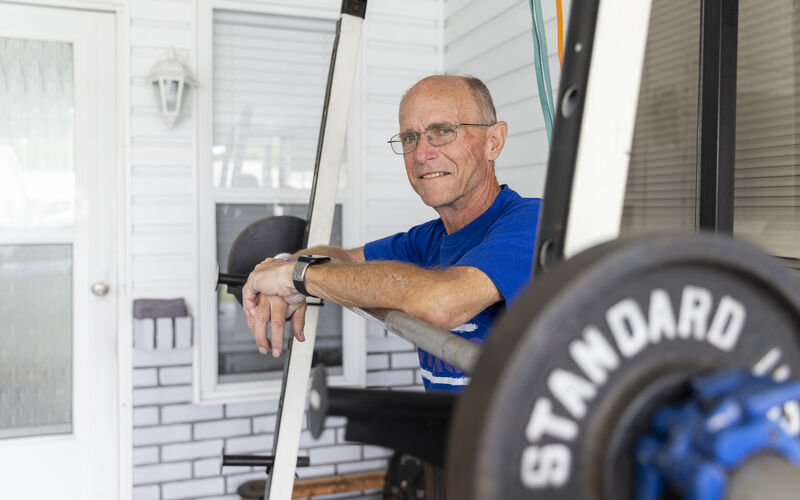
Bob McIntee was always the one pushing others to be stronger. As a teacher, coach and professional snow skier, he spent decades helping people discover what they were capable of — then encouraging them to reach a little further.
He spent 25 years working in the mountains of New York, first at a ski center in Stony Point and later with the New York State Park System at Sterling Forest. Bob earned his master’s degree in exercise science at age 50, opening the door to a new chapter as a teacher and coach. He worked at elementary and high schools, guiding kids from the playground to the weight room.
Eventually, Bob found his way to the United States Military Academy, where he became the ski coach for cadets. This position quickly became more than a job.
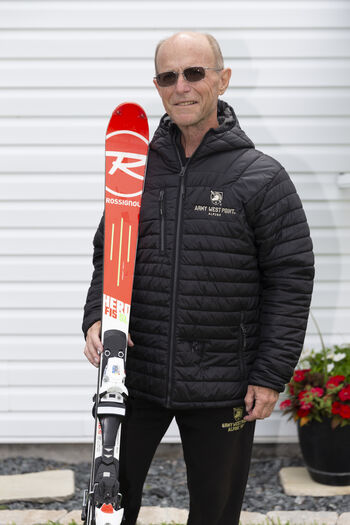
Bob McIntee was the snow ski coach at West Point for eight years. It was a position that quickly became more than a job.
“To be associated with the cadets at West Point, to have a role in helping those young people — it was just something. A culmination of everything I believed in,” Bob said. Bob poured himself into the role for eight years, training alongside the cadets in freezing temperatures and building a team culture grounded in determination. Under his leadership, the West Point ski team became a serious competitor — qualifying for national competition multiple times.
“We went to nationals for the first time ever,” Bob said. “That was a big deal. It showed those cadets they could compete with anyone.”
Coaching isn’t just a job for Bob. It’s a way of life. He and his wife of 37 years, Mary Ann, moved from upstate New York to Florida in 2022 to be closer to their kids and two grandchildren. Even after he retired, though, Bob didn’t slow down.
He turned their yard in The Villages into a personal training zone, hauling stones and gravel for fun. He biked dozens of miles daily, meticulously charting each workout and training his grandkids on the basics of strength and discipline.
“I always told people to control what you can,” he said.
A Sudden Diagnosis, a New Direction
Bob spent his life building strength in himself and others. But nothing could prepare him for what came next. He started having stomach pain in 2023 at age 69. He tried to manage it, but a few urgent care visits turned into a trip to the emergency room and then a scan.
That’s when they found it: late-stage pancreatic cancer.
“They told me I had three to six months,” Bob said. “That was it.”
But his family wasn’t ready to accept that. Within six days, Bob had an appointment at Moffitt Cancer Center.
During their first visit, Bob and Mary Ann were still shell-shocked, trying to process the diagnosis. A nurse practitioner entered the room, saw tears and asked what was wrong.
“I told her we have six months,” Mary Ann remembered. “She looked at us and said, ‘Who told you that? Nobody here. We’re going to rock this.’”
Bob wipes his tears as she tells the story. “That changed everything.”
After chemotherapy and radiation had run their course, Bob’s oncologist, Tiago Biachi, MD, PhD, offered one more option: a clinical trial targeting a mutation in the KRAS gene — specifically KRAS G12D, the most common mutation found in pancreatic cancer and the one in Bob’s tumor.
Cracking KRAS — A New Era of Hope
Bob’s story is deeply personal but also a glimpse into a much larger scientific breakthrough. The clinical trial he was about to enroll in was made possible by decades of research into one of cancer’s most mysterious drivers: the RAS genes.
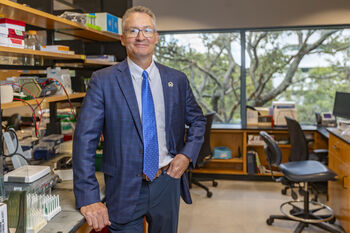
RAS proteins are known to play a role in up to 30% of all human cancers. Eric Haura, MD, explains that new drug designs have made it possible to target RAS gene mutations.
“There’s a family of genes called RAS,” explained Eric Haura, MD, associate center director of Clinical Science at Moffitt. “They’re like switches that tell cells to grow or not grow. That’s how they work in normal cells. But in cancer, they’re abnormal — like a gas pedal stuck in the ‘on’ state.”
RAS mutations were first linked to cancer in the early 1980s. Today, they are known to play a role in up to 30% of all human cancers, including lung, colon and pancreatic cancers. According to the National Cancer Institute, RAS-driven cancers are responsible for over a million deaths worldwide each year.
Despite their impact, RAS proteins were considered “undruggable” for decades because of their smooth surface — leaving no clear area for medicines to latch onto and block their cancer-causing signals.
“People knew it was a driver of cancer, but it was difficult to come up with therapies,” Haura explained.
That changed recently, as new drug designs made it possible to target specific members of the RAS gene family — including a gene called KRAS, which is especially common in pancreatic cancer. Within the KRAS gene, there are several common mutations including G12C, G12R, G12V and G12D.
“The last big therapeutic breakthrough in pancreatic cancer was more than a decade ago,” Haura said. “It’s been a desert of opportunity for these patients. But now, we’re seeing people with KRAS G12D mutations have very deep and durable responses to a single pill.”
That breakthrough drug became available through a clinical trial at Moffitt in March 2024. “Before that, people couldn’t benefit from it,” Haura said. “Now that we have access to it, we want patients and referring doctors to know — if you have a RAS mutation, clinical trials need to be at the top of the list.”
Haura’s team and other researchers at Moffitt are studying how RAS works inside cancer cells. They are looking at why some tumors respond well to treatment, while others shrink at first but eventually grow back.
Researchers are also exploring the best ways to attack RAS-driven cancers, not just with targeted drugs, but by combining them with other treatments like immunotherapy. Moffitt is now running several first-in-human RAS-targeted trials, with more on the way. It’s a larger push to rewrite what’s possible for cancers once considered untouchable.
“We’re building a strong portfolio of clinical trials for patients with RAS-driven cancers,” Haura said. “It’s an exciting time. There’s incredible hope now.”
A New Option, a New Outlook
Bob signed the consent paperwork for the trial on April 2, 2024. Two weeks later, he swallowed his first dose, an oral medication designed to block the growth signals sent by the KRAS G12D mutation. It was his first day on what’s known as a phase 1 clinical trial, led by Dae Won Kim, MD, a medical oncologist in the Gastrointestinal Oncology Department at Moffitt.

Dae Won Kim, MD
“KRAS is a major driver of pancreatic cancer,” Kim explained. “About 90% of patients with pancreatic cancer have this mutation, and 40% of those have the G12D subtype. That’s what this trial targets.”
The drug, called RMC-9805, is part of a new wave of targeted therapies that aim to shut down cancer at the genetic level with fewer side effects compared to traditional chemotherapy.
Bob takes the medication once a day.
“So far, we’ve seen much less toxicity,” Kim said. “Patients like Bob tolerate it very well.”
Rachel Erickson, a clinical research coordinator at Moffitt, met the McIntees on day one.
“Bob was our first patient enrolled on this trial,” she said. “I called him, introduced myself, then brought him in for screening and consent. He’s been with me ever since.”
Erickson handles everything from scheduling and side effect management to keeping sponsors updated on progress. But to the McIntees, she’s more than the logistics lead.
“She’s like family now,” Bob said. “She’s been by our side the whole way. She’s great at keeping us informed, being a friend and someone we can rely on. It’s all the professional stuff but on a personal level, too. It means a whole lot.”
At first, visits were frequent — five times in the first 21-day cycle — to monitor side effects. But Bob, the coach, took it in stride.
“From the beginning, he had the mentality of ‘I’m strong, I’m going to get through this,’” Erickson said. “He’s never missed a dose, never missed an appointment. If you had to define what a perfect clinical trial patient looks like, it’s Bob.”
He also had results. By his third scan, Bob’s tumor had shrunk by more than 30%.
“That’s considered a partial response in the trial, and for pancreatic cancer, that’s amazing,” Erickson said. “Not only is it not growing or spreading, but it’s also getting smaller.”
Even more impressive is that Bob experienced almost no side effects. Unlike traditional chemotherapy, which often wipes patients out, this drug has allowed Bob to maintain his energy and stay active.
Now, more than a year in, Bob still takes the medication daily and visits Moffitt every three weeks.
“He’s always my first patient in the morning,” Erickson said. “I’m a morning person, too. It starts the day of on a high note. He walks in, telling me stories about his grandkids, his workout that week and what he’s building in the yard. He’s thriving. It’s incredible.”
The study is now expanding, and more patients are enrolling. It is designed to continue for up to two years. “If the next phases confirm what we’re seeing, we hope this becomes an FDA-approved option,” Kim said. For now, Bob is focused on what is right in front of him: the next bike ride, the next ski trip and the next scan.
A Life in Motion
Before the clinical trial, Bob and Mary Ann were bracing for the worst. Instead, over the past year, the McIntees have traveled to see family, spent quality time with their grandchildren and even returned twice to West Point.
“When he went for the last ski race of the season, Bob decided to surprise the team and be at the bottom of the hill. When they saw him — oh, they lost it,” Mary Ann said.
The McIntees were back a few months later to sit in the stands during graduation and were guests at parties for the last of his former team members.

Bob McIntee and his wife, Mary Ann, spent the year traveling and spending time with family.
“Some didn’t even know I was there,” Bob smiled. “They were talking about me in the speeches — how I turned the team around and built something that lasted. I was like a ghost walking around.”
Being back at West Point reminded Bob just how much he’d poured into the team and what he got back in return. “I used to tell the cadets that if you want to be better, work harder than the guy next to you. That’s it. That’s the rule.”
He carried that same rule into treatment — not dwelling on the diagnosis, but tracking his treatments, showing up and keeping his eye on the next goal.
“This gave me a chance,” Bob said. “It’s given me a year so far. And I’ve made the most of it.”
Mary Ann nodded her head beside him. “A door opened when we thought they were all shut.”
For the McIntees, the clinical trial didn’t just extend life — it gave them time to live it. And for others facing similar challenges, it’s a powerful reminder that being part of a trial can help write the next chapter in cancer care.
“Clinical trials give people hope,” Bob said. “And sometimes, they give you more than that.”
RAS Trials at Moffitt
Thanks to advances in research, Moffitt is part of a growing effort to bring new hope to patients through RAS-targeted clinical trials. These studies are exploring new treatment options across several cancer types, including colorectal, lung, pancreatic and blood cancers. Many trials combine RAS-targeted drugs with chemotherapy, immunotherapy or other treatments to improve outcomes and help prevent resistance. Others are testing new approaches to help the immune system better fight cancer.
Clinical trials aim to deliver safe, more personalized options for patients with hard-to-treat cancers. New trials open often, so patients should talk with their care teams and regularly check for available clinical trials. Learn more here.
This article originally appeared in Moffitt's Momentum magazine.