

Are Doctors and Patients on the Same Page With Symptom Scales?
Patients who have undergone any type of procedure are often asked to rate their symptoms, such as pain, on a scale. The scale typically ranges from 1 to 5, with higher numbers indicating more bother from a symptom. Physicians, likewise, have a separate scale for rating patient symptoms. But how well do these physician and patient ratings match up?
Niema Razavian, MD, a radiation oncologist at Moffitt Cancer Center, has spent the past year examining the correlation in symptom ratings between physicians and head and neck cancer patients who have undergone radiation treatment. Head and neck cancers are treated with some of the longest courses of radiotherapy, Razavian said, and side effects can begin as early as one week into treatment and last for a month or more after the final treatment.
Presenting the Findings
He presented the findings at this year’s American Society for Radiation Oncology annual meeting in San Francisco this week.
“Physicians have a specific way in which we rate symptoms,” Razavian said. “We are given a specific metric to follow. For example, a zero may indicate no pain, while a 4 may indicate severe pain requiring hospitalization. But what our patient experiences is not always captured in these ratings.”
The study asked patients about a range of symptoms during their radiation treatments, including pain, dry mouth, swallowing challenges and voice changes. Razavian said 364 patients were asked to fill out the scale for themselves prior to treatment and through every follow-up visit after completing treatments. Clinicians did their own standard assessment at the same time.
Razavian then analyzed and compared the data from both.

“We found that some symptom ratings between the two matched up quite well, while in others, the physician rating underestimated the patient rating,” Razavian said. “When it came to symptoms, dry mouth and taste changes, the two scales matched well. The lowest correlation was connected to voice changes.”
Helping Physicians Understand Their Patients
According to Razavian, the results of the study can be used to help physicians understand how to best interpret what patients experience during and after treatment. A better understanding of the patient’s condition and experiences with side effects can help radiation oncologists and their colleagues understand how to improve care.
Following his oral presentation at #ASTRO25, Niema Razavian, MD (@RadOncDoc_Niema), discusses Real-World Validation of a Head and Neck PRO-CTCAE in Radiation Oncology.
— Moffitt Cancer Center (@MoffittNews) September 29, 2025
👉 In head and… pic.twitter.com/N9H614hp81
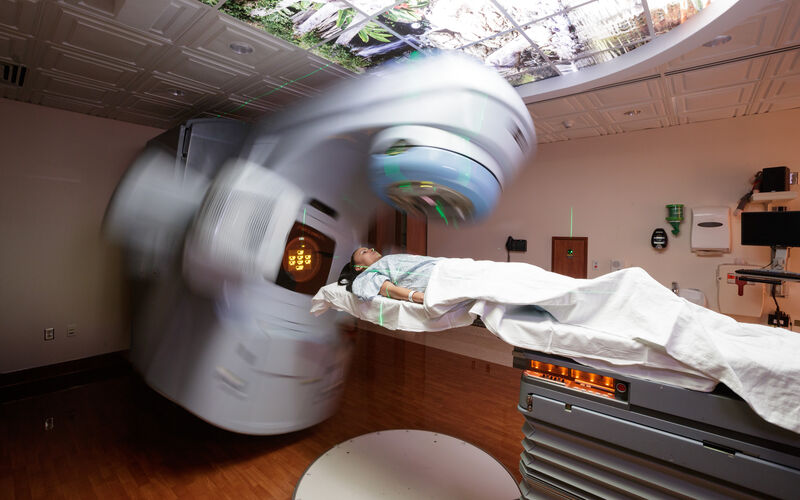
Standard radiotherapy involves a high-energy X-ray delivered through a linear accelerator, Razavian said. Some patients may also receive proton therapy, which will be offered at Moffitt in 2026.
“By looking at differences in physician and patient rating scales, we can ask ourselves if there is an aspect of care that we just don’t have a grasp on,” Razavian said. “Hopefully we can use this information to improve side effect management in the future.”
