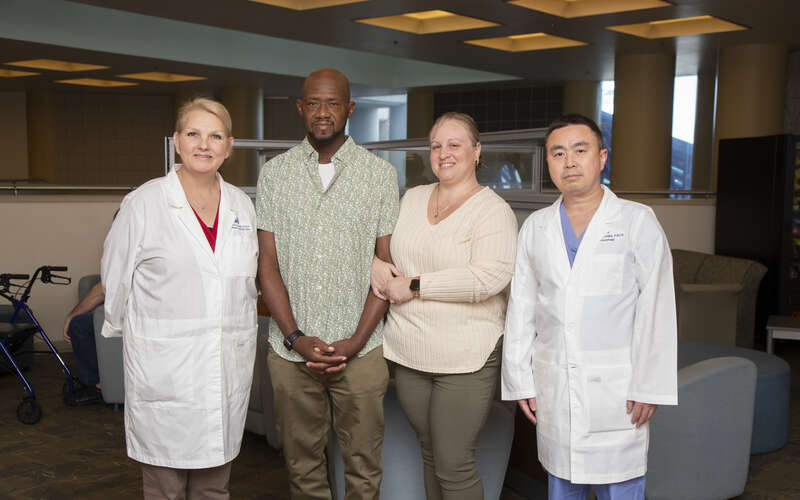
Beating the Odds
Key Takeaways:
• Jimel Smart survived rare tongue adenocarcinoma but suffered multiple cardiac arrests and a massive pulmonary embolism right after his final radiation treatment
• Moffitt Cancer Center doctors performed nearly 84 minutes of CPR and emergency bowel surgery that saved his life
• After months of rehabilitation, Smart regained mobility, speech and independence
When Jimel Smart’s wife, Brittany, began planning his 48th birthday party, the theme came to her instantly: peacocks.
A peacock may symbolize many things in life, depending on whom you ask. For Brittany and Jimel, the bird possesses rare qualities and represents divine protection and strength.
It’s what Brittany sees when she looks at her husband. He’s a man who not only beat a rare cancer but also survived multiple catastrophic health emergencies.
“He is truly as rare as they come,” Brittany said. “He has beaten the odds time and time again and has shown immense strength in every situation thrown his way.”
‘A Gut Feeling’
The story behind the peacock-themed birthday began a year earlier in June 2024.
Jimel was getting ready for the day with his usual morning routine. As he began shaving, he felt an unusual lump in his neck.
“In that moment, I had a gut feeling that something was wrong,” Brittany recalled.
A visit to Jimel’s primary care doctor revealed that the lump was a swollen lymph node. A biopsy led to a diagnosis of adenocarcinoma at the base of his tongue.
Adenocarcinoma is a cancer that begins in the glands that line the organs. It’s typically found in the lungs, breast, pancreas and colon. Adenocarcinoma in the tongue is rare.
Jimel turned to Moffitt Cancer Center for treatment. He underwent seven rounds of chemotherapy and 35 rounds of radiation.
“His treatment days were very long, and it was really hard on Jimel’s body,” Brittany said. “After being an electrician for more than 20 years, he had to stop working, and I took time off to take care of him.”
Jimel received his final radiation treatment on Nov. 18, 2024. It’s a date the couple will never forget. A day that’s typically a celebration quickly took a terrifying turn.
“I remember that he was up walking and talking, acting fine, and then he started to feel faint,” Brittany said. “I went out to the nursing station to see if I could get him some juice, and when I came back into his room, he was gasping for air and unable to speak.”
This was the first time Jimel went into cardiac arrest.
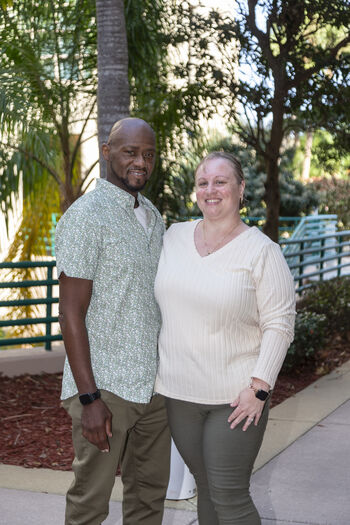
After his final radiation treatment, Jimel Smart was with his wife, Brittany, when he started to feel faint. Minutes later, he went into cardiac arrest.
Lifesaving Teamwork
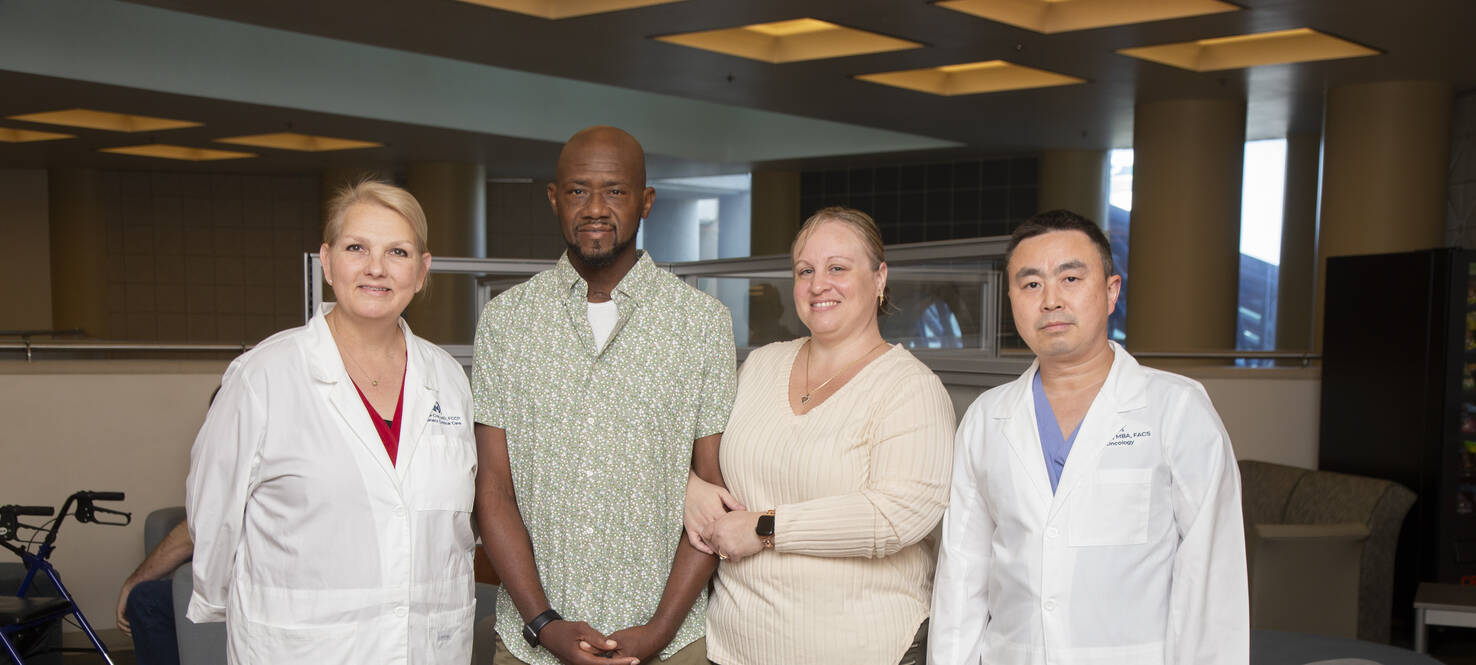
Jennifer Cox, MD, was the attending physician in Moffitt’s Intensive Care Unit (ICU) that day. Moffitt’s ICU is a place where patients go to receive care that cannot be done elsewhere in the hospital, such as vasopressors to bring up blood pressure, mechanical ventilation to support the lungs, continuous renal replacement therapy for kidney failure and frequent lab draws due to organ failure.
Nov. 18, 2024, is a day that Cox also remembers vividly.
“There was a call to the ICU team for a patient who was in urgent care under observation status — Jimel,” Cox said. “We came down and he was awake and talking, and we left. Within just a few minutes, we were called back for a code blue — meaning the heart or the lungs have stopped — and that is when we start CPR.”
Jimel required nearly an hour of CPR before he stabilized enough to transfer to the ICU.
The ICU team determined he had suffered a massive saddle pulmonary embolism — a large clot lodged in the main pulmonary artery that blocks blood flow to both lungs.
In the ICU, Jimel experienced two additional code blues, requiring another 24 minutes of CPR.
As doctors treated the saddle pulmonary embolism, Jimel remained in Moffitt’s ICU for six weeks. However, his condition worsened. His kidneys began to fail. His bowels stopped functioning. His abdomen was hard to the touch and distended — signs that demanded urgent intervention.
“He wasn’t in ideal shape for surgery,” Cox said. “We questioned whether he would make it through. But I knew the only way he was going to survive was if we intervened.”
Cox made the call to gastrointestinal surgeon Ji Fan, MD. Fan serves in a unique dual role — specializing in both complex cancer cases while also responding to urgent surgical needs.
“His wife was a very strong advocate for him, and so was Dr. Cox. After careful consideration, we made the decision to move forward with abdominal surgery, although it was a risk,” Fan said.
In the operating room, Fan and the surgical team found extensive bowel dysfunction and a large leak. Fan removed the damaged bowel and performed an ileostomy — creating an opening in the abdomen that diverts waste into an external pouch.
“This surgery ultimately saved his life,” Brittany said. “If it wasn’t for Dr. Cox first and then Dr. Fan and their teams, Jimel wouldn’t have survived. Watching the communication and teamwork between different teams at Moffitt is incredible to see.”
‘Another Miracle’
On Jan. 1, 2025, Jimel was discharged from Moffitt’s ICU.
Jimel’s recovery journey was long and rigorous. He was in a wheelchair. He was unable to form a full sentence. He couldn’t complete basic tasks on his own.
“For the amount of time Jimel was under CPR, it was expected that he likely would have had irreversible damage to his brain,” Brittany said. However, the damage was limited, and his brain is expected to recover some functions over time.
“It is really shocking and, once again, another miracle,” she said.
Jimel spent months undergoing physical therapy, speech therapy and occupational therapy, all with Brittany by his side. It was part of the promise the two made to one another when they married in 2021: to stick by each other’s side in sickness and in health.
“It was a difficult time,” Brittany shared. “Through hard times, I will always be by his side. In our relationship, we not only love each other, but we also genuinely really like each other and like to be together. He is so unique and unlike anyone else I know.”
A Rare Recovery
Nearly a year later, a lot has changed for Jimel.
He is able to walk and doesn’t need a wheelchair. He can have full conversations. He completes daily tasks like shaving and getting dressed without assistance.

Brittany gave this peacock paperweight to Cox as a thank you gift. Cox keeps it in her office as a reminder of Jimel and the crucial work of the ICU team.
“He is able to do normal things every day without a problem,” Brittany said. “He just can’t complete complex tasks because it becomes overwhelming.”
In August 2025, Jimel reunited with Fan for an ileostomy reversal, allowing him to go to the bathroom normally again.
“Seeing Jimel come so far is a miracle,” Fan said. “Watching him walk around, talk and overall live his life again is beautiful to see.”
Jimel says he is taking things day by day, thankful to be present.
“Overall, I feel good and blessed,” he said. “I couldn’t have gotten through all of this without my faith and without the support of my wife.”
To Brittany, Jimel has not only remained her partner through sickness and health, but he’s truly a peacock in her eyes.
“His cancer was rare. Surviving a saddle pulmonary embolism of that magnitude was rare. The fact that he did not receive a permanent brain injury is rare,” Brittany said.
For Cox, Jimel’s story is also a reminder of why the work matters.
“Before they left the ICU, Brittany gave me a gift — a paperweight with a peacock on it,” Dr. Cox said. “I keep it in my office. I look at it often. It reminds me of Jimel — and why we do what we do.”
These days, if Jimel is asked to describe himself, he’d say he’s a husband, a son, a father, a believer, and with a chuckle and a smile, he’d include a peacock.