Stem Cell Transplant Brings Two Strangers From Different Continents Together
How do you thank someone for saving your life when you have never met them? How do you show appreciation for such a gift? These were the questions that ran through Delia Cancel’s mind when she first contacted her stem cell donor. Cancel was diagnosed with stage 4B extranodal natural killer/T cell lymphoma in July 2018. The extremely rare and aggressive blood cancer attacked her bone marrow and left tumors throughout her body, including one dangerously close to her spinal cord that affected her mobility. The extremely rare and aggressive blood cancer attacked her bone marrow and left tumors throughout her body, including one dangerously close to her spinal cord that affected her mobility.
“I was tired all the time and not feeling like myself. I could barely walk and doing the normal things would exhaust me, so I went to see my doctor,” Cancel said. That visit changed everything. Tests showed her blood counts were very low and she was immediately taken to the hospital for a transfusion and further testing. That is when she learned her cancer diagnosis.
“My doctor in Miami told me there are very few experts for my type of cancer, but that he would like to consult with Dr. Lubomir Sokol at Moffitt Cancer Center before finalizing a treatment plan,” Cancel said. She was given a 20% to 30% chance of survival if she could complete the necessary chemotherapy and become healthy enough to have a stem cell transplant. Without the transplant, survival was slim.
Cancel shrugged off the bad odds and remained positive. “I knew I was going to make it to and through the transplant. I just focused on doing what needed to be done. Despite having to go through chemo, which is known to make you sick and tired, I got up every day, showered, got dressed, put on makeup and tackled treatment. I refused to lie in bed in a hospital gown. I wanted to be up, walk around and talk to people. Be as normal as possible,” she said.
Searching for a Match
While she started her treatment in Miami, Cancel ended up having the last few cycles of chemotherapy in Tampa at Moffitt. Once in remission, Sokol and Hien Liu, MD, told her it was time for the transplant. The only issue? Finding a donor.
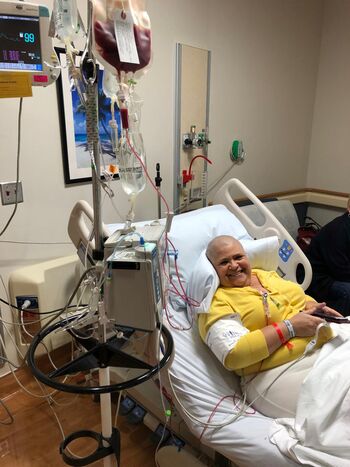
Delia Cancel received her donor cells in January 2019.
“No one in my family was a match, so we had to look for an unrelated donor,” Cancel said.
Liu worldwide registries where she found two potential donors. Both were young, which she said made them good candidates for Cancel, who was in her 50s.
“Younger donors tend to have healthier stem cells and also have a lower risk for complications,” Liu said.
The only thing Cancel knew at the time was that the donor was a 20-year-old woman living in Poland. To protect the donor and patient, knowing any more information or having the ability to contact the donor is prohibited for one to two years after transplant. On Jan. 17, 2019, six months after her initial diagnosis, Cancel received her donor cells.
Cancel faced her transplant with the same positivity she brought to her initial treatment. She spent more than a month in the hospital at Moffitt for her transplant to give her new immune system time to grow and ensure her cancerous cells were gone. Once discharged, she had to stay locally for two more months, in case any complications arose. In total, she spent over 100 days in Tampa for the procedure.
Connecting Across Continents
Two years later, in 2021, Cancel was handed a piece of paper during a check-up. That paper contained the name and contact information of her donor, Maja Sikorska.
“I was so excited to contact her, but at the same time, I had no idea what to say to her. She gave me such a precious gift. She saved my life,” Cancel said. “I waited a few days and then sent her an email.”
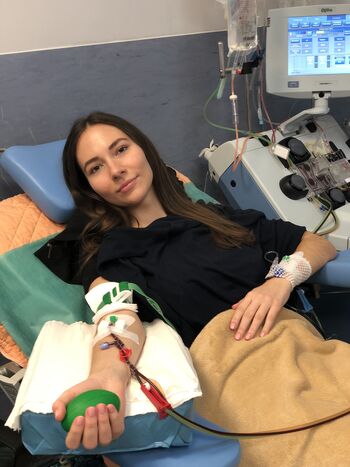
When Maja Sikorska made her donation in January 2019, it took two days to collect all the cells needed for Cancel's transplant.
Sikorska was delighted to hear from her donor and learn how she was doing. She, too, only knew that a woman in her 50s in the United States received her cells, but nothing else. She remembers traveling to Warsaw for cell collection in 2019. It took two days because they needed so many cells to ensure enough survived being shipped overseas.
“I registered as a donor when I was 18, and within two years I got the call that I was a match — a perfect match for someone in the U.S.,” she said. Sikorska was inspired to join the donor registry to help others. “It felt like the right thing to do. It is very common for people in Europe to register as donors.
Her experience reflects a broader trend in Europe, where donor registration is more common. The National Marrow Donor Program is the world’s largest donor registry, with over 42 million donors worldwide. The global donor pool includes over 18 million Europeans, compared to 9 million in North America.
A Long-Awaited Reunion
Cancel and Sikorska kept in touch over the years. The pandemic made it difficult to schedule a visit, but in 2026, just over seven years after Cancel’s transplant, the two finally met face-to-face. Sikorska traveled to Florida to visit her friend and meet her treatment team at Moffitt.
While Cancel remains cancer free after her transplant, she continues to manage chronic graft versus host disease, a complication in which donor cells mistake the patient’s body for foreign and attack tissues such as the skin, eyes, gastrointestinal tract or liver.
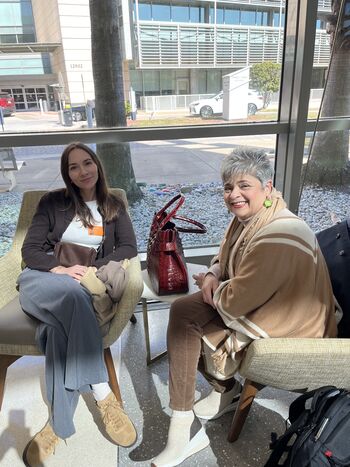
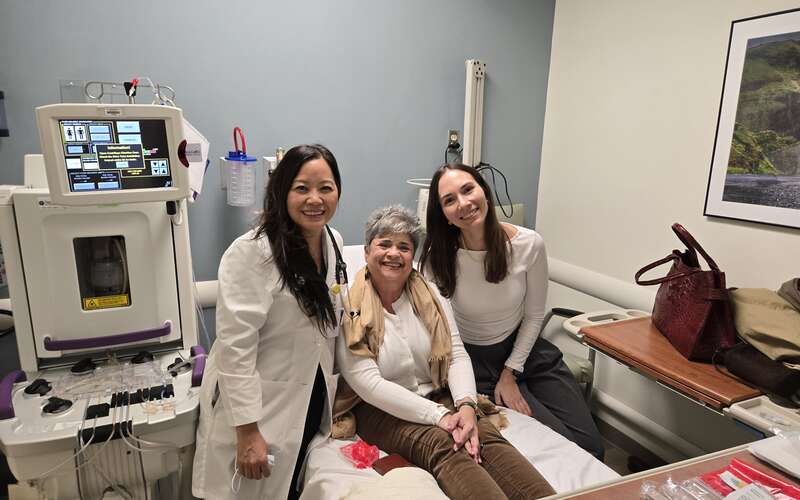
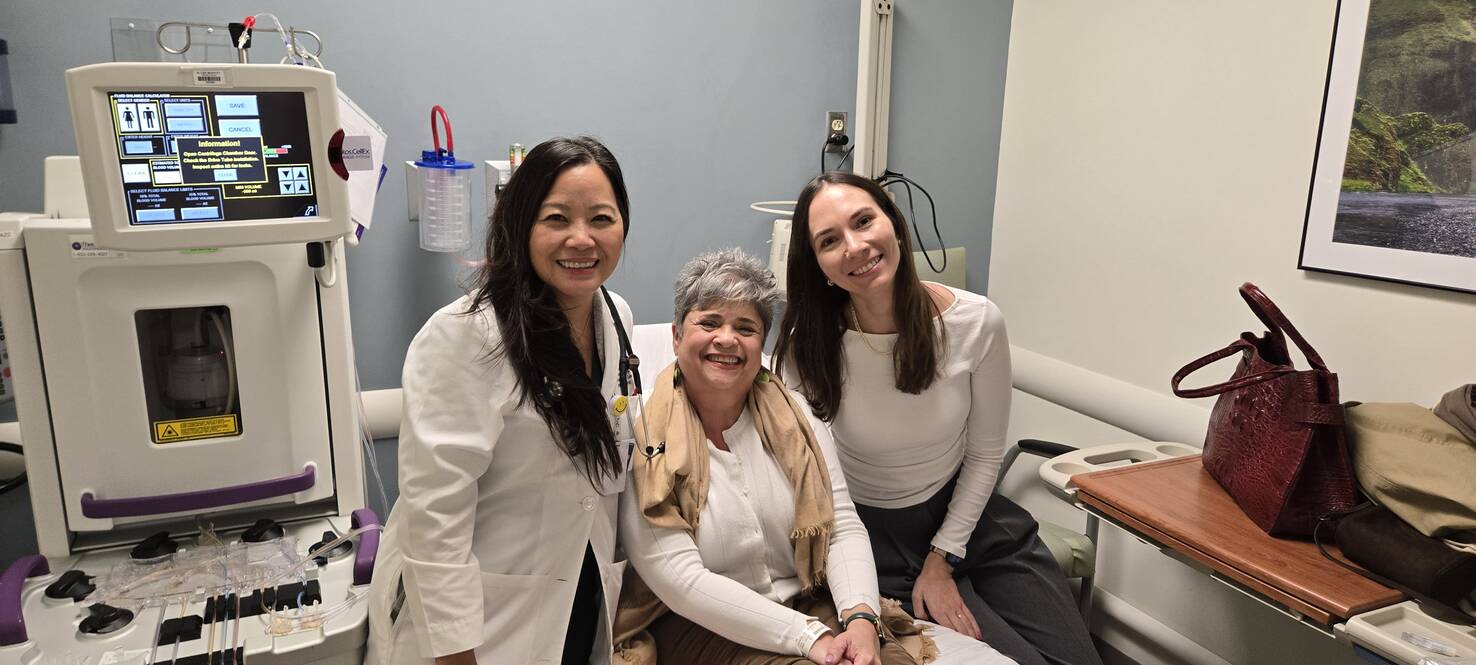
Cancel brought Sikorska to her most recent appointment at Moffitt to see where she was treated and meet her doctor and care team.
During a recent visit to Moffitt for treatment, Sikorska had the chance to meet Liu and the nurses in the apheresis unit, where Cancel is receiving treatment for her chronic graft versus host disease. For Sikorska, seeing the place where her donation made an impact was deeply moving.
"It has been so meaningful to meet everyone and see where she is receiving her care,” Sikorska said. “When you donate, you hope it helps someone, but you never imagine standing in the hospital where your cells made a difference. It makes the whole experience feel real.”
Liu said the meeting was just as meaningful for the clinical team. “We do not often get to meet the donors, so this was a very special moment. Their gift has such an impact not just on the patients receiving their cells, but on their families and our staff,” she said.
For Cancel, the visit confirmed what she had felt for years. Even before they met in person, she considered Sikorska part of her family and someone whose generosity shaped every milestone she reached after her transplant. Meeting her in Florida only strengthened that connection.
“I have thought of Maja as a daughter since the day I learned her name,” Cancel said. “Because of her, I got to see my son get married and meet my granddaughter. I am looking forward to enjoying my future, and I know we will stay connected for the rest of our lives.”
If you would like to learn more or register to be a donor, please visit www.nmpd.org. You could be the only match for a patient in need and could save a life.