

Moffitt’s New Brachytherapy Suite Provides More Efficient Radiation Treatment
Treating cancerous tumors with radiation therapy is a common method for a variety of cancer types. The beam of radiation kills cancer cells within the tumor, hopefully sterilizing it and improving the patient’s quality of life.
The downside of that treatment is that sometimes healthy tissue is impacted by the radiation. According to Stu Wasserman, chief radiation oncology officer at Moffitt Cancer Center, brachytherapy gives doctors a way to treat cancerous tumors and spare healthy tissue at the same time.
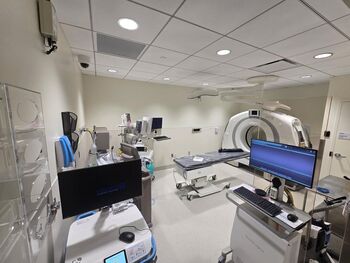
The Richard Gonzmart Brachytherapy Suite will help streamline the treatment process for many patients.
It’s so effective that Moffitt has expanded the space offering the treatment and is now actively treating patients in the new Richard Gonzmart Brachytherapy Suite on the Magnolia campus. Gonzmart, fourth generation owner of the Columbia restaurant and Moffitt Foundation board member, is a prostate cancer survivor who was treated with brachytherapy. He donated $1 million towards the expansion of the new suite.
“The new Richard Gonzmart Brachytherapy Suite is an incredible improvement for our patients receiving high-dose radiation therapy,” said Daniel Fernandez, MD, PhD, section head of Moffitt brachytherapy. “It allows for all the steps of a complicated brachytherapy procedure to be completed in one location while the patient remains under anesthesia.”
Brachytherapy is delivered in different forms, depending on the patient’s needs. One thing remains the same for every treatment: it must be precise.
“The trick is how do we get that amount of radiation in without doing significant harm to the patient?” Wasserman said.
The answer? Implants, often called seeds, are placed inside a patient’s body to target a specific area and avoid harming healthy tissue.
What Cancers Are Treated With Brachytherapy?
Brachytherapy is a great tool in combating cancer, but it does have its limitations. It’s best used to treat “easily accessible” cancers or small target areas. Skin cancers, gynecologic cancers and prostate cancers are the most common forms of cancer treated with brachytherapy technology, Wasserman says.
“The issue is a technical one. You must have a location that is easily reached by a needle or catheter to get the source radiation implanted,” Wasserman said. “The advantage of brachytherapy is that the radiation is delivered locally into a very small area. However, if there is significant concern that the disease could spread outside of the area, it would need to be combined with other modalities.”
That’s when external beam radiation is more advantageous, he says. In some cases, irradiating areas surrounding the target benefit the patient in that it prevents the disease from accessing healthy cells and spreading into other parts of the body.
What Are the Types of Brachytherapy?
Brachytherapy comes in two forms:
- Low dose-rate brachytherapy involves placing relatively low energy radiation sources (seeds) inside a patient often permanently for the rest of their life. Those seeds deliver radiation slowly over weeks to months, and the patient must follow strict radiation safety precautions until the seeds are no longer active.
- High dose-rate brachytherapy can be considered a specialized form of temporary implants that has the advantage of delivering radiation treatment over a 10 to 20-minute period.
The new suite brings advanced 3D imaging, ultrasound and Moffitt’s treatment technology into a radiation-shielded operating room.
“This allows us to expand our capabilities to deliver more precise and safer treatments to our patients in a much more comfortable fashion,” Fernandez said.
The brachytherapy suite also allows Moffitt to offer the treatment to a larger patient population.
“We cannot thank Mr. Gonzmart and his family enough for this generous investment in our program,” Fernandez said. “This suite will make a huge impact on so many patients’ lives for years to come.”
