

On Course for a Full Life
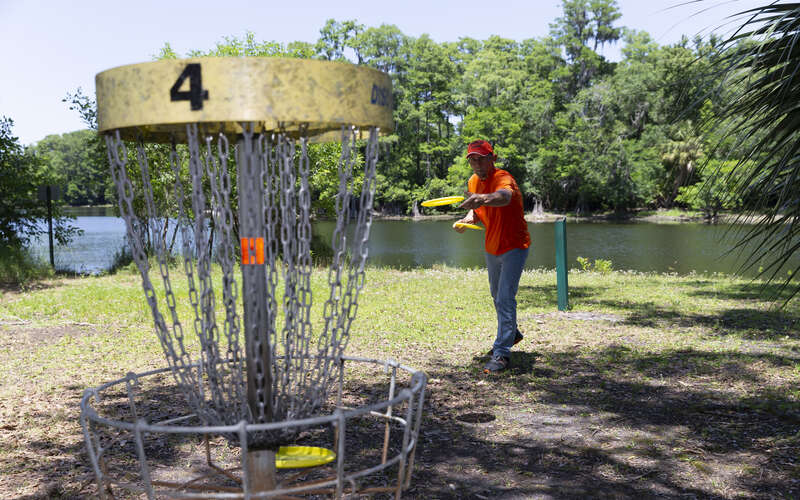
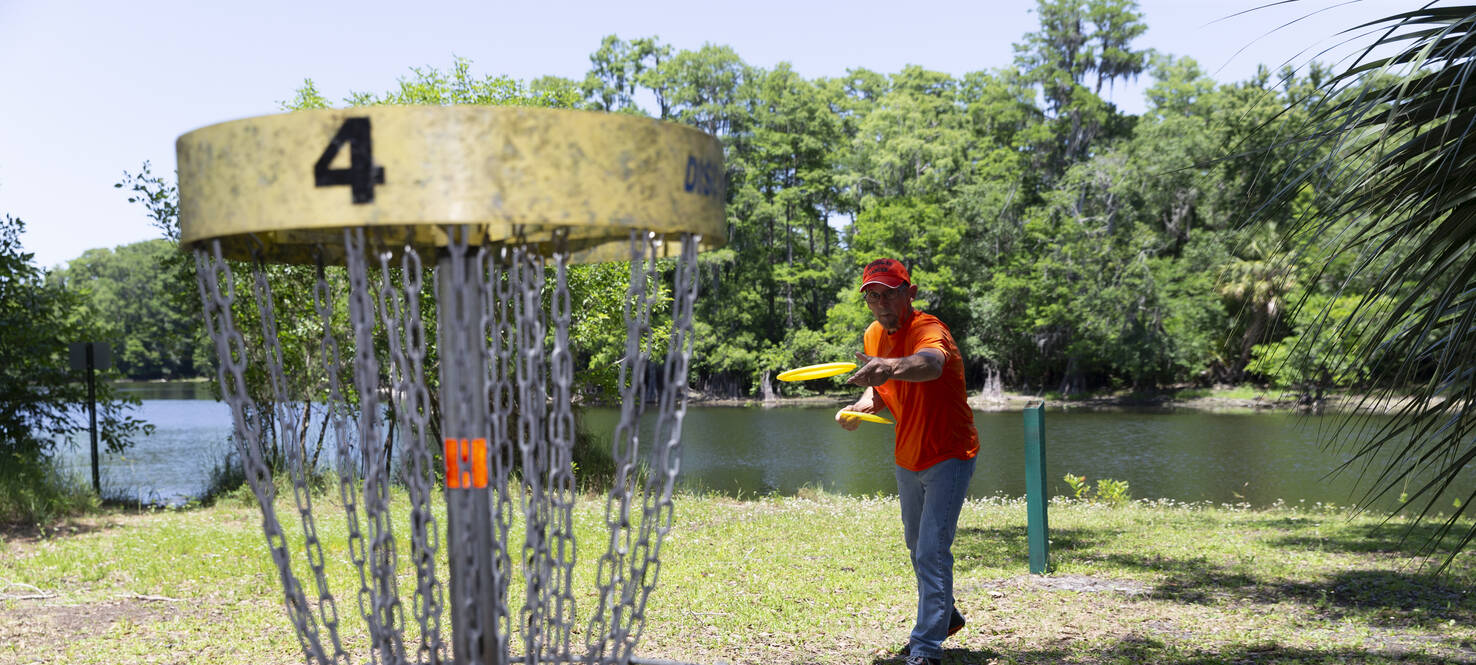
Watching Eric Bilow on the disc golf course is a thing of beauty.
He quietly lines up his shot, takes a breath and aims. He watches intently as the disc leaves his hand and sails toward its goal. When the plastic disc hits the metal chains on the basket, the sound elicits a smile.
Disc golf is a hobby that Eric, 65, picked up while doing all he can to enjoy life. After all, he says, life is a gift, and his was extended thanks to the treatment he received at Moffitt Cancer Center for oropharynx cancer, a type of head and neck cancer.
Eric has been cancer free for the past four years, but it hasn’t been an easy diagnosis to overcome. He went through surgery, radiation and chemotherapy. He had to relearn how to speak after losing part of his tongue, and he regularly visits the cancer center for checkups.
But since his initial diagnosis, Eric has taken on many challenges. He has skydived twice, participated in a 5K and a kayak marathon, and he formed a Polaris Slingshot Open-Air Roadster social club in The Villages, where he lives with his wife, Debbie.
This summer, he set out on the open road in his 2023 bright orange Polaris Slingshot, an open-interior, three-wheel autocycle that he describes as an adult-sized go-cart. His goal: to play disc golf in each of the lower 48 states. His mission: to celebrate those who have survived cancer and honor those lost to it.
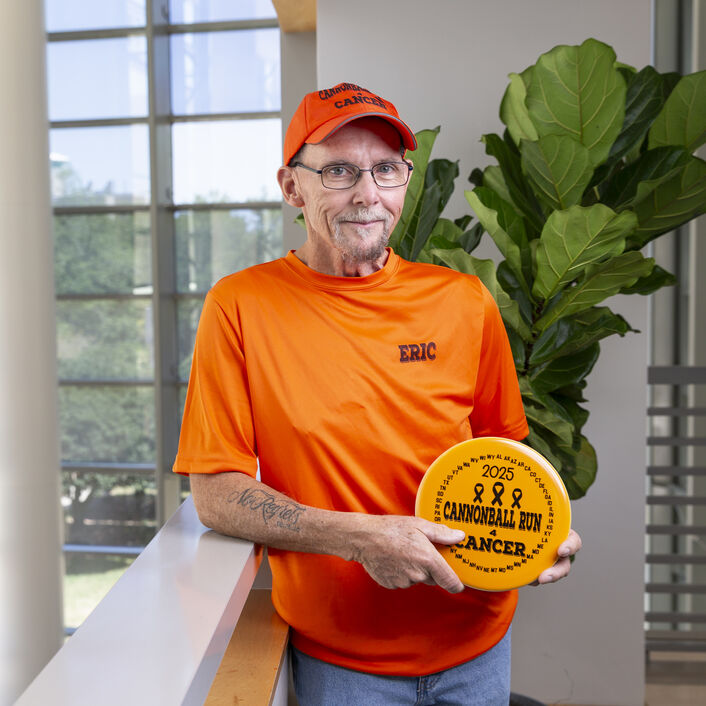
He called his two-month journey the 2025 Cannonball Run 4 Cancer.
“I wanted to do something to raise awareness for the tenacity of cancer patients and survivors, so I decided to combine all three of my passions: disc golf, cancer awareness and the Slingshot,” Eric said. “My doctors at Moffitt have made it possible for me to enjoy life, and believe me, I’m fully taking advantage of the gift.”
A Routine Dentist Appointment
In 2019, Eric noticed a soreness in his throat, back near where his tonsils used to be. When he visited his dentist, he asked for an opinion. The dentist saw some swelling and suggested he see an ear, nose and throat doctor. “It was the ENT who first told me I had throat cancer,” Eric said. “The next thing I knew, I was undergoing radiation treatments.”
Technically, Eric was diagnosed with oropharynx cancer, wh
ich develops in the middle part of the throat behind the mouth. It is also sometimes referred to as tongue base cancer. According to Moffitt surgeon Deepa Danan, MD, oropharynx cancer is treated in one of two ways — through radiation and chemotherapy or surgery.
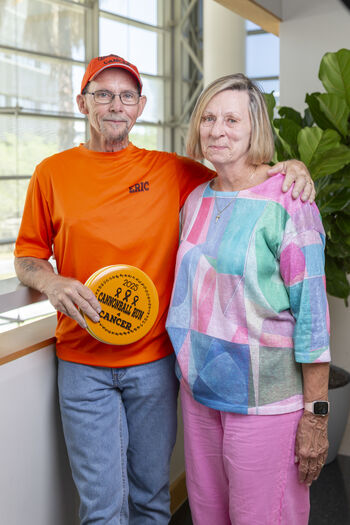
Eric Bilow, with wife Debbie, is a champion for living life to the fullest. Since his initial diagnosis, he has skydived, completed a kayak marathon and embarked on a 48-state disc golf journey.
While initially successful, the four months of radiation treatments didn’t hold off the cancer for Eric. The difficult news came at a bad time, too.
In May 2020, Debbie had been diagnosed with breast cancer. While she was in surgery at Moffitt for a lumpectomy in July, Eric got an urgent call. His cancer had returned.
This time, his doctors suggested surgery, which they warned would impact Eric’s ability to speak and eat. After talking with his wife, Eric opted for the surgery, and she paused her scheduled radiation treatments in order to care for her husband.
“I’d never been in that position before,” Eric said. “What do you do in a situation like that? I decided to do what was suggested and fight it the best way we could.”
A ‘Pretty Radical’ Surgery
Danan describes the surgery as “pretty radical,” adding that once she operated on Eric, she realized the procedure would be more involved than initially thought. “Once I was in there, I realized I was going to have to take a portion of his voice box and a very large portion of his throat,” Danan said.
Danan also removed a portion of Eric’s voice box called the epiglottis, a flap of tissue that covers the voice box when you swallow and directs food and liquids to the stomach rather than to the airway. Danan used Eric’s left pectoralis muscle and chest skin to reconstruct the structure of his throat. It was a successful surgery, but the reconstructed epiglottis was not fully functional.
“When I woke up in intensive care, I had a trach and a feeding tube,” Eric said. “I was also unable to speak.”
Eric spent the next two weeks in the hospital, healing and learning what he needed to do next to return to a normal routine. He was determined to get back home to his wife and his life in The Villages.
“I learned sign language to help me communicate,” explained Eric, who also worked through physical therapy to recover from the surgery. “I did all that while wearing a feeding tube.”
Debbie stayed by his side throughout his recovery, and the two would send text messages to each other since he couldn’t speak, even when they were both sitting on the same couch. Eric began working with a speech therapist in October 2020 while also learning American Sign Language.
“I spent a lot of time in a room by myself where she couldn’t hear me, going over my speech therapy exercises,” Eric said.
When he was confident in his ability to speak, he told his wife three words: “I love you.”
“I was just stunned,” Debbie said. “I said, ‘What did you just say?’ I was emotional, for sure.”
Once Eric was on the road to recovery from surgery, Debbie proceeded with her radiation treatments, and in November 2020, she was declared cancer free. She was alone when she rang the bell because Eric was immunocompromised and it was the height of the COVID-19 pandemic.
As Debbie celebrated her successful treatment, Eric was making progress. He was learning to feed himself through a permanent feeding tube. Without the ability to swallow, he must ingest liquid nutrition through a syringe and tube that connects directly to his stomach.
But Eric had one more medical obstacle to face: He needed intense radiation treatment.
A 10% Chance
Even after his surgery, Eric’s cancer came back quickly, this time in a location that could not be removed surgically. The best way to try to eradicate it was through radiation therapy, where risks increase with each treatment.
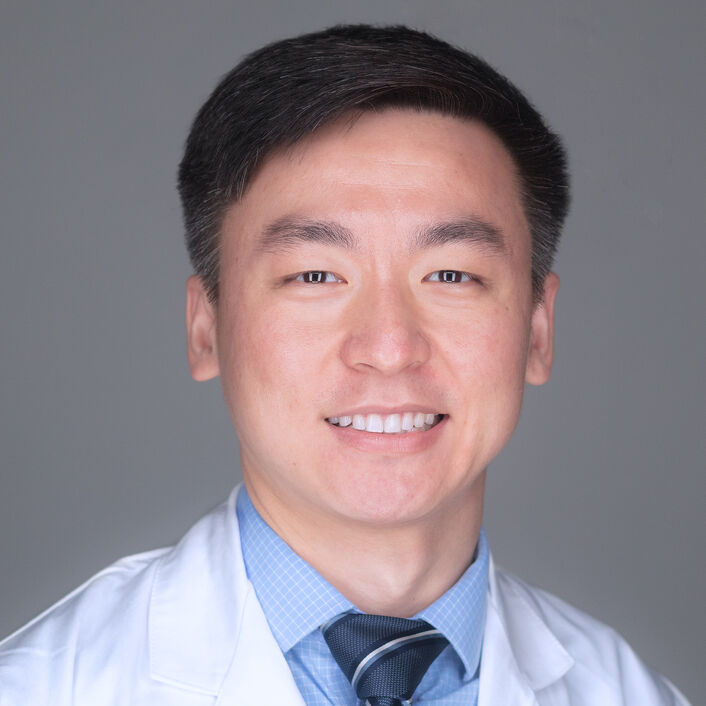
“With today’s technology, we’re able to shape exactly where the radiation goes and doesn’t go,” explained radiation oncologist George Yang, MD. “We try to be very meticulous about not treating in excess things that have seen a lot of treatment before. So we are very careful about the spinal cord and brain stem, the mandible, the jawbone and the salivary structures. We don’t want to overradiate where the cancer is not present.”

Eric is now considered disease free, and he credits surgeon Deepa Danan, MD, and radiation oncologist George Yang, MD.
Eric understood the risks and knew that another round of radiation could have some side effects. After speaking with Yang, Eric was confident that moving forward with radiation was the right step.
“Dr. Yang told me that if I went forward with the treatment that he had a 10% chance of saving my life,” Eric said. “So I went to radiation and chemotherapy every Monday for a month and a half.”
According to Yang, patients with this particular head and neck cancer who undergo radiation again face similar odds, and success is not always possible. However, it was around Eric’s third or fourth treatment that Yang shared the good news. The tumor was shrinking, and things were looking better.
Three months after Eric’s final radiation treatment, Yang confirmed that the tumor was nonexistent.
“It’s gone completely,” Yang said. “He is considered disease free.”
It’s a result Eric had longed for, and one he places squarely on the hard work of both Danan and Yang. He sees both of them every six months for a routine checkup, just to make sure things are still looking good.
“They call me a bad repeat offender,” Eric laughed. “Seeing me twice a year for 10 years to make sure I’m healthy is definitely worth my time. I’m four years out right now, and I’m doing fantastic.”
Eric was excited to tell his doctors about his plan to drive around the country and play his favorite sport in each of the lower 48 states. While they were surprised to hear his plan, neither was shocked that he followed through.
“You know, I think for some patients, there is a light at the end of the tunnel,” Yang said. “You know Eric can shine like a beacon of what you can do no matter what happened to you. It doesn’t have to hold you back, because he certainly hasn’t.”
Danan agrees, saying it’s hard to put into words how she feels about Eric, his progress and how he’s living his life postcancer.
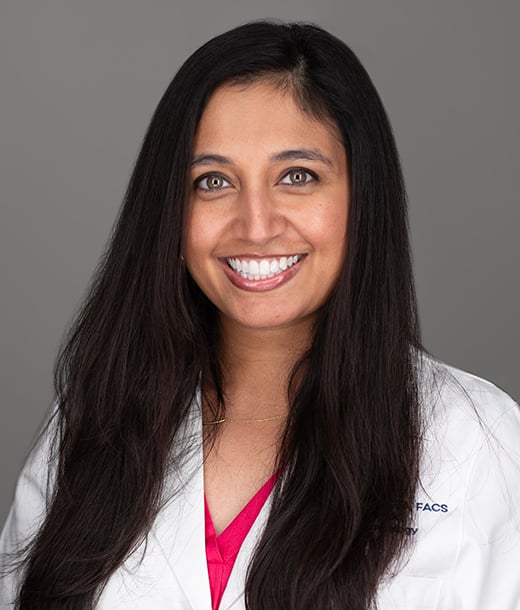
“It’s kind of magical the way he approaches things,” she said. “It’s truly beyond optimism. I’ve never met someone who is willing to give up so much but still feels so fulfilled. He never has any regret, and he has never felt sorry for himself — ever.”
A Plan To Hit the Road
“I learned how to play disc golf after my first round of radiation when I could still eat and talk,” said Eric, who has built The Villages disc golf club to nearly 700 members since he joined. “When it came back a second time and they rebuilt my throat with my left pectoral, I had to take a year off. I came back and had to learn how to play with my right hand. Despite that, I love coaching others and I’m an average player who plays more than anyone else I know.”
Eric also had to learn how to use his permanent feeding tube, which is connected to him 24 hours a day.

Eric traveled all across the U.S. in his open-air Slingshot, stopping to play disc golf in each state.
With his nutritional supplements carefully packed in what little space he had in his Slingshot, and the rest strategically placed with friends around the country, Eric began his trip on a rainy May 12 this spring. Driving north from The Villages and then west, his journey literally circled the country clockwise. He tallied more than 14,000 miles in his Slingshot and an estimated 100 hours of disc golf during his trip. He reunited with his wife on July 4 in South Carolina.
“I had no doors, no windows and no windshield,” Eric said. “I sat low to the ground on only three wheels and took as many backroads as possible.”
He averaged six hours of driving each day, followed by an average of two hours of disc golf.
When he returned to Florida from his adventure, he stepped right back into the other roles he relishes at The Villages. When he’s not leading the Slingshot or disc golf clubs, he’s co-leading the community’s head and neck cancer support group. He often accompanies new patients to Moffitt to help them navigate the center and feel more comfortable. It’s an unofficial role he takes seriously and is happy to continue.
“I recommend Moffitt to everyone I can,” Eric said. “I come with people to Moffitt on their first visit. I walk in with them, show them the bathroom, get them to the doctor’s office and the cafeteria. I show what I can and what I know.”
Calling him busy is an understatement, and having fun while helping others is part of his new outlook on life postcancer. He’s accomplished so much, one may wonder what would be next for an adventurer like Eric.
To be honest, he’s not sure, he said.
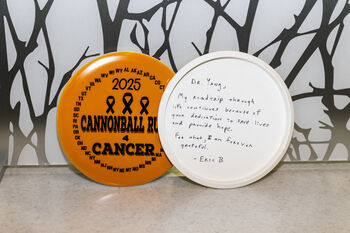
Before his trip, Eric gifted signed discs to Yang and Danan. He also had the two doctors sign his Slingshot.
“There’s nothing I’m afraid to do,” Eric said. “In the last four years, I’ve survived cancer three times. I’m living the next 30 years doing everything I possibly can.”
With an odometer filled with memories and countless new friends collected along his disc golf journey, Eric has accomplished what many people would never even dream of doing. His message, other than celebrating cancer victories and remembering those who weren’t as fortunate?
“May you live each day to the fullest as I do.”
This article originally appeared in Moffitt's Momentum magazine.
