

Overcoming Melanoma as a Teenager
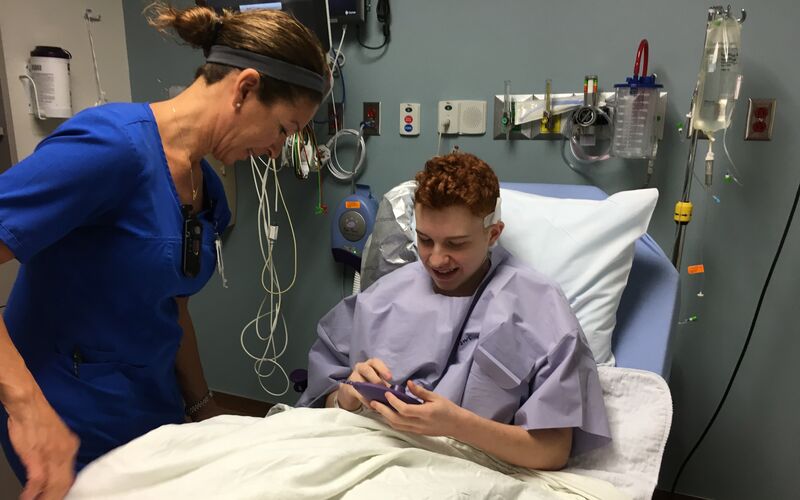
As a 16-year-old, arriving at Moffitt Cancer Center was incredibly intimidating for Kevin Rizzo. Shortly after a “nasty looking mole” was discovered on the left side of his head during a haircut, a trip to a dermatologist soon resulted in an appointment at the cancer center.
“My dermatologist had a gut feeling and it turns out I wasn’t OK,” said Rizzo, now 25, of Sarasota. “That office wasn’t equipped to deal with melanoma and that’s how I ended up going to Moffitt.”
Rizzo knew he was a rarity at Moffitt. He was the only teenager in the waiting room and said he never saw anyone close to his age during those early appointments. Fortunately, Vernon Sondak, MD, chair of Moffitt’s Cutaneous Oncology Department, and the clinical staff made him feel welcome and more comfortable than expected, he said.
“I was so intimidated when I first went to Moffitt,” Rizzo said. “But Dr. Sondak and (cutaneous nurse) Sarah Farmer made me feel like family and made me feel so comfortable. I feel like I became a little celebrity.”
Catering to Younger Patients
Rizzo was one of a small number of patients under 18 who gets treated at Moffitt. And while their numbers may be small, their presence and impact on the clinic is big. Each summer, Sondak and the cutaneous team host a pediatric melanoma clinic, which caters to younger patients and incorporates extra activities, treats and décor to make the visit even more welcoming.
“We recognize that when younger patients have to come to the doctor’s office, it brings back some unpleasant memories,” Sondak said. “That’s one reason why we try to make our annual Kids’ Clinic fun and as stress free as possible, so they actually look forward to it rather than dread the appointment.”
Novel Treatment for Youths
Initially, Rizzo was seeing Sondak and his team much more often than once a year. Scans led to biopsies and eventually two surgeries. He was also one of the first pediatric patients in the country treated with adjuvant BRAF-targeted therapy for melanoma, a postoperative treatment that administers pills for a year after surgery to decrease the chances of the melanoma coming back.
When Rizzo received the adjuvant therapy, it was largely based on interferon-alfa, a relatively ineffective treatment that had many side effects. Using the treatment in someone so young wasn’t widely done at the time because the impact on long-term quality of life was mostly unknown.
However, because there was some BRAF-targeted therapy used in in pediatric brain tumors, Sondak and his team had a high level of confidence that it would be effective for Rizzo’s melanoma.
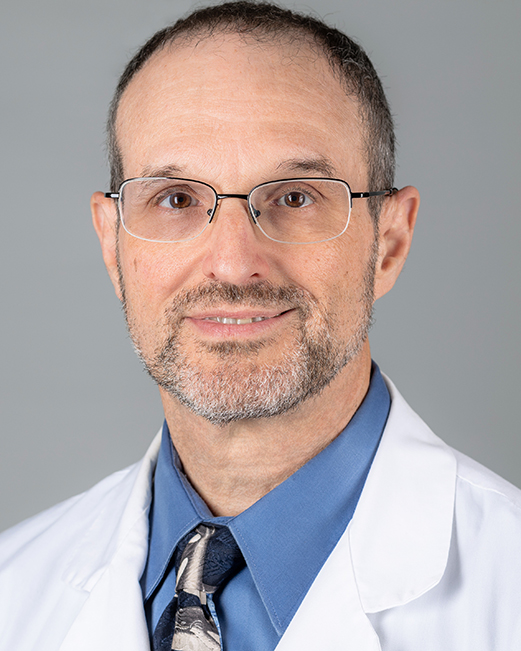
“With this approach, therapy is administered for up to a year after the surgical removal of all known melanoma,” Sondak said. He added that interferon is no longer used for melanoma and adjuvant BRAF-targeted therapy is more widely accepted today for appropriate melanoma patients of all ages.
Before receiving the treatment, Rizzo underwent surgery where more than 45 lymph nodes were removed from the left side of his neck.
“I don’t remember specifics, but I know the surgery was historic,” Rizzo recalled. “My recovery took some time. I couldn’t do much but watch TV and lay on the couch. My neck kept wanting to curl to the left too, but I was able to overcome that. I still don’t have all the feeling, but my cancer is gone.”
‘I Was in Good Hands’
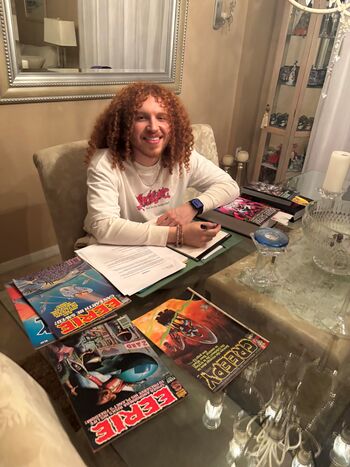
Today, Rizzo is pursuing writing in the graphic novel genre.
Sondak sees Rizzo once a year, and he and his team enjoy seeing their younger patients. Like with Rizzo, the cutaneous team has seen many of their patients grow up. Rizzo says he enjoys reconnecting with his care team, who he’s known for nearly a decade.
“Moffitt made me feel like family from the very beginning and made me feel like I was in good hands,” Rizzo said. “Every time I go back, I get to see my favorite nurses and doctors.”
Today, Rizzo checks in with Moffitt’s cutaneous team once a year, just to ensure that his cancer hasn’t returned. He said he’s healthier now than he’s ever been in his life and is focused on acting, writing and filmmaking. His newest project is writing a series of graphic novels. He just needs to find the right artist.
Hitting Home Again
In 2024, Rizzo’s relationship with Moffitt shifted. When his mother was diagnosed with stage 2 cervical cancer, he found himself in the role of caretaker and driver. But today, all traces of her cancer are also gone.
“Cancer is scary, but I would tell someone just diagnosed to remember that you are more than your sickness,” he said. “Obviously, you have been through tough days and there will probably be more to come, but don’t let it change your soul. Hold onto your laughter, your dreams and your family if you can, because that’s what will keep you strong.”
