

Patient Receives Personalized 3D-Printed Lung Stent
On a typical weekday morning, odds are, 70-year-old Jennifer Josephi is striding away in her water aerobics class. Although an active morning is now part of her regular schedule, that wasn’t always the case.
Josephi has overcome liver cancer and lung cancer, undergoing multiple surgeries and numerous rounds of chemotherapy and radiation treatments. Her most recent cancer diagnosis was neuroendocrine cancer.
Josephi’s neuroendocrine cancer developed in a gland near her lungs. After surgery, there was a leak in her lungs, making it difficult for her to breathe.
“When I took a breath, I could hear it leak,” she said. “I couldn’t hold my breath, and I had trouble getting up the stairs.”
Printing a 3D Stent
Josephi temporarily received a thoracic window, a procedure that creates an opening in the thoracic wall to allow for drainage and prevent infection.
The ideal solution to prevent the leak in her lungs and help improve her breathing involved receiving a lung stent. A lung stent is a device placed in the airway that is shaped like a hollow tube and is typically made of metal or silicone. It helps improve a patient’s airflow and breathing.
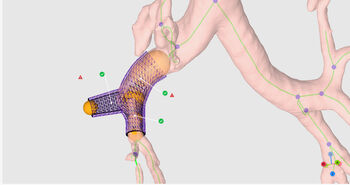
After receiving the patient's CT scan, VisionAir Solutions creates a virtual image of what the personalized 3D stent will look like before making the product. Due to her previous surgeries, Josephi could not receive a regular lung stent. That’s when Eduardo Celis, MD, an interventional pulmonologist at Moffitt Cancer Center specializing in lung procedures within the airways and pleural space, decided that a 3D-printed airway stent was the best solution.
After analyzing the patient’s CT scan, the VisionAir Solutions 3D stents are created based on the patient’s specific airway anatomy.
“To fix where the air was escaping in her lungs, we put in a patch, then we used something called fibrin glue on top to seal it, and on top of that, the personalized stent was inserted,” Celis said.
Back to Aerobics
It has been several months since Josephi received her personalized lung stent.
“I take my aerobics classes weekly,” she said. “I can go up and down the stairs without having to stop and take a break for the first time in a long time.”
Celis says that using a customized 3D stent can be the only option in cases like this one, where patients have scar tissue around their lungs from prior surgeries.
“This stent is not for everybody,” Celis said. “Having a 3D stent is not necessarily better than a standard stent; it is just an excellent alternative for situations like this where the standard stent is not an option.”