Physician-Scientist Explores How AI Can Improve Treatment Decisions
As a kid growing up in Ireland, Ciara Freeman, MD, PhD, was endlessly curious. She loved to read, solve puzzles, reorganize messes and fix things that were broken.
“I asked a lot of ‘why’ questions, not just about how the world worked, but about why people felt the way they did,” she said.
Freeman also loved watching medical dramas like “ER,” where doctors and nurses would rally around patients facing life-threatening emergencies.
“Somewhere in that mix — the science, the problem solving and the human stories — medicine emerged as the place where it all fit: a career where I could use that love of puzzles and systems to help real people on the hardest days of their lives,” she said.
In high school, a work experience program gave her a first glimpse behind the scenes of hospital life. Shadowing health care providers on the wards, she watched how decisions were made and saw how much care and thoughtfulness went into every interaction.
“From that point on, I was hooked,” she said. “I loved science, but I didn’t want to be purely in a lab that felt far away from patients. I wanted to be where the science met the person in front of you. Becoming a physician felt like an extraordinary privilege: to translate complex biology into real decisions at the bedside and to use data and evidence in a way that matters to one human being at a time.”
Freeman earned her medical degree from the National University of Ireland and specialized in hematology at St. Bartholomew’s Hospital in London. She obtained a master’s degree in clinical drug development from Queen Mary University of London (QMUL) and completed a doctorate in immuno-oncology and therapeutics at the Barts Cancer Institute of QMUL. She then pursued a fellowship in lymphoproliferative disorders at the British Columbia Cancer Agency in Vancouver before joining Moffitt Cancer Center’s Department of Blood and Marrow Transplant and Cellular Immunotherapy.
The Joy and the Gaps
Freeman was drawn to oncology by the complexity of cancer, the rapid pace of new discoveries and the chance to offer real hope to patients. She also has her own history of cancer, which shapes how she hears the word “cancer” in the clinic.
“I know what it’s like to get that call with biopsy results and to sit with the fear of the unknown,” she said. “That lived experience makes this work very personal.”
At Moffitt, she specializes in treating people with multiple myeloma, a blood cancer that starts in plasma cells in the bone marrow. Patients with multiple myeloma have many potential treatment options, including chemotherapy, radiation, bone marrow transplant and immunotherapies such as chimeric antigen receptor T-cell (CAR T) therapy. But their journey can span many years and multiple lines of therapy as care teams work to keep the disease under control.
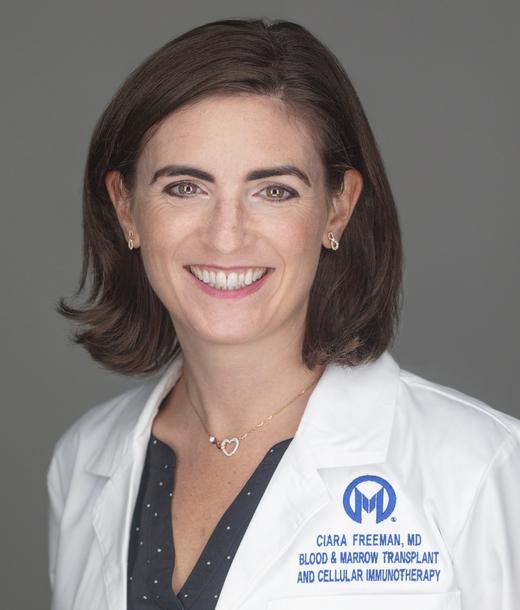
“Over that time, we build intense relationships with patients and their families,” Freeman said. “When treatment works well, you see the joy in the result. But I also see the gaps — where our therapies fall short, who is left behind and where we have to do better.”
Freeman and her colleagues at Moffitt are working to close those gaps and rethink how oncologists approach care for patients with multiple myeloma. They are developing an artificial intelligence (AI) platform that brings together data from electronic health records, imaging, digital pathology, genomics and circulating biomarkers. By applying AI to these large, complex data sets, they hope to uncover patterns that clinicians can use to guide real-time decisions.
“We’re bringing together data that usually lives in silos and turning it into a unified ‘risk engine,’” she explained. “The goal is very practical: to give clinicians usable tools that tell us, before we treat, which patients are at high risk of early treatment failure or severe toxicity with complex therapies such as CAR T, so we can intervene differently rather than realizing it too late.”
Looking to the Future
As one of the top bone marrow transplant and cellular therapy centers in the Southeast, Moffitt is uniquely positioned to lead this kind of AI-driven research.
“Moffitt is both a high-volume cancer center and a data-rich environment,” Freeman noted. “We care for large numbers of myeloma and cellular therapy patients, which gives us depth of experience, and we also have the infrastructure and culture to treat data as a strategic asset for patients, not just a byproduct of care.”
In multiple myeloma and cellular therapy, Freeman envisions AI moving beyond broad risk scores toward individualized “digital twin” models that simulate how a specific patient might respond to different treatment options.
“I think AI will increasingly act as a quiet copilot for oncologists,” she said. “It can help us answer questions like: Is this regimen likely to work for someone with this exact pattern of disease, comorbidities and prior treatments? What is their real-world risk of severe toxicity? Are there trial options they might be a match for that we would otherwise miss? AI can surface patterns, but clinicians and patients will still decide, together, what to do with that information.”
‘The Quiet Engine’
Although her research keeps her immersed in data, Freeman never loses sight of the people behind each data point.
“My deepest connection comes from my patients,” she said. “I look after people through transplant and CAR T, following them for years afterwards. I’ve seen them ring the bell, and I’ve also shared those hard conversations with them when our best treatments stop working. Those relationships are the quiet engine behind everything I do in the research space. Every model, every trial, every grant is about trying to give those same patients a better set of options.”