

Please Stop Calling Thyroid Cancer the ‘Good’ Cancer
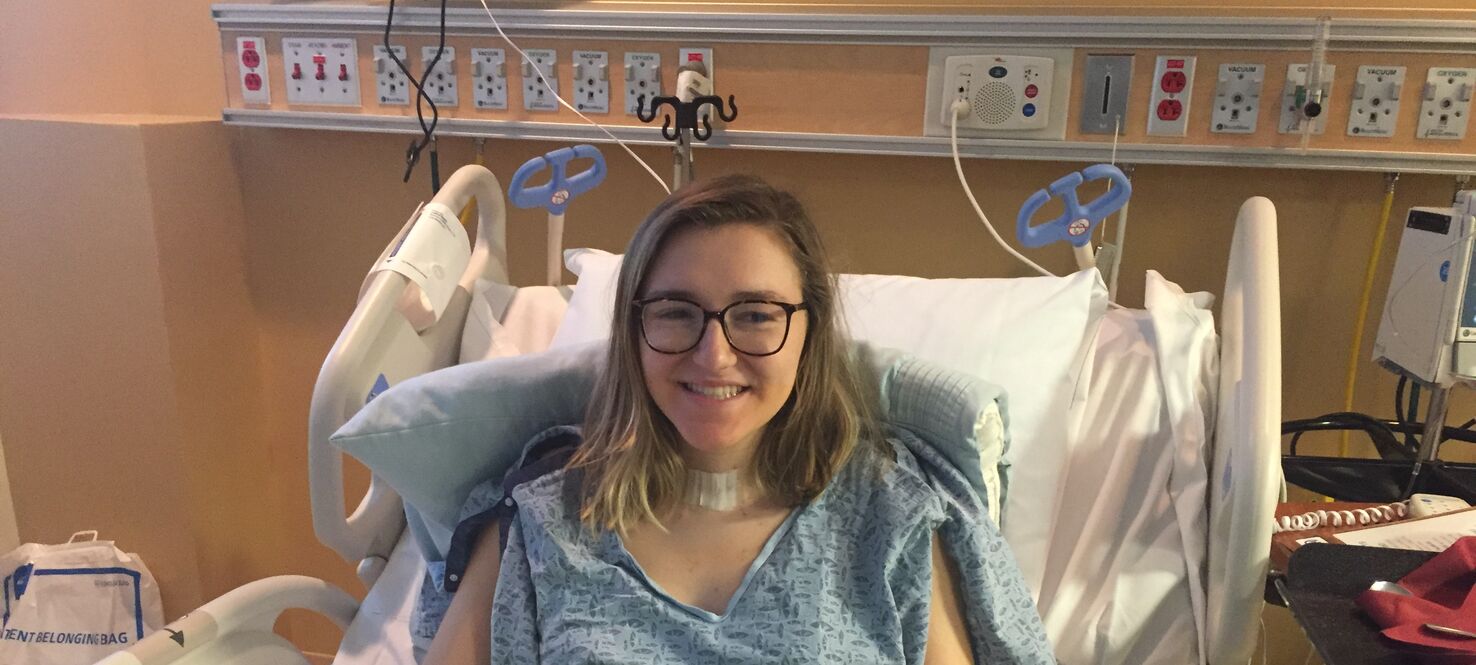
When Emma Stevens learned she had thyroid cancer at 19, she heard the same statements of support repeatedly.
“At least it’s only thyroid cancer.”
“It’s the good cancer, and easy to deal with.”
“These are such weird things to say to me,” said Stevens, now 26. “I know they didn’t have any ill will and they couldn’t see how such statements could be upsetting. It’s been my goal to shed some light on how what they see as encouraging thoughts can upset someone like me.”

Emma Stevens celebrates her bachelor's degree, which she earned while undergoing cancer treatment.
Stevens’ cancer journey began with a routine exam at her general practitioner’s office in 2017, just as she began her sophomore year at the University of Central Florida in Orlando. While feeling along her neck and throat, her doctor noticed something unusual and ordered an ultrasound. The results came back inconclusive, and doctors scheduled more tests.
“No one said the word ‘cancer’ at first,” Stevens recalled. “And I was told to not to jump to any conclusions. I was sent to Moffitt Cancer Center for a closer look and by the time we had the second biopsy, I was pretty convinced that it was thyroid cancer. I kept telling myself that so when I heard the words I wouldn’t be surprised.”
Eventually, Stevens did hear those words, and she was scheduled for a thyroidectomy. She also had seven lymph nodes removed and sent for evaluation, which is standard procedure with a diagnosis like this, according to Stephanie Giparas, a physician assistant in the Head and Neck-Endocrine Oncology Department at Moffitt who is part of Stephens’ care team.
“Most papillary thyroid cancers are cured with surgery alone and other rare treatments can include external beam radiation and chemotherapy,” Giparas said.
The success rate of the treatment is high and many thyroid cancer patients survive and can return to their normal life. However, that doesn’t mean their lives aren’t altered.
“After treatment is complete, patients will require regular follow up with bloodwork and imaging for years to come to ensure the cancer does not return,” Giparas said.
Patients like Stevens who have undergone a thyroidectomy must also take medication that replaces the hormone the thyroid gland produces naturally.
“Taking that is part of my routine now, but it’s something I’ll have to do for the rest of my life,” Stevens said.
In 2019, doctors discovered a malignancy in Stevens’ neck, which required a right side dissection. That surgery was more difficult to come back from she said, but she said she feels lucky.
“The treatment was so straightforward,” Stevens said. “The first surgery was better than the second, meaning the second one was more uncomfortable. I was out of classes for a week after the second surgery and came back with a scar.”
Throughout her treatment, Stevens continued her studies at UCF and is now in grad school at Nova Southeastern University, where she’s in the physician assistant program. She credits the team at Moffitt with not only treating her cancer, but for assisting her in gaining access to the graduate program. Giparas, she said, helped her with her acceptance paperwork into the school.
“Stephanie has been so wonderful, and I even shadowed with her to get into PA school,” Stevens said. “She’s been huge in my treatment journey and in my personal life journey to become the provider I want to be.”
