

Young Woman Holds Onto Joy Through Rare Cancer Diagnosis
Twenty-three-year-old Ainsley Cole says she lives her life with joy, faith and hope — three things she wasn’t going to let cancer take away from her.
Around a year ago, Cole’s stomach started to feel abnormally distended and hard to the touch.
“I vividly remember one night looking at my mom and telling her we needed to go to the hospital and get it checked out because I just knew in my gut that something was wrong,” Cole said.
The abnormal symptoms that she was experiencing turned out to be caused by a rare type of tumor called ependymoma.

Ependymomas typically arise from ependymal cells in the brain or spinal cord. These cells line the ventricles of the brain and the central canal of the spinal cord, playing a vital role in producing and regulating cerebrospinal fluid.
According to Robert Wenham, MD, a gynecologic oncologist and Chair of the Gynecologic Oncology Department at Moffitt Cancer Center, although exceedingly rare, ependymomas have can be found in places such as the uterine broad ligament, base of the spine, chest and ovaries. In Cole’s case, it was found in her ovary.
“In this case, we think it was from a germ cell tumor of the ovary called a teratoma, which can make many different types of tissue,” Wenham explained. “We think the neural tissue there evolved into this rare central nervous system type of tumor in her ovary.”
Only about 2% of adult brain tumors are ependymomas. When it comes to finding this type of tumor in the ovary, Wenham says there have only been a few dozen cases reported.
Shortly after her diagnosis, Cole underwent surgery to remove the large mass at another institution. Due to the rarity of her disease, when she arrived at Moffitt, Wenham worked with additional Moffitt specialists to come up with a specific treatment plan.
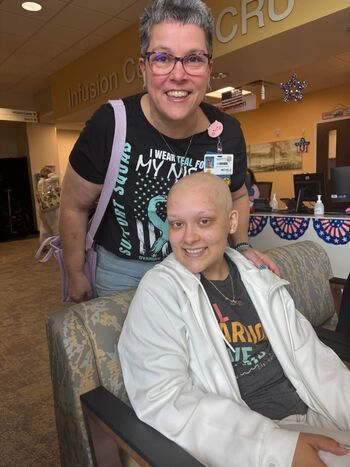
Throughout her cancer journey, Cole says she leaned on her loved ones as her support system, including her aunt, who is a staff member at Moffitt.
“She had some residual disease involving the surface of her organs, including the colon and pelvis,” Wenham said. “Because it was not isolated in one area, further surgery for her could mean losing the bowel with a possible colostomy and her remaining gynecologic organs, resulting in infertility. We all came to a consensus that the best plan was to give a germ cell tumor chemotherapy regimen, and we have followed this with a hormonal deprivation, or blocking, maintenance.”
Several months into treatment, Cole says she has resumed normal activities. She even participated in her first Miles for Moffitt Race in October with her loved ones by her side.
“I have always kept my faith and find joy in every situation, even the difficult ones,” Cole said. “It was actually my elementary school teacher in fourth grade who would always tell us to find joy in life, and I have never forgotten that.”
Wenham says Cole will continue receiving hormone deprivation treatment and will be monitored for any symptoms, with exams and scans done periodically.