
Norman's Story
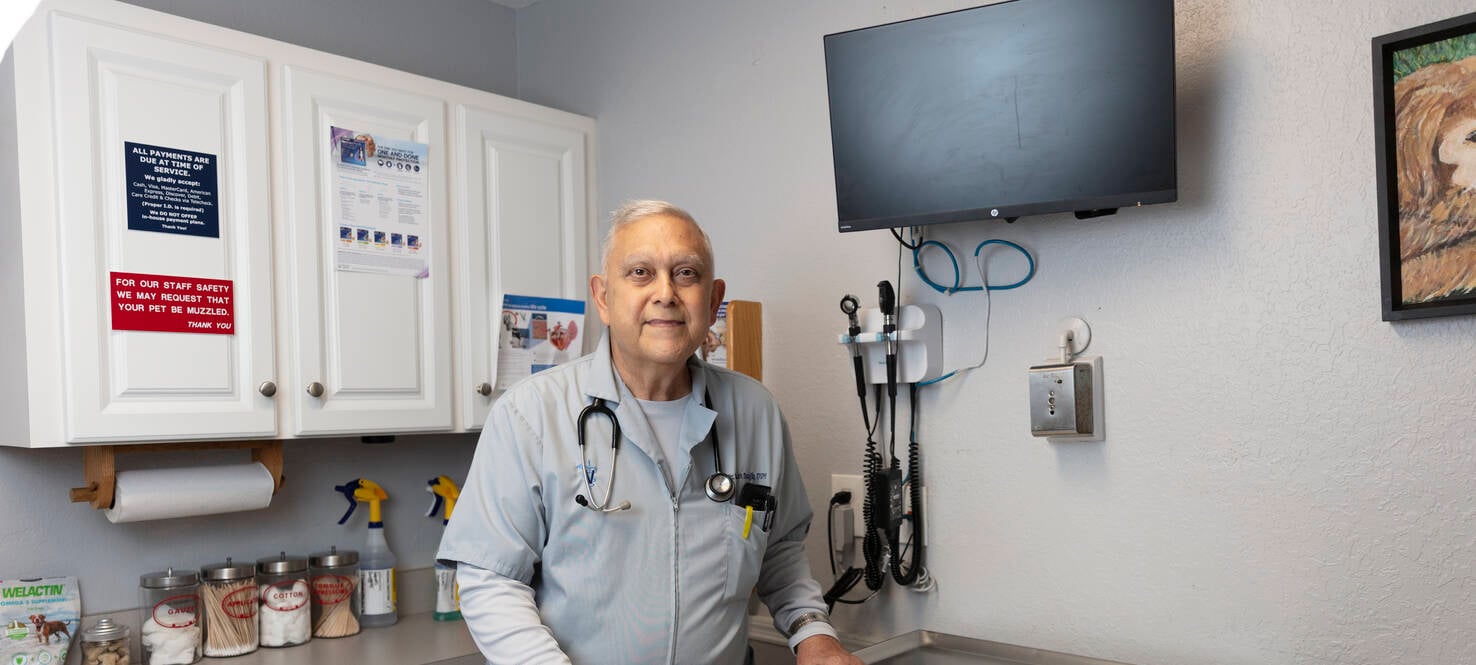
Meet Norman
Metastatic Prostate Cancer | Radiopharmaceutical Clinical Trial Participant
“Each scan, the bone metastases would disappear more and more. When the pain went away after the first treatment, I knew it was working.”
A Journey of strength, science and second chances
For decades, Norman Busciglio built a life defined by movement and purpose. As a veterinarian in Brandon, he rarely missed a day at his animal clinic. His off hours were spent on the tennis court, tending exotic fruit trees, or gathering his family around the table every Sunday.
Even a prostate cancer diagnosis in 2012 couldn’t slow him down. After surgery, radiation and hormonal therapy, he returned to caring for pets and the people who love them. He was grateful for more time, and hopeful the disease was behind him.
But in 2018, everything changed.
When back pain sent him to the doctor, scans revealed that the cancer had returned and had spread to his bones. The image, covered in dark spots, left no room for doubt.
“Looking at the scan, the black dots were everywhere: from the tip of my head to the tip of my toes. I said, ‘Well, it’s over. I am gone,’” Norman said. “I was shocked. I started making all my arrangements to die.”
Hormonal therapy and chemotherapy brought no results. Norman was told he had run out of options.
But he wasn’t ready to stop looking.
Searching for one more chance at treatment
When standard treatments failed, Norman turned to the only place left: research.
Online, he found a clinical trial in Germany testing a new approach called radiopharmaceutical therapy, a way of delivering targeted radiation directly to cancer cells. The idea of spending months overseas wasn’t feasible, but the science stayed with him. He waited, checked again, and kept working at his clinic, treating only small animals to manage his pain and strength.
Then, in July 2019, everything shifted. The same therapy he’d found online became available in the United States.
“It was a long shot,” he said. But he made the call anyway.
What makes radiopharmaceutical therapy different?
Radiopharmaceuticals pair a radioactive isotope with a molecule designed to find and bind to cancer cells. The therapy then delivers radiation inside the tumor, minimizing damage to healthy tissue.
This field, known as theranostics, uses the same mechanism for both diagnosis and treatment:
- Diagnostic imaging shows whether a tumor has the right receptors for the therapy.
- Targeted treatment then delivers radiation directly to the cancer.
- Follow-up imaging can show in real time whether the therapy is working.
For patients like Norman, this approach opens new doors when other treatments stop working.
“Part of the beauty of some therapeutic radiopharmaceuticals is that you can also image where the drug went,” said Ghassan El-Haddad, MD, interventional radiologist and head of Moffitt’s Radionuclide Therapy Program. “It’s immediate feedback. It really is the most targeted and personalized type of treatment.”
Comprehensive Radiopharmaceutical Therapy Center of Excellence
This recognition by the Society of Nuclear Medicine and Molecular Imaging assures patients and their families that rigorous procedures are followed, leading to appropriate patient selection and the best outcomes.
Hope returns with clinical trial at Moffitt
Later in 2019, Norman found the therapy he had been waiting for: a study testing 177-Lu-PSMA-617, which would eventually become known as Pluvicto. He received his first two treatments at Tulane University before transferring his care to Moffitt, where Dr. El-Haddad was leading the cancer center’s arm of the trial.
“Each scan, the bone metastases would disappear more and more,” Norman said. “When the pain went away after the first treatment, I knew it was working.”
Unlike chemotherapy, this treatment came with few side effects — mostly dry mouth and some neuropathy.
Norman completed six cycles of radiopharmaceutical therapy. Since then, his cancer has remained stable, and his prostate-specific antigen stayed undetectable for six years.
“I am on top of the world now. I don’t know how much time I have left, but I am going to enjoy it,” he said.
Living fully and gratefully after cancer treatment
Today, at 73, Norman still begins every morning at the gym at 5 a.m. He continues to work part-time at the veterinary clinic where he started nearly half a century ago. He and his wife recently celebrated 51 years of marriage and have made several trips to Europe. And every Sunday, his daughters and grandchildren still gather around his table.
If the disease returns someday, his doctors have already discussed another radiopharmaceutical option he may be able to try.
Norman keeps his message simple:
“There is always hope. Never give up,” he said. “I was lucky to get this treatment, and I am still lucky to be here.”
Advancing radiopharmaceutical therapy for patients everywhere
Moffitt has become a national leader in developing and refining radiopharmaceutical therapies. The cancer center played key roles in pivotal trials that led to the approvals of Lutathera and Pluvicto, and researchers are now exploring new radiopharmaceuticals for:
- Small-cell lung cancer
- Brain cancers
- Gastric and breast cancers
- Kidney cancers
- Uveal melanoma using Actinium-225, an alpha-emitter that delivers high-energy, short-range treatment
Moffitt experts including scientists like David Morse, PhD, and clinicians like Nikhil Khushalani, MD continue to push the field forward, developing first-in-human therapies and expanding clinical trial access.
Dr. El-Haddad hopes that Moffitt’s new Speros campus will accelerate this progress by providing the space and technology needed to produce new isotopes and expand radiopharmaceutical research.
“We want to become a hub for radiopharmaceuticals,” he said. “We want to continue doing what we did with the Actinium-225 uveal melanoma-targeting agent with other compounds in-house at Speros.”
A future built on innovation and patients like Norman
Norman often reflects on what his doctor told him back in 2012:
“Even after my original diagnosis in 2012, my doctor said, ‘Norm, you have a very nasty tumor. You may live 10 years.’”
More than a decade later, he is still strong, hopeful and surrounded by family.
“They still contact me today, and I update them on how blessed I am,” he said. “With new treatments being developed, long life with prostate cancer is possible to obtain.”
His journey shows what can happen when leading-edge research meets a patient unwilling to give up and a cancer center determined to change what’s possible.