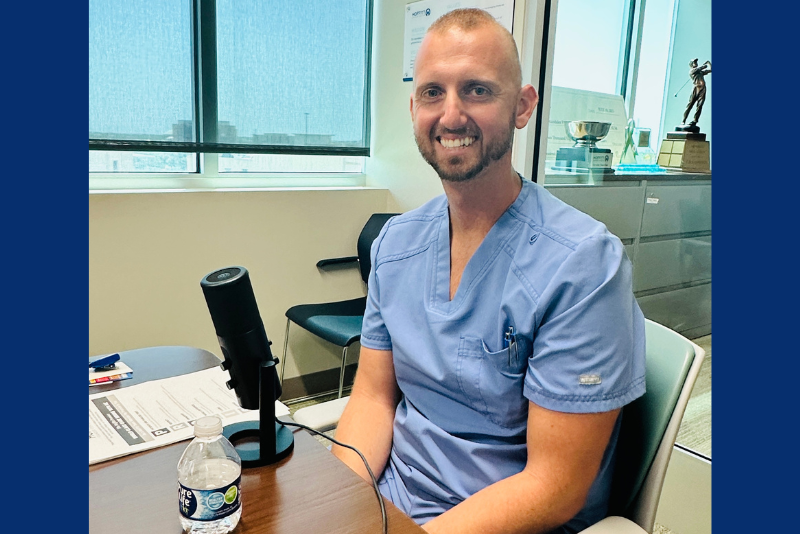
Alexander Dojcinovski: Bringing Hope to Patients
Alexander Dojcinovski is a supervisor in Moffitt Cancer Center's experimental cell therapy department. He was a patient here before he was a team member, having endured a long and arduous treatment regimen for stage 4 Hodgkin’s lymphoma. As he finished his treatment and was thinking of his future, he was so impacted and inspired by the care he received at Moffitt that he knew he wanted to be part of our mission, bringing hope to patients.
As a team member, Alexander values the Moffitt Promise. It reminds him of why we are here, what matters most to our patients, and what we are all fighting for.
Thank you to our Storyteller: Alex Dojcinovski
To our Narrator/Host: Loreen O’Brien
And to our Production Team: Kathi Barden (podcast project leader), Anne Bidelman, Heather Bistesto, Donna DiClementi, Robin Gordon (Patient Advisor), Randy Isaacson (Family Advisor), Loreen O’Brien, Terry Payton, and Cristina Perez
Podcast Transcript
My name is Alexander Dojcinovski. I've been an employee here at Moffitt for five years now.
I work in the experimental cell therapy department. I'm one of the supervisors there. Given my background, I have a big appreciation for kind of what we do. We work on therapeutic drug products under clinical investigation. So it's exciting to be able to kind of have that opportunity to give hope to patients that have, you know, they’re at the end of the line with standard of care options. I find it very rewarding.
So I'm a father of two kids. I got two boys, thirteen and seven. They were my kind of motivation behind everything. The reason why I kind of had to focus on myself and, you know, get better.
So my wife was 40 weeks pregnant, and about two weeks before my diagnosis, I just started feeling sick. Flu like symptoms. You know, I had a fever at night. I was kind of tired throughout the day. Cough. And it just kind of lingered. Um, so finally, my wife got on to me. She's like, we're gonna have this baby any day. I need you to be better. So, alright, I'll go to a walk-in clinic, get some antibiotics or something. So I go to into a walk in clinic, kind of tell them my symptoms, what's going on? They want to do a chest X-ray. So I went out and did the chest x ray.
And then the physician at the walking clinic called me, um, and he said, I need you to go back to the facility that I just got the x ray and do, um, two stat CTs. So I was with my brother on my way to go fishing, so I said, you know, can this wait till tomorrow? You know, can I do it first thing in the morning? I'm at the boat ramp right now. Um, you know, not understanding. I was, you know, 24 years old, kind of the severity of it. And I remember he said, go enjoy. Have a good day of fishing. But promise me first thing in the morning you'll go and get the scans done.
Next day I go to get the, uh, scans. And before I walked from the lobby to the parking lot, the doctor called me. And I remember because I stopped in the middle of the parking lot and my wife was there with me, and he's like, I need you to come in right away.
And, um, I knew it was something serious just by the way he came in. He came in, and he himself was, like, shaky. I remember like, I remember seeing the pamphlet, the paper that he had in his hand was trembling. And then he took his glasses off, too, and he asked about my wife because he hadn't seen her before. And he said, you know, is this is this a friend here for support? And I said, no, this is my wife. She's 40 weeks pregnant. And he said, okay, this is going to be challenging. And then he kind of he told us so the there was a bit a football size mass kind of around my heart that they saw on the X-ray. And then when they got the report from the CT scans, that's when in the doctor's office, that's when he said, I believe you have lymphoma.
I didn't know what to do. I mean, I was broken down trying to keep myself together. Um, I couldn't even turn around and look back at my wife. All I could do is hear her. But I knew if I turned around it would have been over, I wouldn’t be able to talk anymore. And even the doctor himself, he he was in tears and, uh, you know, he looked at me and said, if it was me or my kids, I'd go to Moffitt.
Once I arrived at Moffitt, I met with doctors and they kind of gave me a plan. That was on a Friday. So I had the biopsy done. Saturday, I was very sick. So I come here and spent the morning here, received treatment and started feeling better. I went home and then that evening my wife went into labor. And then my son is born early in the morning. It was it was awesome because it was like a blessing in disguise. And then Monday I came back to Moffitt for my PET scan. Um, and then they told me I shouldn't hold the newborn for at least 24 hours because they had just injected me with radioactive dye.
After the biopsies and PET scans, I was diagnosed with stage four Hodgkin's lymphoma. So initially they call it the quote unquote good cancer because it's, uh, 80% of people are treated with front line therapy. Unfortunately, that wasn't my case. The doctor told me I had primary refractory disease, uh, which meant it was basically aggressive and resistant to chemotherapy.
So when I came in for my first transplant, you know, I got to, uh, to speak to my kids, and it was through a glass, you know, because they're not allowed into the transplant area because we're all, um, you know, Neutropenic and kids are germy. They didn't understand why I was, you know, in the hospital and could only talk to dad through a glass for, you know, three weeks.
Shortly after, the PET scan revealed that the transplant was unsuccessful. So then I switched to another therapy. And that's when the, uh, talk started about the allogeneic transplant and working on donors. Uh, the best, uh, match was my brother. So he was, uh, same blood type. 12 out of 12 HLA match. I don't think there was another person on the planet that could have been better suited for this.
So when I was in for the alo transplant, my, you know, kids would come in and see me and again, I'd go to kind of the nursing area at the, at the intake and they'd be outside and I'd, you know, just kind of hang out and talk with them. At the time, I had the duckbill mask. Um, so my youngest son, um, Austin, just kept pointing to it and calling it a duck. My oldest son actually shaved his head as well. Um, because you wanted to, you know, show support. It was his idea. That was very heartwarming. I remember I cried when I got those pictures. Um, just to, you know, see a little boy, take that thought and run with it on his own. You know, we'd spend some time there.
Nurses would come and go. And I remember one nurse coming, and she kind of came behind me and asked about my family. I told them my kids and she got to see them, and she was very energetic, and she saw how important, you know, they were to me. And so as we were sitting there, she kind of what I thought was went about her day. Um, but then she came back and there was a doctor with her as well, and he said that I could go leave the unit and go into the, uh, there was a little room right there on 3West and spent some time with him there, and that, that just that was a big game changer for me, just being able to step out and just give them, you know, big hugs and hold on to them. Just that thought that the nurse had to even do that like meant the world to me. That action that she did gave me more energy and strength because it was like, I'm in here and they're taking care of me, but they want me to get out of here as well. You know, they see my family here, they see my kids here. They see how important everyone you know is to me. And they recognize, you know, what I'm fighting for and just gave me the opportunity to take five, ten minutes and, you know, give them big hugs, tell them I love them and made a very big difference.
That first six months to a year post-transplant, I was kind of in the recovery, starting to feel much better and trying to get back into the workforce. And I wanted to come work at Moffitt because of what I had been through. I wanted to get involved. I wanted to give back, you know, give hope to patients that are facing, you know, these challenges. From there, I scoured the Moffitt job board and I saw cell therapies, and it was really what I was interested in. And my education had kind of fit. So I had applied and interviewed. And, you know, they took me on. And since then, I've kind of had the opportunity to work on cutting edge and upcoming treatments for patients. And I love it. I tried to take that motivation and my story like to my team as well. I've been on the front side of it. So now being on the on the back end, it kind of gave a very different perspective. I think that's very important, and it puts me in a unique position to be able to relate and provide insight at a different level.
The way I mean, I inspire my team, I think the most is, um, communicating and letting them know that we may not see the patients on the day to day, but we impact them every day, whether we're in the clean room or in the lab, we're creating drug products that are going to be infused in the patients. Um, some of the studies that we work on, my team goes to the OR, collects the tumor, you know, from the surgeon, brings it back to our lab. We go through our process and create a drug product, and then members of our team go back and infuse this product. You know, we don't know their individual situations, but when you're waiting for a drug product to be, you know, manufactured for you, I know that that patient is very hopeful that this product is going to help them eliminate their disease burden, hopefully eradicate it, and so they can move on with life with their families and get back to what's important.
So walking into Moffitt, it was very, very different, uh, because I was 24 at the time. And, you know, when you walk through the doors of this big building, you don't see too many people in their 20s. Um, it's, uh, you know, mostly older folks that are here. I felt slightly isolated because I didn't have, um, many people, you know, of my age to relate to or or kind of see what they're going through, what their emotional state was. Um, so it was it was challenging.
I found out about the AYA program, the adolescent and young adult, uh, program here at Moffitt when I came on as an employee, I was at a generation and meeting, and I was sitting at the table with Amber Skinner, who was, um, one of the leaders of the AYA program. And we just kind of got to talking and, you know, shared a little bit about myself. And so she kind of gave me some information and contacts. And I attended the meetings. And shortly after that, we came on board the AYA program as a patient ambassador. You know, I find that really rewarding as well, because it takes that that feeling of isolation that I had. I have now the opportunity to provide feedback on how we can, um, improve that for, for future patients. How can we make AYA demographic more comfortable in Moffitt Cancer Center?
My health now is good. I am coming up on six years post-transplant in September, so I am in complete remission and everything is going great. I have the energy to keep up with my kids, so that's, uh, that's what's important to me. My kids were my biggest motivation, um, behind, you know, my mentality going into everything. I knew that I had to be strong for them because I needed to come out of this in good health so I could be there five, ten, 15, 20 years down the road. I didn't want to miss out on any of that.
The Moffitt Promise is very important to me, and I have it printed here. I have it laminated hanging up at my desk because, you know, when you look at it, it's just that quick, daily reminder of what we're here for, what we came here to do. And it just kind of gives motivation behind the mission, which is to contribute to the prevention and cure of cancer. And that's the important part of what we do from the day to day. That's every decision we make feeds into into the mission in some form or fashion. And I think it's just an important daily reminder that through the day to day grind, it's it's bigger than ourselves. And we have to we have to put as a team all egos aside and, and approach this, you know, with care, compassion, ownership, you know, all of the components of the promise so we can be successful.
Music from #Uppbeat (free for Creators!):
https://uppbeat.io/t/ben-johnson/woke-me-at-the-break-of-day
License code: WKFESBO1FPM56MTF
https://uppbeat.io/t/simon-folwar/a-creative-mind
License code: SJCJLQ3DXCOG5VZX
https://uppbeat.io/t/simon-folwar/the-lonely-mountain
License code: EJ84HFB2GSFIWVG5
https://uppbeat.io/t/monument-music/love-story
License code: CHVGA6WOIGFIPCO1
https://uppbeat.io/t/dan-barton/in-wonderland
License code: MPY8WSLQHN7LMEYB