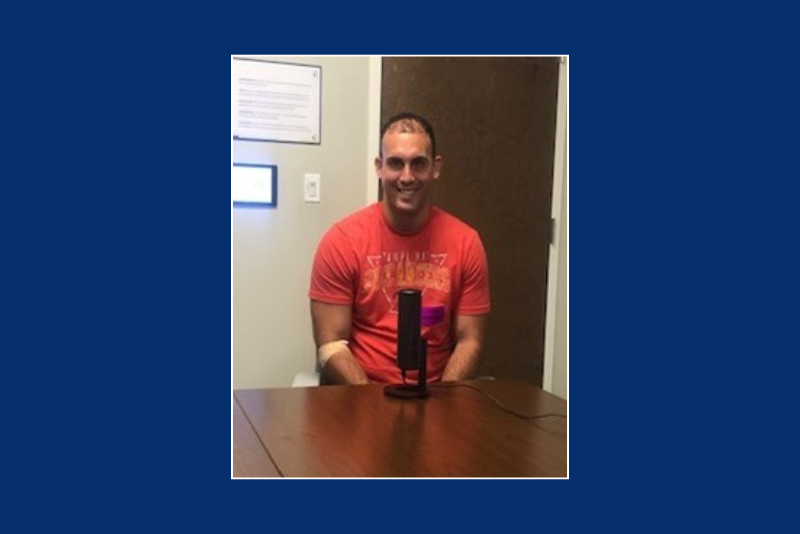
Joel Gonzalez: The Support at Moffitt Was a Gamechanger
Joel passionately underscores the importance of learning about and referring patients to the available resources that can profoundly benefit them, just as they did for him. Joel's story is a powerful reminder that when we come together as a team to provide the right support tailored to each patient's specific needs, it can be life-sustaining. In Joel's own words, it was a gamechanger!
Listen closely and take Joel's experience to heart, ensuring that every patient receives the support they need to thrive.
For more stories, search for "Pep Talks with Moffitt" wherever you get your podcasts, or tune in and subscribe via our show page.
Podcast Transcript
My name is Joel Santos Gonzalez. Um, I'm 34. I was born in Puerto Rico, but I've really lived in Florida my whole life. So at this point, I guess I consider myself kind of more Floridian than anything.
When I was diagnosed, I was 28. I was a teacher. To me, I felt like I was in prime shape. I started having a strong cough. So I went to our local clinic. So they just say, oh, we'll do an x ray. Then the scary moment of them all is I come back for the x ray and she's like, yeah, it looks kind of irregular. We're going to send you for a CT. So I do the CT. They call me in for the results. And that was a rough day for sure, because they had my wife come in there with me where they're basically like, yeah, we think that what we see on that CT scan is possibly a tumor. And we're going to refer you to Moffitt Cancer Center to get it checked out further.
What really stands out from that day is I remember my, uh, wife was crying. The two kids were crying. Annabella and Julian. They're young and they don't really know what anything is. They just know that it's a serious thing.
The first time I went to Moffitt, I met the nurse who was for Doctor Chervenick, who retired. So I had him as my first doctor, his nurse Becky. Very first visit. Extremely happy, extremely smiley. It was immediately reassuring, like I felt good about being at Moffitt. So that was a good start. And Doctor Chervenick was extremely kind. Very patient. Becky was always very funny and personable and all that, so we enjoyed that. I didn't know it then, but I would be dealing with this for like four years.
So I was in infusion and it was one of those signs. So people that think that those signs aren't read, I promise you we get bored. We read those signs. So as, uh, an AYA holiday party sign and I said, let me go check this out.
I was starting to get kind of depressed. I was about three months into the treatment. So like the initial adrenaline, the sort of like, yeah, we'll do this had, like, worn off. So now it was like just very real of like, this is my life. Like I'm doing these treatments. I don't know how it's all going to go. I'm not really in the same boat as my age group anymore. Like I'm not just the young teacher going to happy hour with the buddies and being like, no big deal. Did I have people I could relate to now? Um, I'm dealing with this crazy life or death thing that they don't know anything about.
Adolescents and young adults. AYA.
It is 18 to 39 year olds dealing with cancer at some level, whether survivor or in treatment, that middle age is kind of a lost area. Sometimes, like some people don't even really know it's there, you know, don't even realize that those people like you think cancer is either elderly or babies, or it's toddlers and they get it and they go on with their lives. You don't really think of this population of working young adults or college kids or whatever that are getting cancer. So it made a difference there. Then they find your resources. They help you navigate health insurance, help you navigate jobs, they help you know your rights for sick leave and all these kind of things. You're right in the thick of it. You're right at a point where people usually are building their lives.
It's kind of a national thing that and we have a section here that we're really pleased with. Amber Skinner does just such great work with it and has created such an awesome program. Some of the best friends I have, I've met through it. AYA - I jokingly call it AA for cancer or something. You know, there's like a certain partnership or a cohort or a companionship to it that you really don't get anywhere else.
So like it was December, I was bummed out. I went to the party. I met my friend John, who's a testicular cancer survivor. John relayed to me his treatment. Right. So his was like chemo every single day for like 2 to 3 months. Something about just knowing this guy in front of me has done the same thing and he's fine. Like he's doing well. He's happy he got through it. Like, if he can get in there repeatedly day after day, you could get in there. So the next day it just it changed the game. Like when I went to go get chemo that day, I felt just significantly less anxious, less afraid. And uh, it made a big difference. So that was the first one. And then from there I was just hooked, I guess, like I started going to every event they had and meeting more people and getting more friends out of it. And, uh, we just really have supported each other a lot.
Families first came later actually to the game, but was a game changer for sure. And a lot of it is just fun. They put together really cool activities for your kids.
Uh, there's a part of you that feels guilty with kids. Even though you didn't do anything. There's a part of you that feels like you're messing up your kids lives by having cancer. Like there's a part of you that's like, you know, there's things that they're supposed to be doing that I can't right now. Things I hate it, like when it was Covid and they're doing the online school and they hate online school and they're doing it for dad.
And, uh, you know, so when other people, right, like when people like families first, right? They take something as terrible as cancer, that can be something so negative to your kids, and they can make it something fun Where your kids get to do all this special cool stuff that other kids don't do. And part of it is because you know, you're dealing with something, it just spins it.
Like my kids just did the whole Camp Kessim thing, which I heard, um, through Families First. That's a camp. If your parents had cancer, they go for free. They get a weeklong adventure. So I'm thinking, you know, I just see Annabelle, Annabelle loves camp and Annabelle won't stop talking about camp. And it's like, you know what? Then there's some good out of this. Like I do get to give them something back for all the time they, you know, put dad first and all the things they sacrifice that nobody should have to sacrifice when they're nine years old, when they're 12 years old. So that, you know, that's really heartwarming to see people put money towards that, put time towards that, but attention towards that, towards helping your kids when you feel like you can’t.
We asked Joel if he had anything to say directly to our team members.
You have a heart for this. You're here for this because somewhere in you you want to help others.
Don't let the day to day grind take you away from helping others. You can help others anytime, and it could be as simple as referring someone to a family's program. It could be as simple as going to an AYA event. It could be as simple as saying to somebody, how's your family? There's so many ways. Remember the insane power that you have walking in these hallways and being able to talk to patients. You could make a massive difference.