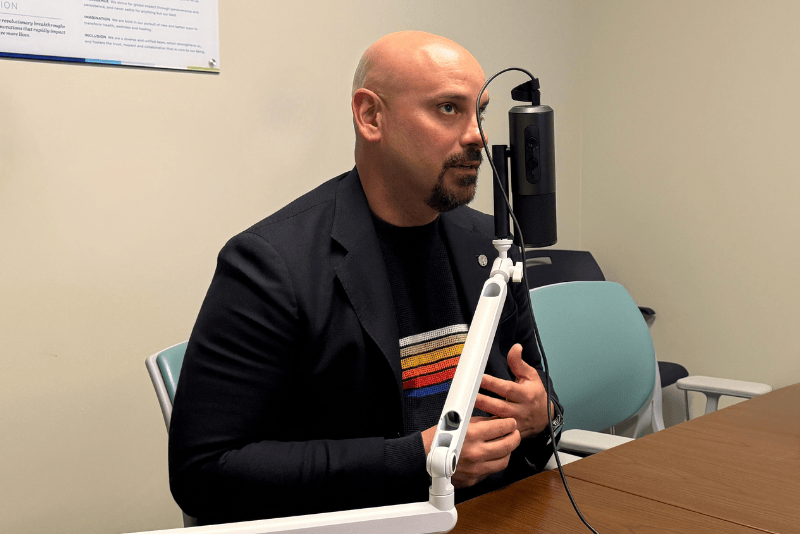
Joshua Rivera: The Power of Resilience and Living the Mission
Joshua Rivera is a sarcoma survivor, Moffitt Cancer Center team member, and passionate advocate for patients everywhere. Joshua shares his incredible journey from diagnosis at age 27 to becoming a leader, mentor, and voice for change. From founding roles in the Adolescent and Young Adult (AYA) program to cycling hundreds of miles for cancer advocacy, Joshua’s story is one of resilience, purpose, and unwavering commitment to the mission of curing cancer. Tune in for a conversation filled with hope, practical wisdom, and a powerful reminder that every role in healthcare matters.
What You'll Learn From Joshua
-
Finding Purpose After Cancer: How Joshua's diagnosis led him to discover his true calling in advocacy and service.
-
The Power of Patient Advisors: Why shared experience and peer-to-peer support matter as much as medical treatment.
-
Building Programs for Young Patients: Joshua’s role in founding the AYA program and shaping patient-family engagement.
-
Cycling for a Cause: How Cure on Wheels connects patients, survivors, and advocates while raising awareness at the state level.
-
Professional Growth at Moffitt: Lessons on mentorship, resilience, and why it’s okay to take an “unorthodox pathway.”
-
Serving All Communities: The importance of addressing language barriers and expanding cancer awareness in Puerto Rico.
-
A Message to Every Team Member: No matter your role, you are essential to Moffitt’s mission of preventing and curing cancer.
For more stories, search for "Pep Talks with Moffitt" wherever you get your podcasts, or tune in and subscribe via our show page.
Podcast Transcript
The Heart of the Story
-
Diagnosed with sarcoma at just 27, Joshua turned his cancer journey into a life of purpose and advocacy.
-
As a survivor, he visits and encourages patients during treatment, offering hope from someone who’s been there.
-
Through Cure on Wheels, Joshua cycles hundreds of miles to raise awareness and support cancer research.
-
He works to expand cancer education in Puerto Rico, making sure Spanish-speaking patients know Moffitt is here for them.
-
Joshua’s story reminds us that cancer does not define you—it can be the beginning of a new purpose.
CRISTINA
Today we have an incredible guest, a great person, a great friend. We have Joshua Rivera, sarcoma survivor, Moffitt team member and Moffitt Advocate. I don't know what it is you don't do Joshua! We're so excited to have you here today. Would you like to introduce yourself?
Yes, it's great to be here on PEP Talks. My name is Joshua Rivera. As Christina stated, I'm a team member, survivor, advocate, lobbyist, fundraiser. That kind of sums it up high level.
You have an incredible story. So much to talk about today, but maybe tell us a little bit about Joshua, what led you to Moffitt?
JOSHUA
I was actually born in Tampa, one of the few people born here, but. Is in Puerto Rico. You know, in modern families are complex and so I have a pretty big family now. And so my stepdad was here in Tampa still and I moved in with him in 2006 to kind of get my life back on track, so to speak. And then a year later, I'm diagnosed with sarcoma. And I didn't know anything about Moffitt, but my dad and he grew up in the Tampa Bay area. He's from Hernando County, and he's like, he immediately said the moment I walked in, you know, with tears in my eyes, I walked into the living room and. He's like. No ifs, ands or buts - you're going to Moffitt. So that's how basically I ended up. I'm off it. And so I had my appointment within days of my diagnosis. Well, I had outpatient surgery first to deal with some of the symptoms I had. And then then I saw Doctor Agresta, Sam Agresta in the Sarcoma Clinic and then about two maybe 3 weeks max after being diagnosed, I had my first chemo here at Moffitt. So that's kind of how it all that's a short story.
CRISTINA
Yeah, you're very young, right, Joshua, how old were you?
JOSHUA
Yeah, I was 27 years old. So yeah, October 19th, 2007. A day that will live in infamy. I like to tell people like I really didn't find myself until like I had cancer. Right. You know, I was kind of meandering. And then after going through beating the cancer, thanks to my wonderful Moffitt providers and team members, I found my purpose. Which is why we're sitting here today.
...after going through beating the cancer, thanks to my wonderful Moffitt providers and team members, I found my purpose.
CRISTINA
I know you did some work with the AYA program you want to. Tell us a little bit about that.
JOSHUA
Yeah, I I was incredibly honored. After I finished my treatment, I moved under Doctor Damon Reed and he was the founder of the adolescent and Young Adult Program here at Moffitt Cancer Center. Incredible Visionary. Incredible clinician. Incredible researcher not much older than I am actually, and actually so somebody who I admired and honestly aspired to be. Maybe not like as a doctor, but just as a person. And so he reached out to me and asked me to be the founding patient advisor, member of the AYA. So I'm technically the founding patient advisor and the very first AYA meeting was at the Columbia in Ybor at one of the meeting rooms that have there on the 2nd floor. I spoke from my heart about how important it was for the adolescent and young adult group to be there for how this was going to change the trajectory not just of their lives of the people in that room, but all of the organization. Right. And like laying the foundation, you know bricks and blocks for what eventually is now, you know an incredible AYA program that we have here and I was still very active with the Patient Family Advisory program at the time. And so I would literally go back to 5 N, which is the where I would did all my impatient chemos. And I would go to every room and talk to patients as they would be willing and sit down with them and talk to them. And that was for me, like, emotionally healing, because when I was going through my treatment, I was very businesslike. I was like, I was very, you know, schedule oriented because I and I didn't deal with the emotional aspects of what was happening to me. It wasn't till I became a patient advisor that I dealt with that. So I would go into these rooms and I would be I would cry with these patients and these caregivers and just kind of they would open up to me sometimes like they would tell me stuff that they wouldn't tell their spouses or their brothers or their parents because I had that shared experience. I literally could tell them I literally had chemotherapy and that same bed that you're in right now, right. And so that legitimacy that the patient advisors provide is incredibly important for the overall journey and the health of the patient right? Because Moffitt does a great job the providers do a great job on the therapeutics and, you know, even social work aspects and others. But nothing like a patient advisor to talk to. In my experience.
I literally could tell them I had chemotherapy and that same bed that you're in right now. And so that legitimacy that the patient advisors provide is incredibly important for the overall journey and the health of the patient...Because Moffitt does a great job, the providers do a great job on the therapeutics and, social work aspects and others. But [in my experience] there's nothing like a patient advisor to talk to.
CRISTINA
Thank you. Is there a particular story? Maybe a patient that you did meet and you felt like that you really made an impact in their life.
JOSHUA
A young patient. So I was working in IT at the time and one of my fellow IT managers reached out to me and said my son has a friend who is on the baseball team with him and he got diagnosed with sarcoma and he's currently really struggling right now, inpatient and like, would you be willing to go talk to him? And I was like, of course, you know, so I went. it was a Monday so I cleared my afternoon off which in IT is very hard to do so but this is very important to me, So and I had never met this individual when I went to the room his mom was there and I spent the next four to five hours chatting with him, chatting with the parents. At some point I was able to have one on ones just with him and he was in a point very similar to where I was at where? OK, The chemotherapy is cumulative and it's just so intense for sarcoma in particular is high anthracycline for those of you not familiar. Basically sarcoma is so aggressive that they throw like the 99th percentile of chemotherapy at you. And so like the highest toxicity drugs that are essentially available, S this patient. Young guy. Very young teen didn't want to continue. He's like I I'm done. I don't want to do this anymore. And we had, you know, spent these four or five hours together. And I go home and then the next day I get a text from his mom and she says he's decided to continue his treatment. Thanks to the conversation that we had.And. And then now you know, Fast forward. It's been probably six or seven years since then and now this person has graduated college. He was honored at the Tampa Bay Rays game and he's living his best life, you know.
CRISTINA
That's incredible, Josh. Tell us a little bit about Cure on Wheels. That crazy ride you do have to Tallahassee. What is it like 4 days, 300 plus miles? Tell us a little bit about kind of how how you got involved in that.
JOSHUA
Yeah, it all started again. Richard Spade close personal friend two time bone marrow transplant survivor. We were both PFACt members, Patient Family Advisory Council members at the time. This is in 2010 and Richard reached out to me. He's like, hey, my volunteer coordinator quit for this organization that I run, called Cure on Wheels. Can you help me with the this event we're gonna host. And so it was a one day event up in Flatwoods Park. So I jumped in, you know head first and helped organize this mega event with over like it was like 200 riders and it was crazy, crazy about and never I didn't even own a bike, which is hilarious and so. And they came up with this two day this this multi day ride to celebrate Moffitt Day in Tallahassee. So, Moffitt Day is the day that Moffitt is allowed to lobby the state legislature for specific items that Moffitt needs. So the thought behind the capital ride, which is the event, is that we leave a few days before Moffitt Day and we arrive the morning of Moffitt Day to kick off, you know, with fanfare the legislative efforts and lobbying that we're going to be doing as an organization. Again, Cure on Wheels is a separate organization, a separate 501c-3, but in partnership with government relations and other entities within this within Moffitt. Never having cycled before, and so in 2012 I did the capital ride for the first time it was by far, at that point in time, the biggest achievement of my life outside of like surviving cancer. And so, and that's how I started in 2012. And then just you know, things progressed from there. It's just been amazing. It's been a huge part of my personal journey.
....in 2012 I did the capital ride for the first time it was by far, at that point in time, the biggest achievement of my life outside of like surviving cancer.
CRISTINA
How many 14 years at Moffitt am I right?
JOSHUA
14 in May at Moffitt Cancer Center, in many different roles, right. I remember revenue cycle, IT, you brought phreesia here, right? online registration to Moffitt. And now in pathology- Director of Pathology.
CRISTINA
You've moved up the ranks, you know fairly quickly. What do you think? That's that's due to.
JOSHUA
Being open to new experiences, honestly. And not being afraid to fail. I already faced death-literally faced death like. For those of you listening Ewings Sarcoma at the time had a 15% chance for survival rate like 1/5 and I beat those odds so everything else is cake after that.
CRISTINA
Any mentors or people that have influenced you along the?
JOSHUAN
Way, yeah, for sure. Yvette Tremonti. She was the head of HR at the time. And I met Yvette when she was a PFAC member and even from afar, like seeing her trajectory, this is another thing. Talking about like professional growth like. Don't be afraid to move like I used to report to the CFO through the CFO. Then I reported through the CIO and I report to the COO, right. And that's like an unorthodox trajectory, but who had a similar trajectory, Yvette did. And then another personal mentor - Joanna Weiss, who's now our CFO. She was a mentor of mine for about three years or so when I was in revenue cycle and then actually I took a leap of faith going to IT.
But Joanna's guidance on that decision making was instrumental on me doing that leap of faith as well. And now I have Christine Alvero, right, because now I'm in operations and I really like operations actually. And Christine Alvaro, you know, I've known her since my days in revenue cycle working with her on things related to finance and revenue cycle for rehab service and she's grown immensely, and she's now the VP of Moffitt McKinley Hospital. And you know, I kind of wanted to see through her eyes like, you know, from an operational standpoint, like, what should I be doing to kind of become maybe the next Christine or move up, which is my ultimate goal. Right. And so don't be afraid to reach out to people who you know don't be afraid to be curious and don't be afraid to follow an unorthodox pathway.
Don't be afraid to reach out to people who you know, don't be afraid to be curious and don't be afraid to follow an unorthodox pathway.
CRISTINA
Great, great advice, right? Great advice for our team members here listening. I know you do a community event with international relations. Tell us a little bit about that and then maybe tell us something that we should consider for our Spanish speaking patients.
JOSHUA
We've been doing events in Puerto Rico twice a year since 2011, and I've been the emcee of that event, working alongside Martha Sanz, our wonderful manager of International relations, close personal friend of mine, Lizette Toro - also, my close personal friend and and the international teams at large. Working on twice a year, we bring down a physician to basically it's a public education event, but it's also not just cancer awareness and education, but also Moffitt publicity, right? So like this is Moffitt. This is who we are. We're the closest NCI comprehensive Cancer Center geographically to the island and we see we're a tertiary care Cancer Center, so there's great physicians in Puerto Rico. There's great medicine in Puerto Rico, but there's not a lot of specialty medicine. So there's no sarcoma specialist down there as an example. So like if you have a rare cancer or if you have a not so rare cancer but it's, you know, Stage 3, stage 4. Maybe your best chances and your best odds are coming to our office like we have Spanish native speakers who can go down there and speak to the audience in Spanish and that has drastically improved not just the communication but the overall event and success of it. That right, just having that, it's absolutely incredible. And for our Spanish speaking like we need to remember and remind ourselves that you know this, our Spanish speakers are huge portion of the American population, but also a huge portion of like the population in general and we should not be dismissing the health disparities that exist as a result of the language barrier. And so it's essential for us. As the NCI Comprehensive Cancer Center, as a you know, a stalwart in the Community to ensure that that we are serving the needs of the entire Community, not just those who speak English.
CRISTINA
What's one thing you'd like Moffitt team members to know?
JOSHUA
That you your role, whatever your role is, is equally as important as the surgeon’s role or as the Med Onc’s role or the nurses role or the APP's role. It doesn't matter what position you you have at Moffitt you are contributing to the mission. You're essential to the mission because we couldn't do it without all the team members. So when and when you come into work every day, be it remotely or physically, here on a campus, a campus, because we have, like I said, many campuses now - that you are contributing to the prevention and cure of cancer and that you should be super proud of that. And so when I always encourage and still to this day encourage my team members to make sure that you stay in touch with the mission. Make sure that you listen to PEP Talks. Make sure that you take a look at the Momentum magazine. Make sure that you read those flyers or those documents that are published and disseminated throughout the enterprise that highlight the patients journey and the patient story because that's why we're here. We're not here for a paycheck. If you're here, it's because you should believe in the mission because you are part of the mission.
It doesn't matter what position you you have at Moffitt you are contributing to the mission. You're essential to the mission because we couldn't do it without all the team members.