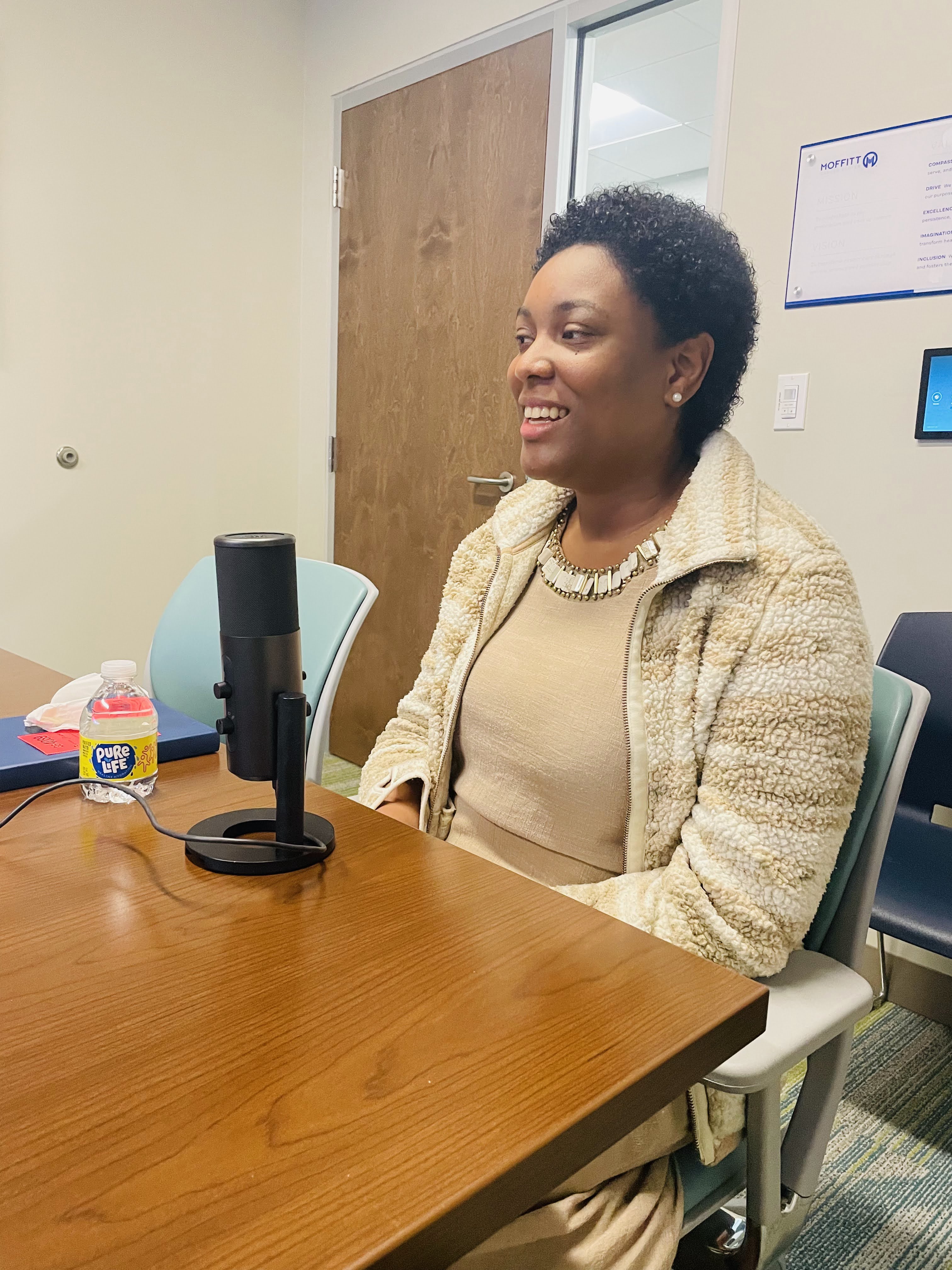
Kerrijo Ellis: What Matters Most
Navigating cancer is never easy—especially without the right information and support. When Kerrijo first came to Moffitt, her care team immediately recognized her deep need for knowledge. Just as importantly, they understood that her family needed to be part of the journey too.
Moffitt's patient-and-family-centered care ensures that both patients and their loved ones receive timely, accurate information and are invited to actively participate in care and decision-making. Because healing is stronger when no one walks the path alone.
What You'll Learn From Kerrijo
-
How Kerrijo’s cancer journey began with misdiagnoses and uncertainty, and the powerful moment she received her diagnosis — alone.
-
The impact of compassionate communication from Dr. Saeed and the staff, and how Moffit's team made space for her family to be informed and involved.
-
Kerrijo's advice to healthcare providers: empathy, small conversations, and treating people like family matter deeply.
- The impact of a compassionate physician who finally listened and took action, and why empathy and inclusion make all the difference for patients.
The Heart of the Story
-
Small acts—like asking if a caregiver has questions—can leave a lifelong impact.
-
Moffitt’s family-centered approach transforms the cancer experience by keeping support systems informed and involved.
-
Clear communication, empathy, and proactive education build trust and reduce fear.
-
The lasting power of including caregivers in care—because “they don’t have cancer, but they have cancer.”
For more stories, search for "Pep Talks with Moffitt" wherever you get your podcasts, or tune in and subscribe via our show page.
Podcast Transcript
LOREEN
Welcome to Pep talks, a Patient Experience podcast where we share stories of Promise - our culture of connection and care.
Navigating through cancer without information or education is tough. It's even tougher when your support team is not included. When Kerrijo first came to Moffitt, her treatment team instinctively recognized her need for knowledge, and it was very important that her family also be included in her treatment and care.
Our patient and family centered care at Moffitt ensures that both the patients and their families receive timely and accurate information, inviting them to participate in the care and decision making. What a big difference this made in Kerrijo’s journey with cancer.
KERRIJO
My name is Kerrijo Ellis. I am a sister, a niece, an aunt and a daughter. I am a full time PhD student at the University of South Florida, so I think my stress level really, really went up. So, when I started seeing signs. I figured it was stress.
LOREEN
Over several months, Kerrijo had a challenging journey of hospital visits with testing and misdiagnosis and was still uncertain what was happening to her. She finally ended up at an ER, where they ran the correct test and gave her a diagnosis.
KERRIJO
I went to the emergency room, and I had a black woman doctor. I'm going to specify that because she heard the concerns that I had and she started putting IV's in and everything and rushed a CT scan. And when they did the CT scan, I lit up like a Christmas tree. There were tumors all over and she came in and she spoke with me. She sat on the bed, and she was like, we have to send you to the hospital right now. We think it's either leukemia or lymphoma and I was like, what is that? Cause I have no experience. No one in my family has had cancer. I've never heard those words before. And she was like, it's cancer. And she took me to the hospital that was linked to this emergency room.
They put me in the ambulance. That was my first time going through that whole experience and they took me to the hospital, and they took me to the floor that was the oncology floor. So, I started like putting two and two together, maybe trying to figure out, you know? OK, that's what is going on. And about two days into my stay at the hospital they came back and took a lymph node that was in my neck because my neck was swollen, but I just thought it was just something that was just happening to my body. I don't know. And when they tested, it said that I was at Stage 3 of non-Hodgkin’s lymphoma.
They told me that I had cancer alone. I had none of my family with me. No one was around and they told me that by myself. At the time when I was diagnosed, I was 28 years old, a month and a half shy of my birthday. So, I'm 29 years old now. And that that was a really, really, really, really painful day for me and figuring out how to let my family know.
Immediately when I shared it with other people, Moffitt was the first name that came up, The first name. Every single person that I spoke to, they were like, you have to go to Moffitt. You have to go to Moffitt. You have to go to Moffitt.
I came to Moffitt in January of 2022. So, on that first day, my mom and my brother came with me to my appointment. So, I went up to the front and the woman that was there I shared with her. I was like, hey, you know, I know that Moffitt now has a policy where only one person can be in the room with you. But my brother is here with me as well. Is it possible that he could come in or whatever? He wants to hear too as well. And she's like, we'll set him up with an iPad and whenever you get into your meeting, he'll just join you there through the iPad. And so, my brother was moved to a separate room. He had headphones so that none of the information that was confidential would be heard by the rest of the people in the lobby area.
I went in, you know, did the preliminary checks and everything. Sat in the room and then the nurse came in and she explained the process of how our first initial meeting would go. And then she shared that Doctor Saeed will come in and then I'll come back and then, you know, we'll go from there.
When Doctor Saeed came in, he sat down in his chair, and he got as close as he possibly could to us. And he just sat there and kind of just explained everything.
Now I was in the hospital for three weeks. I didn't know where the cancer was located. I never saw one scan of my body. Nothing. So, this was the first time that I had seen all of that. So, it was very informative.
After talking to us and everything at the very end, he said to my to my brother and to my mom - Do you have any questions? And I just remember how powerful that was because they mean so much to me. That my mom and brother were there and they were able to ask questions about my condition. And doctor Saeed was actively listening. He was so attentive. And that that was just powerful for me and my mom still talks about it to this day about that very, very first meeting that we had here at Moffitt.
So, after asking my family, my brother, and my mom if they had any questions, he went into the chemo treatment that I would be receiving here. And he told me the name of it and so on. So, he talked about it and then there was paperwork that highlighted these things. And some of the things that stood out to me on that paperwork, the number one thing was fertility. The other one was neuropathy. Hair loss was one. And obviously, knowing cancer, that's one of the things. He told me all of that before giving me the paperwork that has all the information on it for me to sign off on it too as well. So I had a chance to read those over before signing, signing it as well. And after we talked basically, he was like, you know, you'll have your first treatment and so on. And then he told me that his nurse would be coming in with some more information about things.
He also did share, too, which I think is important to note for every chemo treatment that I have, because you have to do blood work before you do chemo and so on. He was like you probably won't see me on those days. But like for the really big scans like the PET scan or a CT scan he said that, you know, you'll see me on those days. I was assured that the team has all my information, and they know everything about me. And so, I'm in good hands. Having that information about the team and to receive all of that information about Moffitt, for me it was really, really, really important.
Cancer is such a… saying the word itself just carries so much load. And when you have the experience or have had the experience of it just being brushed off and you're not hearing information about how you're doing, like even that information was just great to have and to know that you're not like going into this like with a lot of uncertainty. That was an amazing experience. I will say that very, very first initial meeting was night and day compared to what I had in the hospital for three weeks.
I think for Moffitt team members, I think it's important to remember the delicacy of cancer and just treating everyone like they're part of your family. And treating everyone like they, they're close to you and that you're experiencing this devastating disease with them as well. So that's going to require a lot of empathy and a lot of work on the part of the team members. Before a new patient comes in have a reset, take a deep breath and just reset and think, OK, this is somebody else that has cancer, is going through cancer. Ask questions. You know, those things matter. Starting like little mini conversations, getting to that personal is also really important. And so yeah, just remember that that they are people like you, somebody a part of your Moffitt family.
Having family members be involved in the process of the patient's cancer diagnosis is so important. I'll never forget Doctor Saeed speaking to my family like they were the ones that were also diagnosed. So, it's so important to have them be involved in that process because they will, you know, become caregivers and you know the people that are your patients’ support system. And so, they also need to know what's happening, and what’s going on too as well. And so, everyone is involved in my cancer diagnosis. They don't they don't have cancer, but they have cancer, you know.