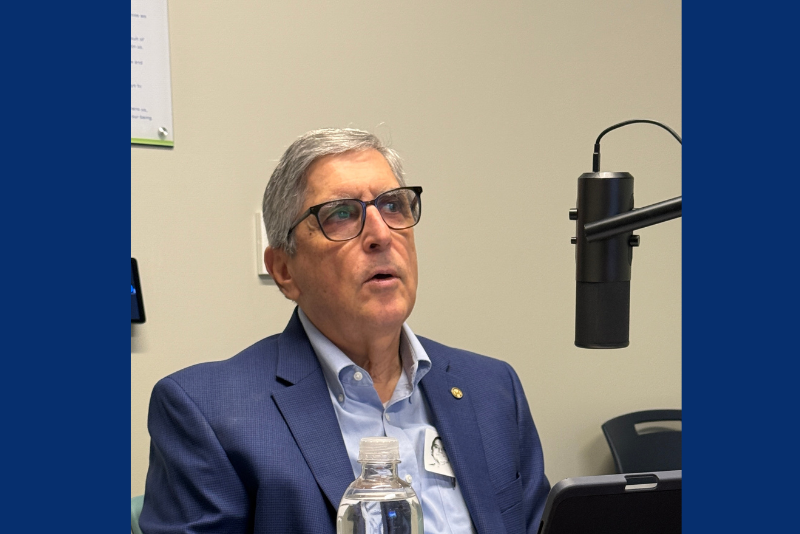
Judge Mark Pizzo: Who Says An Idea Can’t Move Mountains?
We are thrilled to celebrate a truly special milestone—the 20th anniversary of the Patient and Family Advisory Council (PFAC). To mark this occasion, we are honored to welcome a very special guest, Judge Mark Pizzo, one of the original members of PFAC. Judge Pizzo shares his remarkable journey, from his distinguished career in law to his family's profound connection with Moffitt. His invaluable contributions have shaped the culture of Moffitt in countless ways through his dedicated role on PFAC.
Join us for an inspiring PEP Talks episode as we reflect on the past two decades and look forward to the future with gratitude and hope.
For more stories, search for "Pep Talks with Moffitt" wherever you get your podcasts, or tune in and subscribe via our show page.
Podcast Transcript
Welcome to Pep Talks, a patient experience podcast telling stories of connection and care. Each month, we'll introduce you to some of the incredible people at Moffitt Cancer Center and share their amazing efforts that make Moffitt a place of hope and healing.
CRISTINA
Hi, I’m Cristina Perez, Director of Patient Experience at Moffitt Cancer Center.
Today's a special PEP Talks! We're celebrating PFAC’s 20 year anniversary, and we have the privilege of having Mark Pizzo, also known as Judge Pizzo, um, here at the table with us.
So you're a judge for 28 years, you retired?
MARK
I retired. I started my career as a federal defender. I represented bank robbers and drug dealers and even spies. Then I became a federal prosecutor for a short period of time prosecuting drug dealers. And then I became a judge who did both criminal and civil. Because magistrate judges are generalists. We do everything. Might not do it well, but we do everything.
CRISTINA
Tell me a little bit outside of Moffitt - what are some things that you could tell us about you and your family or what do you enjoy doing?
MARK
So I'm a I'm a Tampa boy. I grew up and was raised in Tampa. I'm from that generation of, uh. Tampans whose parents were the immigrants. My father's side of the family came from Sicily. And my mother's side of the family came from Spain. And they met in Ybor city. And, uh, I still remember the immigrant experience, uh, from Ybor City before urban renewal. Grew up, went to Loyola and New Orleans, met my wife there. And we'll be celebrating our 50th wedding anniversary in August.
CRISTINA
Oh that's beautiful. Congratulations. So true Tampa native. Very hard for us to find a true Tampa native.
Mark, would you tell us about you and your family's history at Moffitt?
MARK
So, my father-in-law was diagnosed with, large B-cell lymphoma, and we brought him to Moffitt. Uh, he started CHOP plus rituxan, which was new - relatively new there. But on September 11th, 2002, he developed sepsis and passed away in the SCU. As they were playing taps. September 11th, 2003. Uh, we are at Moffitt, and my wife is starting CHOP plus rituxan. We’re in the same area of the hospital that he was in, and we're wondering whether his fate is our fate. She did well, went into remission. Uh, did maintenance therapy. And then in 2010, she was diagnosed with early breast cancer. lumpectomy, radiation, tamoxifen. then before 2010, my dad was diagnosed with CMML, a myelodysplastic syndrome. And I'm an only child. So, I and he we're regulars at Moffitt. Because if you have a blood cancer, it's likely that you're going to have chronic treatment. And so we were at Moffitt every three weeks and sometimes, uh, even more.
My dad would come here for infusions. This is actually a funny story. Myelodysplastic syndrome. It it it reduces your hemoglobin. Your blood doesn't work as it used to. So his hemoglobin was in the dumpster.
Uh, but he loved to bake, so he would get up in the morning for, you know, 8:30 appointment because I had to go to work. And he would get up. I don't know what time he would get up, but he would get up and make cinnamon buns because he makes really good cinnamon buns, and he'd bring a tray of cinnamon buns to his appointment. And I'm thinking, dad, why are you bringing these? I've got to take these cinnamon buns. I got to make sure you don't fall. I gotta do everything. These damn cinnamon buns are taking over. Why can't we just forget the cinnamon buns? No. I want to bring cinnamon buns. And it was his way of saying to the disease. To hell with you. I'm going to do what I want to do when I want to do it. And you're not going to control my life. It took me a while to figure that out. Uh, but that was his way of saying, okay, disease. I'm not going to pay attention to you today.
In 2017, after my dad had passed, I was diagnosed with prostate cancer, so it was my turn. I joined the cancer club. I say that that there's kind of like a table sometimes that's reserved for you. You know, your turn, your number, your number’s next. Come on in. So my number had been called and I went through 26 rounds of radiation. Happily, I'm in remission. But you know, you always think about what's my next PSA going to be? Nonetheless, I'm doing fine.
So, then Covid came along and, uh, my wife caught Covid. I gave it to her, and then, uh, she started itching. We didn't know what it was. Could be eczema. Could be this. Could be that. Eventually, she was diagnosed with another form of lymphoma. This time a different alphabet, T cell lymphoma. And a very rare form of T cell lymphoma called Sezary syndrome. Imagine the worst itch you've ever had, and it's all over your body. Happily. Uh, she's in remission after immunotherapy. And so Moffitt has essentially saved my wife's life twice, and saved my dad long enough that he could see his great grandchild.
So that is our cancer filled story. It's still going.
CRISTINA
Mark, can you tell us a little bit about how you became part of the Patient and Family Advisory Council or like we call it, PFAC?
So I started with PFAC at it's very beginning. It's one of those things where you have a chance encounter. I've been very lucky in my life. I've had chance encounters, whether it's meeting my wife or starting my first job.
This was a random conversation that I had with, uh, a colleague of mine, the chief bankruptcy judge then at the time, Tom Baynes, who was on the board at Moffitt. And, uh, my mother died of breast cancer in 1981, excuse me, 83. And I wanted to give back. And so I asked him, you know, how did you become board member or how do you go about becoming a board member? And, uh, he explained that to me. He says, I'll put your name in.
And I got a call. And that was 2002. I joined the Moffit Medical Group was called Then Lifetime Screening. Uh, and I got to know Nick Porter, who then was the chief operating officer. And he was kind of like the big city mayor of Moffitt. He knew everybody. He would stand in the hallway or in the lobby of the hospital and greet people. He'd make rounds. And he was. If not the father of PFAC, certainly its greatest patron.
PFAC started after Nancy Newman, who was your predecessor went to a conference, and I suspect it was the Institute of Patient Centered Care. And she came back with an idea of bringing a PFAC to Moffitt. Only one cancer center had started that, and that was Dana-Farber. Uh, and so she brought the idea to Nick. Nick was enthusiastic, and I got invited to be on Patient and Family advisory Council.
When we first started, uh, we had some members on the committee who were larger than life members.
The first chair was, uh, Jack Galloway, who ran Caesar's Palace, ran casinos from Las Vegas to South Africa. Uh, he didn't need to be on the committee. Uh, he was a multiple myeloma survivor in constant treatment, but he wanted to give back. And he, for lack of a better term in the industry, was known as an ass kicker. Not that he brought that mentality to the PFAC, but he couldn't understand, for example, why the infusion times were so delayed. People would have to wait for hours waiting for their infusion, and he was one of them.
There was Howard Keach, who, uh, had been a, I think a chief warrant officer in the Coast Guard and ran an aircraft repair at Vondenberg Airport. Well, Howard was as gruff as they come, and he didn't care how he said it or what he said - he was going to poke somebody in the eye to get his point across. And there were times where administration may not have liked how the message was being presented to them, or what was being said. But to their credit, they took notes, they listened, and they changed behavior. They implemented new policies, and they did the right thing.
I mentioned Jack, there's Howard as well. And I'd be remiss if I didn't mention two others. One of the things that I've learned, and this applies to both Jack and Howard is that the greatest gift that PFAC members give is their time. Particularly those who are in treatment. You become acutely aware of time when you have a cancer diagnosis.
Uh, when I first started on with PFAC, at the introductory meeting, we all sat in the Moffitt boardroom, and we were introducing ourselves. And each person who was introducing themselves as giving their name and what their diagnosis is. And, you know, you hear multiple myeloma, breast cancer, prostate cancer. And the gentleman who was seated to my right, I think his name was Larry Ackerly, said colon cancer. And he said he had just gotten out of hospice. And I thought to myself at the time, I was a caregiver. I thought to myself, Holy Lord, what am I doing here? I'm. I'm a caregiver. I'm not a cancer survivor. I'm not in the foxhole with all these wounded warriors. And now I am. Now, who am I to be in here? What can I give?
And we've had others like that. Uh, John Freeman, who was co-chair with me, who was a pancreatic survivor. And who died while he was serving in that.
Patty Halula, who is a metastatic breast cancer survivor. And when I first met her, and I gave her a hug, I got emotional because it was hugging a sense, not that she was my mother's age, but that she had gone through what my mother could not because my mother did not survive metastatic breast cancer. Back in those days, you know, that survival rate was maybe five years, if you were lucky. So Patty brought a conscience to the committee that was far more intense than any of us brought. Because she was not only in active treatment, she was counting her days knowing that something could change the next day. And she made us aware of that.
And that's the point of PFAC as well. It is to have patients talk to administrators and physicians who know the story, but to hear it in a different setting. It's extremely personal, and it's a comment that can change the way an administrator or a patient does a particular policy or routine or procedure that can make a difference. They can improve the patient experience.
There's one person I didn't mention that I wanted to mention, Bruce Mackey.
Bruce is symbolic of the PFAC dedication. Um, he lost his wife and his wife, uh, to cancer. She was treated at Moffitt and before she passed, she, uh, instructed him. I'll put it that way. Gave him marching orders that he should involve himself at Moffitt. And he lived nearby in a retirement community, and he decided that he would give back. And Bruce had been a successful executive in the insurance industry. He didn't need to come to Moffitt. Uh, he didn't need to volunteer. But what he did was reinvent himself. And he contributed mightily to Moffitt talking to patients, going to coffees, uh, holding hands, being a comfort being Bruce.
So Bruce rightly has an award named after him, and rightly it's named after his wife as well, because she's as much a part of his contribution is he is.
CRISTINA
That’s beautiful, Mark.
So 20 years later. Um, what would you say is, like, your proudest moment of PFAC? Like, what do you think that the PFAC has done that's been really good for Moffitt?
MARK
It's not one thing. It's everything. The greatest effect is a change in Moffitt culture.
Uh, Moffitt was always patient centric. We take that from our founder, H. Lee Moffitt, who started Moffitt based on notion that he lost friends to cancer and he thought he could make a difference. And so this change that PFAC brought was just a reinforcement of its patient centered care, which is nothing more than the Golden rule. Treat others as you want to be treated.
We've done everything. We've done everything from, uh, help design the facilities, whether it's McKinley hospital, whether it's, uh, the main campus of Magnolia. Uh, for example, uh, Ron Giovanelli helped the design, the apheresis clinic. Whether it's the Moffitt, uh, McKinley clinic, uh, whether it's South Shore. We've been involved in all that. Uh, we've been involved in family access to rapid response teams. Special care unit policies, new employee orientations, uh improved uh communication and education for patients. We've done little things. There's one example of making sure that the sandwiches that are provided at the infusion clinic are cut in half, because it's easier for weak infusion patients to grab the sandwich. We've done things like, say, why don't you put a mirror by the scheduling desk so the schedulers can see around the corner, and the patients don't have to wait in line as long. Why don’t you put railings by, you know, the weigh machines so people aren't going to fall. It's little things that patients observe that staff may not because they're too busy doing something else. We've done so many things that are big and so many things that are little and are never noticed.
CRISTINA
Obviously, you've seen so much growth in all of these years at Moffitt, both as a board member, as a PFAC member, as a patient and a caregiver. What do you think is something we have to continue to, to keep at the center of what Moffitt does like as we grow and expand to so many campuses? What would you like to see not change at Moffitt?
MARK
It's actually a complicated question because health care is changing so quickly. We have grown from a hospital. To a system. And it is likely that we're going to be expanding in the future to more than just the locations that we have. Making care more accessible to more people who need it. PFAC itself has a culture. How do you keep that culture? How do you make sure that patients who are on and caregivers who are on the committee understand what their role is? You know, we serve at the pleasure of Moffitt. And so, we have to be wise in how we approach things. Not to overextend our welcome. Uh, to make sure that our voice is heard. And heard in a meaningful way, a constructive way, a way that will change how we do things. Improve patient experience. Improve quality of life. Save lives.
CRISTINA
That’s great advice, Mark. Thank you. So, one last final question mark. 20 years of for lots of time, lots of time here at the cancer center in meetings giving feedback. Has it all been worth it?
MARK
You know, I think about my professional career and my Moffitt career. And if you asked me which one was more important and which one was more. Of a difference. I'd say my Moffitt career.
So, the idea of fact was the idea about changing our culture, or at least inculcating our culture and everything, that we did at Moffitt because we were always patient centric. Uh, but when Nancy Newman and Nick Porter, uh, conspired together to bring PFAC, and the principles of patient centered care to Moffitt, uh, the idea was to move a mountain- to change the culture. And so who says an idea can’t move a mountain?
Thanks so much for tuning in.
Don't miss out on new episodes of Pep Talks dropping every second Friday of the month on all streaming platforms. See you next time.