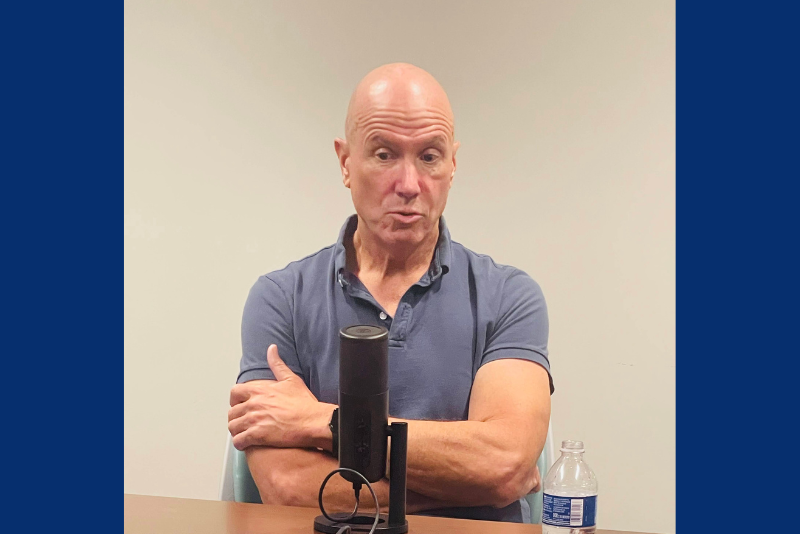
Randy Isaacson: Leukemia was only 162 Days of Our Amazing Life!
Randy Isaacson shares how his wife Lynn’s 162-day journey with Acute Myeloid Leukemia did not define their beautiful 34 years together even though she died of the disease at 55 years old. He tells us how important the nurses were to creating comfort for Lynn and himself during their long stays in the hospital and how he now volunteers in multiple ways at Moffitt, for Lynn.
Thank you to our Storyteller: Randy Isaacson
To our Narrator/Host: Loreen O’Brien
And to our Production Team: Kathi Barden (podcast project leader), Anne Bidelman, Heather Bistesto, Donna DiClementi, Robin Gordon (Patient Advisor), Randy Isaacson (Family Advisor), Loreen O’Brien, Terry Payton, and Cristina Perez
For more stories, search for "Pep Talks with Moffitt" wherever you get your podcasts, or tune in and subscribe via our show page.
Podcast Transcript
So my name is Randy Isaacson. I live in Dunedin and my wife was a patient of Moffitt about four years ago. And our story really starts as we had our physicals in May.
Before we went up north were snowbirds and just starting to kind of get a taste of snowbird life and a taste of more control of your own time. I don't like to necessarily call it semi-retirement, but we had, you know, a lot of control of our own time. We had our physicals and everything went fine. And Lynn, my wife, was just starting to really get more active and take more care in terms of exercise and eating right. And we were preparing for a big family trip to Yosemite National Park. So we were doing a lot of walking three, four miles a day. And Lynn was working hard at that and it was very enjoyable. And but she didn't feel like she was getting it wasn’t getting any easier. So I'd say, well, let's try walking faster. Maybe it's more aerobic exercise will help. And it still was. She just didn't quite feel right.
Well, we went to Yosemite with our two adult kids and their significant others started a hike, and she got about five, ten minutes into it and just had to stop. And this was a trip we'd been looking forward to for almost a year, and she couldn't go any further and had no idea what was going on. Her doctor originally looked into perimenopausal symptoms, and maybe it's something related to her thyroid. And then they did bloodwork and she got a call and said, Get to the emergency room. Your platelets are dangerously low. You could bleed to death. So we hurried to the local community hospital, just like you would if you're going in the emergency room.
A couple of doctors came in and said, we think you have some kind of leukemia. And I had worked in health care a bit and had familiarity in the sense that, well, there are all kinds of leukemia, and we'll just figure out what to do next and how we tackle this. She was admitted and we were there for about ten days. And the doctors said, we've got to get you over to Moffitt.
Fairly quickly after an appointment or two she had had a couple of bone marrow biopsies is that she had acute myeloid leukemia. And step one was you're going to be admitted into the hospital for about 30 to 45 days. Lynn had really, in our adult lives, we'd been together for 34 years and in our adult lives. I think maybe she was overnight when she had a baby, you know. But other than that, hadn't really been in the hospital. So this was going to be a pretty big change.
We were up on, I think it was 4W. And when we came in we had a bag had some clothes. There was a nurse who greeted us and I don't remember her name now, but she's like, Welcome. You're going to be with us for a while. And here, let me show you to your room. This is going to be your home for the next 30 or so days. And it was the thing that felt good it was like, yeah, we do this all the time. This is how it works. This is how you get better.
Lynn started her treatment. And the first course of treatment did not work. And we still were hugely optimistic. She was 54 years old. Fit. Really had no serious health problems. And she started that her second course of treatment right away. She didn’t get discharged from the hospital. And and through all of this, she was pretty comfortable. And and I always kind of would go back to the nurses for me as her. The caregiver doesn't really seem for me as her husband, 34 years, it gave me a good feeling because she was comfortable. When it came to the nursing care. It was one of the points that just really didn't miss. And it was one of the points for me as her partner, care partner. It was one of the points that gave me a lot of comfort, knowing that she was surrounded by really good people to take care of her.
So she had her second course of treatment. And we started to realize, too, that this thing was not going our way. And I think she realized it or confronted it sooner than I did. We didn't really begin a third course of treatment, and we were headed towards a clinical trial that that seemed to fit for her. And she was going to be admitted into the clinical trial on a Monday. And I got a call from her hematology oncologist on Sunday. And she said I don't think she can survive this clinical trial. And you guys need to look into hospice.
We had got a little information before then about hospice, and a real goal for us was to be at home as much as possible. On that Sunday, the nurse from hospice came. They began hospice care. And Lynn said, I'm glad you guys are on board with this. And it's something I think about a lot because she was telling us that she understood what was going on and she was comfortable that this is just the way it goes sometimes. Sometimes, you know, every treatment is not a success.
And it was such an amazing gift. And then that was Sunday. And Lynn died on Tuesday a couple of days later in our bed around noon. And that's just the way it goes sometimes.
I do volunteer work at Moffitt. Sometimes I think it's kind of crazy. Like, why? Why would you go back to this place that was really a major part of the worst part of your life ever. But you know, I come back here for Lynn. And to hope that in some ways it gets better for other people. For me, I love seeing folks who've who've survived their AML. And I get a lot of I just I feel good about that. I didn't quite know that would be my reaction. While this is a place that does miraculous things and a lot of folks survive and carry on, it's also a place where a lot of people go through the most horrible time in their life. And there's things we can do for those folks to. And there's things we can improve for those folks and their families.
Sometimes I feel like I'm in kind of an awkward position. Because ours isn't a success story. And those stories aren't really shouted about, understandably, at a cancer center, but they're very real.
And I guess I would say to the folks who take care of, I don't know if I really like the word patient, but take care of the people who are struggling through cancer and and hoping to beat it. That all they can offer for those folks who may not make it is so appreciated.
An important part of treating cancer is also treating the folks who don't make it and their families.
Lynn was 55 years old when she died. 55 years. She and I were together for 34 years. We met in college and leukemia was only 162 days of this amazing life. And so we couldn't let that somehow overshadow everything else.
That's one of the major reasons that I’ve stayed involved as a volunteer at Moffitt. You know, the people that took such good care of her that she she felt she was well cared for.
And for me, that was what was most important.
Music from #Uppbeat (free for Creators!):
https://uppbeat.io/t/ben-johnson/woke-me-at-the-break-of-day
License code: WKFESBO1FPM56MTF
https://uppbeat.io/t/brock-hewitt-stories-in-sound/living-waters
License code: DD0G5NOJGWIZGNJ2
https://uppbeat.io/t/aylex/lost-in-time
License code: Y0Z7ZH72HBR36MI3
https://uppbeat.io/t/brock-hewitt-stories-in-sound/in-the-silence
License code: ZRDSWQX0Q8O8A6NZ
https://uppbeat.io/t/sonda/without-you
License code: AHTRH0VRHQF6ORGF
https://uppbeat.io/t/albert-behar/tender-beloved
License code: 5VUA18TPGSFQYCBY