From Family Loss to Scientific Purpose: How One PhD Candidate Found His Path at Moffitt
When Rob Miner reflects on what led him to pursue a doctorate in cancer biology, he traces it back to two key factors: a love for research that took root early in his undergraduate studies and a lifetime shaped by the impact of cancer on his family.
Miner, now a fifth year Cancer Chemical Biology major in Moffitt Cancer Center’s Cancer PhD Program in the laboratory of Jennifer Binning, PhD, never expected cancer research to become the center of his scientific path. He began with dreams of becoming a physician. A series of research experiences and a move to Tampa opened the door to a different future.
A Winding Path That Led to Cancer Science

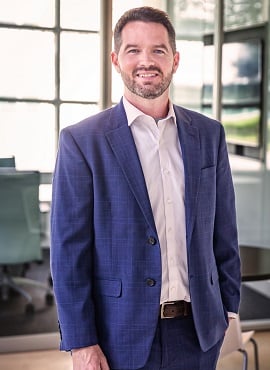
Rob Miner, PhD candidate
In college, Miner threw himself into hands-on research opportunities, primarily studying microbiology. After graduation, his first job was in the laboratory of John Denu, PhD, at the University of Wisconsin–Madison, where Miner’s research focused on the discovery of cancer drugs. That work was transformative.
“That’s where my interest switched from wanting to be a microbiologist to being a cancer biologist,” Miner said. “It’s funny how life opens up different doors.”
A few years later, he relocated to Tampa during the pandemic to be with his now husband. He found himself drawn to Moffitt. He joined the lab of Ernst Schönbrunn, PhD, as a research associate, where he studied oncogenic proteins and biochemical pathways.
From the moment he arrived, Miner knew that Moffitt was where he wanted to earn his PhD.
“I knew I wanted to get my doctorate, and my goal is to drive discovery-based science with implications beyond the bench. I’d like to have my own lab someday,” he said. “The community here, the cutting-edge basic science we do and the chance to connect bench discoveries to future therapies all made me certain this was the right place.”
Cancer Is Personal

Rob's dad, Robert Jr., is a melanoma survivor. His cancer experience inspired Rob's career path.
The science drew Miner in. His motivation runs deeper.
Cancer has always shaped his family. Miner lost most of his grandparents to different cancers and their complications. The most life-changing experience occurred when he was 5 years old.
“My dad was diagnosed with stage 4 melanoma,” he said. “He was told he had six months to live.”
Six months turned into a year. A year turned into a decade. And that decade changed everything.
Seeing how treatments evolved and how those innovations extended his father’s life sparked something within him. A fascination with science. A sense of purpose. A belief that research could transform lives.
That belief grew stronger during Miner’s second year in the PhD program. His father’s melanoma had returned 20 years after his original diagnosis.
“He didn’t call my mom first. He called me,” Miner said. “He wanted to know what he should do.”
Miner isn’t a clinician, but he knew enough to help guide his father toward the right next steps. Fortunately, his father began treatment with a PD-1 inhibitor, a type of immunotherapy that wasn’t even imaginable when Miner was 5. It worked. His father is cancer-free today.
Those moments stay with Miner when he’s at the bench.
“Twenty years ago, we didn’t even know if PD-1 blockers would be viable therapeutics,” he said. “Basic scientists pushed that forward. It became a breakthrough. And they changed what was possible for people like my dad.”
Finding Meaning in the Science

Rob and his dad celebrate on Rob's wedding day
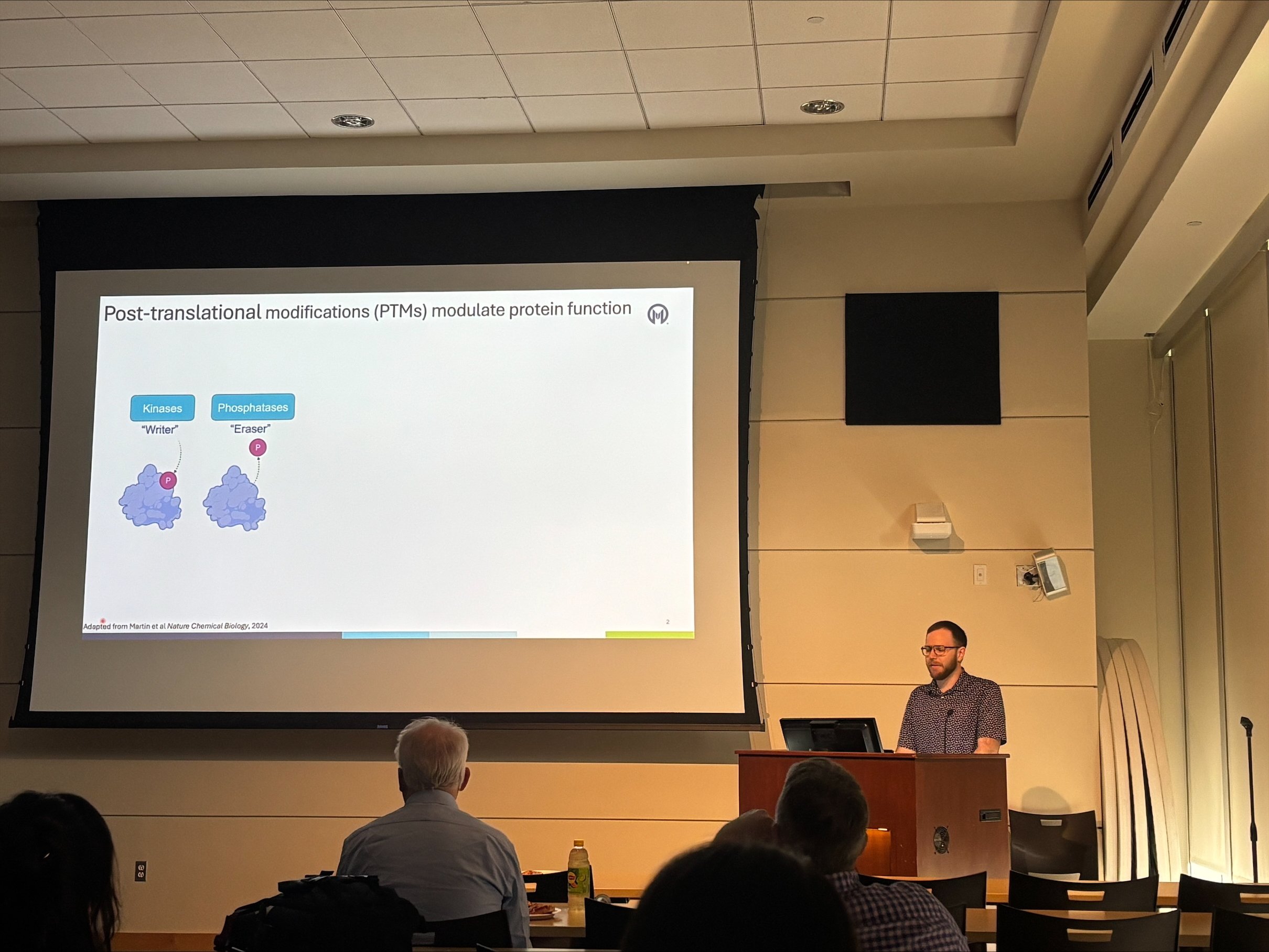
Miner’s research focuses on understanding how specific proteins function inside cancer cells and how those functions might be manipulated to develop future therapies.
“Sometimes the science is very biochemical, and it’s easy to lose sight of the human connection,” he said. “But I remind myself that someday this could be an avenue for a therapeutic. We may not yet know the exact type of cancer. But nobody knew how versatile PD-1 blockers would become when they first started.”
His curiosity has already led him into new avenues. A simple conversation early in his doctorate turned into a collaboration that now has Miner working on developing CAR T therapies for multiple myeloma.
“That project came from just a networking conversation,” he said. “That’s the thing. You never know where an idea or connection will lead.”
To young students considering a career in science, technology, engineering and math or a future doctorate, Miner gives one piece of advice: You don’t have to rush.
“It’s great if you know you want to go straight into a program,” he said. “But it’s also OK to build your skills first, gain experience and figure out who you want to be as a scientist.”
More important is building relationships.
“Force yourself to network,” he said. “Meet people. Collaborate. The smallest conversation can spark an entire project or new direction.”
Miner has his eyes set on leading his own laboratory someday, continuing the kind of work that helped save his father and may help countless others.
“Moffitt offers every opportunity to grow as a scientist,” he said. “You’re surrounded by people who believe in the impact of basic science. You see the translation of discoveries happening right around you. It’s inspiring.”
A Program Built for Scientists With Purpose
Since launching in 2001, Moffitt’s Cancer PhD Program has evolved into a powerhouse and leader in cancer research training. What started with one major in Cancer Biology now spans four specialized tracks:
- Cancer Biology
- Cancer Chemical Biology
- Cancer Immunology and Immunotherapy
- Integrated Mathematical Oncology
The Program at a Glance:
- Over 100 graduates since inception
- 81 students enrolled; currently mentored by 44 dedicated Moffitt faculty
- A global community: more than half our current students are international
- 285 PhD Program applications received last year; annual deadline is Dec. 1