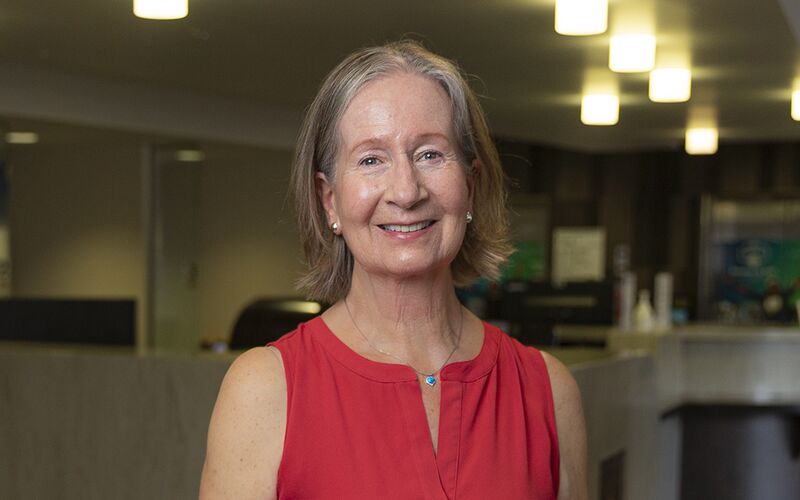

A Firsthand Account of How Lung Screenings Save Lives
Roberta Truetken’s first encounter with lung cancer was watching a friend die at 43. He was having back pain and thought he had pulled a muscle at the gym. It turned out to be lung cancer. He died within a year of his diagnosis.
“I was young then, and that was my first experience with somebody dying that quickly after a diagnosis, especially somebody in their early 40s,” said Truetken, who was a smoker at the time. “That’s when I was cognizant of, oh my God, this is what could happen to me.”
Truetken became what she calls “a professional quitter,” kicking the habit for two or three years at a time before sliding back into smoking. She once quit for a five-year stretch before picking it back up. Whether she was smoking or quitting, that risk lingered in the back of her mind.
In 2007, Truetken saw a TV news story about a National Institutes of Health study that was enrolling current and former smokers for lung screenings in her hometown of St. Louis. In total, she estimates she had smoked for 30 years at that point.
“I’m of that generation where if you got a diagnosis of lung cancer, it was already too late and there was nothing they could do for you,” she said. “I had acquaintances and friends who went through with the chemo and the radiation for nothing. Within a few months, they were all gone.”
Truetken wanted to be proactive. She joined the study and got her first low-dose CT scan for lung cancer screening at age 53. The scan showed she had benign lung nodules that needed to be monitored. She took that seriously, quitting smoking for the final time and following up with annual screenings.
When Truetken moved from St. Louis to South Pasadena in 2011, she went to the hospital in Missouri where she had been getting her annual screenings and got physical copies of her scans to take to Florida. Once she got settled in the Tampa Bay area, she started going to Moffitt Cancer Center once a year to continue screenings.
In September 2021, she got the call. One of the nodules in her lungs had grown. She needed to switch from annual scans to quarterly. By July 2023, the growth and increasing density in the nodule indicated trouble.
Truetken met with Jobelle Baldonado, MD, a surgeon in Moffitt’s Thoracic Oncology Department. Baldonado recommended removing the mass before it got too big to be resected and before it spread elsewhere.
“That was a no-brainer for me, so we scheduled the surgery,” Truetken said.
‘People Fall Between the Cracks’
The U.S. Preventive Services Task Force recommends annual lung cancer screenings with low-dose CT scans for people age 50 and older who have a 20 pack-year smoking history and who currently smoke cigarettes or quit within the past 15 years. A pack-year is equal to smoking one pack per day for one year, or two packs per day for half a year. Like mammograms and colonoscopies, this screening test can catch cancer early, when survival chances are highest. Yet only 16% of those who are eligible get screened, compared with a 76% screening rate for breast cancer and 67% for colon cancer.
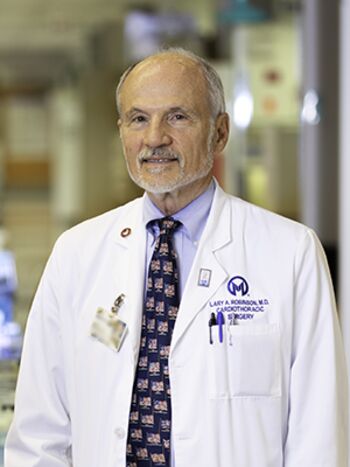
Lary Robinson, MD, leads Moffitt’s Lung Cancer Early Detection Center, which promotes screening, monitoring and surveillance after cancer treatment.
The reasons for the low numbers in lung cancer screenings vary. The primary reason is lack of awareness among both individuals and primary care physicians, says Lary Robinson, MD, director of Moffitt’s Lung Cancer Early Detection Center. Even when individuals are aware of the need for screening, they are often fearful of what they might find and the potential tests, treatment and expense that could follow.
Robinson is working to raise awareness and alleviate those common fears. The Lung Cancer Early Detection Center encompasses three clinics dedicated to screening for early detection, evaluation and management of lung nodules, and surveillance of patients treated for early stage disease.
“There’s survival in lung cancer,” Robinson emphasized. But diligent screening and early detection are key.
About 600 people are screened for lung cancer every year at Moffitt, and that number is expected to continue to increase. In November 2024, the cancer center launched its mobile lung screening unit, which travels into surrounding communities to offer low-dose CT scans in a convenient in-and-out setting. Moffitt partners with local government agencies and community groups to act as hosts for the mobile unit, which can screen up to 15 people per day. In its first year in action, the mobile unit is expected to screen 150 people.
Robinson also regularly speaks to groups of referring physicians to raise awareness of both the screening guidelines and the importance of monitoring lung nodules. Like Truetken, about 1.6 million people every year are found to have lung nodules, small masses that typically do not cause any symptoms. However, unlike Truetken, two-thirds of these people do not receive or pursue follow-up care.
“A lot of those nodules are benign, but some of those are small cancers, and they aren’t getting followed up on,” Robinson warned. “People fall between the cracks. That’s a big problem.”
The Lung Cancer Early Detection Center’s Lung Nodule Clinic aims to prevent that. When a person is found to have a lung nodule, whether through lung cancer screening or as an incidental finding during other testing, the clinic evaluates them to determine whether further testing or monitoring is needed. Robinson and his team follow up regularly to ensure people don’t disappear after that initial finding.
Screening and monitoring efforts like this are driving a shift in early stage diagnoses. The American Lung Association reported in 2024 that early diagnosis rates have increased 11% over the past five years. Still, in 2024, only 27.4% of lung cancer cases in the United States were diagnosed at an early stage. When lung cancer is caught early, the five-year survival rate is 64%, compared with a 9% survival rate for late-stage lung cancers.
That leaves a lot of room for improvement, says Jhanelle Gray, MD, chair of Moffitt’s Thoracic Oncology Department.
“If everyone who is eligible to get screened for lung cancer got annual screenings, we could save so many more lives each year,” she said.
Expansion of Screening Options on Horizon
Low-dose chest CT scans are the gold standard for lung cancer screening. They are fairly quick and painless, but not always accessible and convenient for those in remote rural areas. Moffitt’s mobile lung screening unit is alleviating those barriers with each community event. However, oncologists and scientists see expanded types of screening as the future of early detection.
Robinson is leading cutting-edge research exploring a blood test to separate malignant from benign lung nodules. The test involves two promising investigational biomarkers that measure substances in the blood indicating whether lung cancer is present.
The trial is currently enrolling 250 patients with undiagnosed but suspicious lung nodules. The participants’ blood will be collected and tested while they continue to get the standard biopsies done, and results will be compared to determine how accurate the blood biomarker tests are. Patients with cancerous nodules will be followed for up to three years as part of the study.
“Developing an accurate blood test for lung cancer would greatly facilitate noninvasively differentiating cancer from benign lung nodules,” Robinson explained. “A highly sensitive and specific biomarker potentially could be employed for initial lung cancer screenings with just a blood test at the primary care physician’s office. And if the test were positive, a subsequent chest CT scan could be strongly recommended.”
Matthew Schabath, PhD, co-leader of the Cancer Epidemiology Program at Moffitt, is also exploring a noninvasive breath diagnostic test for lung cancer. The pilot study, in partnership with tech startup Detect-ION, will begin with late-stage patients to identify biomarkers detected in the breath. If successful, the researchers will conduct a follow-up study on early stage patients to determine the potential for early detection with a low-cost breath test.
With promising biomarker research underway, Robinson sees a future where people have multiple options for easier lung cancer screenings, similar to how at-home Cologuard tests have boosted colorectal cancer screenings.
“I’d like to think five years from now we may have something,” he said. “Until then, we do screening CT scans, beat the bushes and screen as many people as we can.”
‘Just Do It’
Truetken is glad she learned so early about the importance of lung cancer screenings. She’s also glad she came back year after year to monitor the lung nodules.
In July 2023, Baldonado removed the growing mass along with about 10% of Truetken’s right lung. The cancer was diagnosed as stage 1. Truetken was back up and walking the same day.
“They said the more you walk the better. So I did. I walked around the nurses station over and over and over again.”
Truetken’s surgery was on a Thursday, and she was discharged Saturday. On Monday, she was in the gym easing back into cardio. Six weeks later, she went back to lifting weights.
Almost two years later, the 70-year-old is as active as she’s ever been. She walks. She swims. She goes to the gym every day. She comes to Moffitt for follow-up CT scans every six months. She’s in and out and back on the road in just a few minutes.
Truetken recently saw a TV news story, similar to the one that prompted her to get her first screening in St. Louis. The story was on Moffitt’s new mobile lung screening unit. She felt hopeful for the people getting screened.
“People always say, oh, well, you’re going to die of something. Well, I’m not ready,” she said. “The only thing I can say to those people who might be hesitant to do it, I’d love to give them some advice: Just do it. It’s one visit a year. And that way they have a base to start with. They can check for changes every year and watch it. Because if you wait till you feel something, it’s too late.”
This article originally appeared in Moffitt's Momentum magazine.