
To refer a patient with ovarian cancer to Moffitt, complete our online referral form or contact a physician liaison at Physician.Relations@Moffitt.org for assistance. Online referrals receive responses within 24 to 48 hours.
Keynote-B96 Trial and the First Immunotherapy FDA Approval in Ovarian Cancer
Key Takeaways for Busy Providers:
-
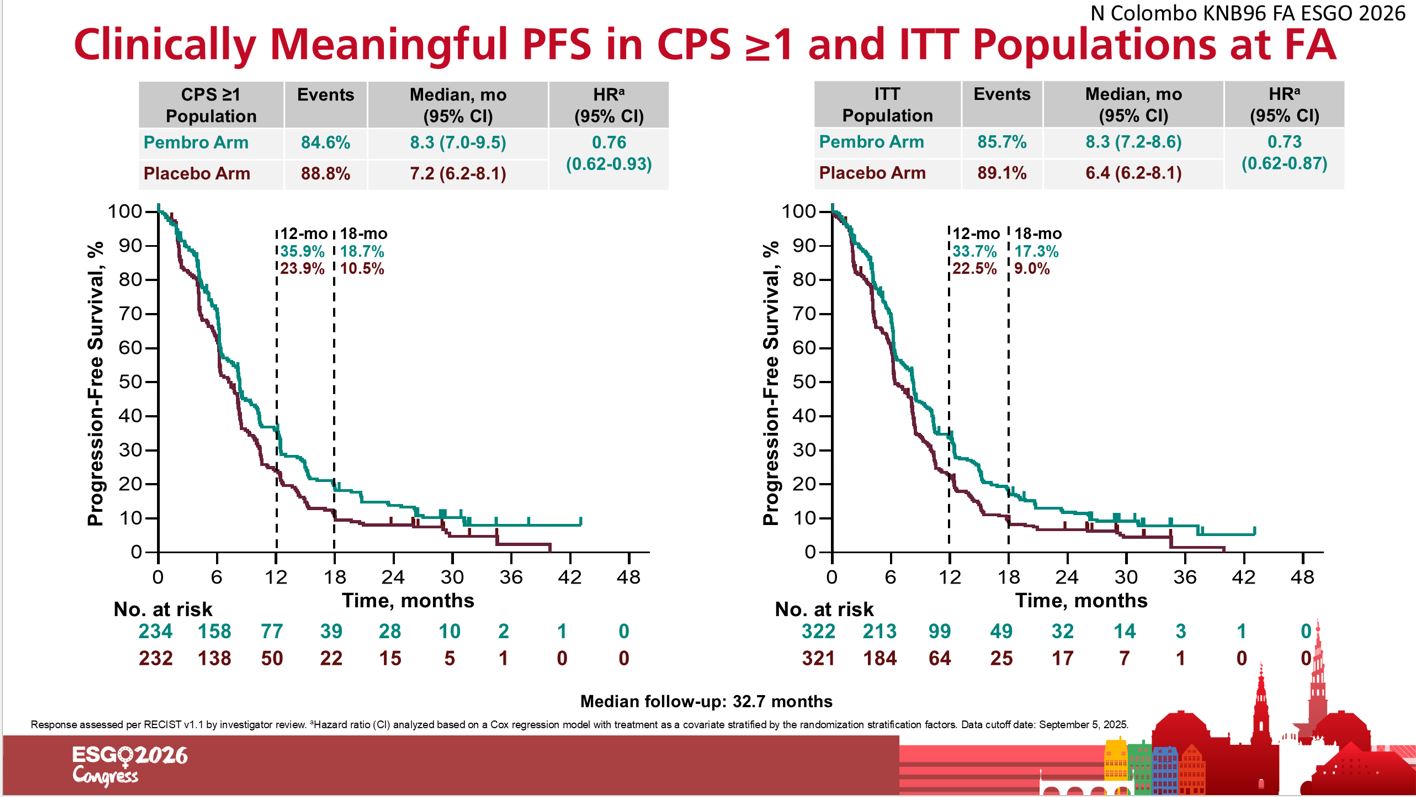
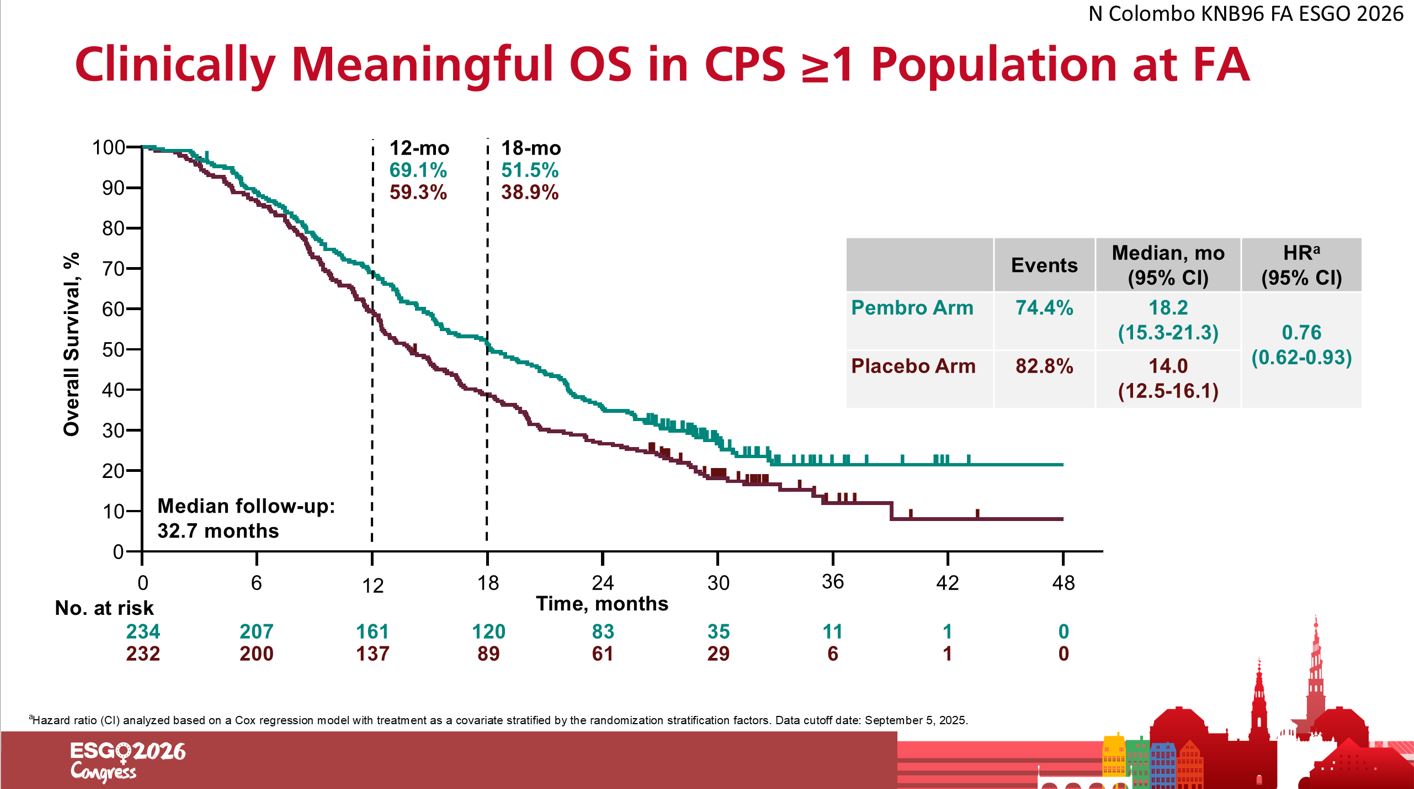
KEYNOTE-B96 was the first phase 3 trial to demonstrate a role for immunotherapy and showed one of the longest overall survivals in this setting. Among patients with PD-L1–positive tumors, the pembrolizumab regimen improved the risk of progression or death by 24% and similarly improved survival by 24%.
- In February 2026, the FDA approved the first immunotherapy for ovarian cancer, providing new options for patients with platinum-resistant recurrent disease.
- Moffitt developed and led a multi-institutional investigator-initiated study testing metronomic dosed taxane-based chemotherapy with immune checkpoint therapy that was a foundational trial that led to and was confirmed by KEYNOTE-B96.
-
- New ovarian cancer trials are open, including NCT05316129, a Moffitt-developed investigator-initiated study available only at Moffitt, investigating CAR T options for ovarian patients.

Our Moffitt-developed and led, multi-institutional investigator-initiated study testing metronomic dosed taxane-based chemotherapy with immune checkpoint therapy was a foundational trial that led to and was confirmed by KEYNOTE-B96.
 Medically reviewed by Robert Wenham, MD, Chair, Gynecologic Oncology Program
For years, immune checkpoint inhibitors failed to gain meaningful traction in ovarian cancer. Trial after trial came up negative, and the disease earned a reputation as largely unresponsive to immunotherapy.
That began to change when Moffitt Cancer Center investigators demonstrated that combining a monoclonal antibody with chemotherapy could produce results in platinum-resistant disease, laying the groundwork for a global phase 3 trial and ultimately the first FDA-approved immunotherapy regimen in ovarian cancer history.
The Challenge of Platinum-Resistant Recurrent Disease
Ovarian cancer remains a significant global health burden, with more than 324,000 new diagnoses and nearly 207,000 deaths worldwide in 2022. Between 70% and 80% of patients with advanced disease will experience progression following first-line platinum-based chemotherapy, and approximately 25% develop platinum resistance within six months of completing that initial treatment. Eventually, nearly all patients with recurrent disease will ultimately have platinum resistant disease.
For patients in this platinum-resistant, recurrent setting, prognosis is particularly poor. Prior to this approval, chemotherapies with or without bevacizumab was the most widely used approach, offering modest progression-free survival benefit without a clear impact on overall survival.
Moffitt’s Role in Building the Evidence
Pembrolizumab (Keytruda) is a monoclonal antibody that blocks the PD-1 receptor on T cells, preventing tumor cells from suppressing immune activity and enabling the body's immune system to better recognize and attack cancer cells.
Dr. Robert Wenham, chair of the Gynecologic Oncology Program at Moffitt Cancer Center, recognized early that pairing this mechanism with metronomic weekly paclitaxel, which could synergize through unique immune modulating effects, could be meaningful in platinum-resistant disease.
Read More About the Moffitt Study: A phase 2 study of pembrolizumab and weekly paclitaxel for platinum-resistant epithelial ovarian cancer
"Our Moffitt-developed and led, multi-institutional investigator-initiated study testing metronomic dosed taxane-based chemotherapy with immune checkpoint therapy was a foundational trial that led to and was confirmed by KEYNOTE-B96," said Dr. Wenham, "which is the first study to firmly establish a role for immunotherapy in ovarian cancer by improving survival time with some of the longest survival seen in chemo-resistant cancer."
Keynote-B96 Trial Results
Building on that foundation, Moffitt served as a participating site in KEYNOTE-B96, with Dr. Wenham as a co-investigator. The trial was a randomized, double-blind, placebo-controlled phase 3 study enrolling 643 patients with platinum-resistant epithelial ovarian, fallopian tube, or primary peritoneal carcinoma who had received one or two prior lines of systemic therapy.
Investigators randomized patients 1:1 to pembrolizumab plus weekly paclitaxel with or without bevacizumab, or placebo plus the same chemotherapy backbone. Approximately 72% of enrolled patients had tumors expressing PD-L1 with a combined positive score (CPS) of 1 or greater.
Among the 466 patients with PD-L1–positive tumors, the pembrolizumab regimen improved the risk of progression or death by 24% (median progression free survival (mPFS) o f8.3 months versus 7.2 months with placebo; HR 0.76) and similarly improved survival by 24% (median overall survival of 18.2 months versus 14.0 months; HR 0.76). The pembrolizumab arm achieved an objective response rate of 53%, including a 9.9% complete response rate, compared with 46.6% in the placebo arm.
Notably, the OS benefit extended to the all-comers population as well, making KEYNOTE-B96 the first phase 3 immune checkpoint inhibitor trial to demonstrate an overall survival advantage in this setting.
The safety profile aligned with previously reported data for the individual agents, with investigators identifying no new signals.
FDA Approval
On February 10, 2026, the FDA approved pembrolizumab (Keytruda) and pembrolizumab plus berahyaluronidase alfa-pmph (Keytruda Qlex) in combination with paclitaxel, with or without bevacizumab, for adult patients with platinum-resistant epithelial ovarian, fallopian tube, or primary peritoneal carcinoma whose tumors express PD-L1 (CPS ≥1) and who have received one or two prior systemic treatment regimens.
Alongside the drug approval, the FDA approved the PD-L1 IHC 22C3 pharmDx assay as a companion diagnostic to identify patients eligible for treatment.
What This Means For Your Patients
This approval establishes PD-L1 as an actionable biomarker in platinum-resistant ovarian cancer, joining
Moffitt's gynecologic oncology team brings direct experience with this regimen that traces back to the investigator-initiated research that helped establish its foundation. That depth of experience, combined with our multidisciplinary approach to treatment sequencing, means eligible patients can access this therapy within a program that has been involved with its development from the earliest stages.
We welcome early consultation to assist with treatment planning. Connecting with our team before platinum resistance develops gives patients the best opportunity for timely evaluation and treatment planning and access to the latest FDA approved treatments and clinical trials, like NCT05316129, which is currently investigating CAR T options for ovarian patients.