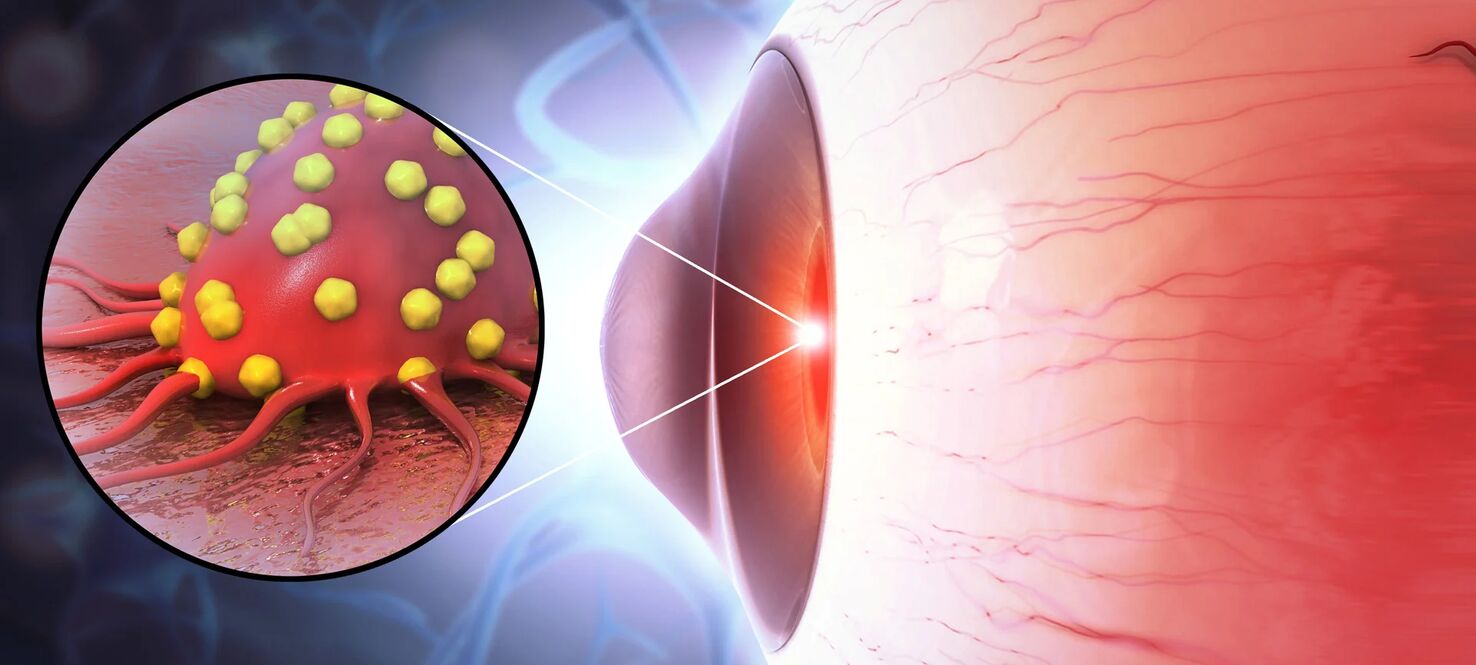
Moffitt Study Creates More Realistic Mouse Model of Eye Cancer
Key Highlights
- Researchers have produced a new mouse model that replicates how the most common form of human eye cancer develops over time.
- The model recreates the same step-by-step genetic changes found in patients, allowing scientists to better study how the disease evolves.
- Cancer cells in the model can shift, moving from more stable forms to more aggressive states that are hard to treat successfully.
- The model reveals molecular biomarkers linked to aggressive uveal melanoma that could help guide risk assessment and treatment strategies for patients.
- The model replicates the immune microenvironment of human uveal melanomas, making it suitable for testing immunotherapies.
TAMPA, Fla. — Researchers at Moffitt Cancer Center have developed a new mouse model that more accurately reflects how uveal melanoma acts in humans. This could improve research, resulting in better patient outcomes. The new model, published in Cancer Research, addresses shortfalls in current versions.
Uveal melanoma is the most common eye cancer in adults. It starts in the uvea, a pigmented layer of tissue between the retina and the white outer wall of the eye. In about half the cases, it spreads to other parts of the body, most often the liver, where treatment options are highly limited.
Researchers engineered mice to develop uveal melanoma through the same sequence of genetic changes seen in human patients. Activating a mutation in the GNAQ gene led to benign eye lesions. Removing the BAP1 gene, which suppresses tumors, increased the chances that these non-cancerous growths would become malignant. When researchers increased activity of the MYC gene, the tumors became far more aggressive and looked very similar to uveal melanoma seen in human patients.
The research team also found that not all cancer cells behaved the same way. Some still looked like normal pigment-producing cells while others shifted into more aggressive forms associated with poor patient outcomes. This ability to change may help explain why uveal melanoma can become more dangerous over time.
Additionally, the experimental model reproduced the immune environment typically found in human patients with eye cancer. In both cases, tumors contained immune cells that were present but ineffective, suggesting that the cancer suppresses the immune response. This may explain why immunotherapy has been relatively unsuccessful for most patients with uveal melanoma.
The model also identified telltale molecular biomarkers associated with high-risk tumors, providing new clues for studying aggressive forms of the disease.
Because the new model closely tracks how uveal melanoma develops in humans, it may lead to more effective detection and treatment.
Q&A with Florian Karreth, Ph.D., senior author, vice chair of the Molecular Oncology Department and associate member of the Donald A. Adam Melanoma and Skin Cancer Center of Excellence at Moffitt.
Why has it been so difficult until now to develop a mouse model that truly reflects how uveal melanoma behaves in patients?
Previous genetic mouse models engineered the mutation in the GNAQ gene that is found in the majority of human uveal melanomas; however, these mice developed eye tumors without any additional genetic changes. That is different from uveal melanoma in patients where three or more genetic changes are typically evident and where the GNAQ mutation alone only leads to the formation of a mole. We suspected that when, where, and to what extent the mutant GNAQ gene was activated in mice was very different from patients and caused these undesired effects. So, we developed a refined mouse model and with this improved approach, mice with the GNAQ mutation only develop moles in the eye just like in patients. Using this as a starting point, we included additional genetic changes that are frequent in human uveal melanoma, leading to the development of tumors that became more aggressive with every additional mutation.
What does your discovery of distinct, shifting cancer cell states tell us about why uveal melanoma becomes so aggressive and hard to treat?
We know from skin melanoma that these cancer cells are great at adapting to stress, for instance, in response to therapy. This ability to shift into different cell states fuels metastasis, the main cause of cancer deaths. Our study shows that uveal melanoma cells also can switch their state, and these states have similarities with the states found in skin melanoma cells. While we don’t know yet if the cell states we found in the mouse uveal melanoma cells are associated with more aggressive behaviors such as metastasis, we will use our mouse model to test this hypothesis. If we can block the switches that help cancer cells adapt and survive, we might be able to prevent metastasis or improve treatment response.
Could your new model be used to help determine why this specific type of eye cancer spreads to the liver, and no other organs, in about half of patients?
We observed uveal melanoma cells in the liver of our mouse model; however, these did not expand into full-blown metastasis. In uveal melanoma patients, liver metastasis is typically not evident when the primary tumor is diagnosed and treated – this often takes years after the initial diagnosis. We are now refining our model to recapitulate this: by treating the primary tumor, the cells that have already spread to the liver will have more time to grow into secondary metastatic tumors. We have also developed transplant models in which we can specifically inoculate liver metastasis. Our hypothesis is that cells in the primary eye tumor are in a state where they rapidly divide, then switch to a migratory state that enables them to spread to the liver and possibly other organs, and eventually switch back to the state where they divide and form a secondary metastatic tumor. Using these tools, we will assess this hypothesis and why this switch that reverts cells back to the original state only happens in the liver.
In what ways could your model accelerate the development of treatments for high-risk patients?
Our model, as well as uveal melanoma cells derived from it that can be used in transplant experiments, forms tumors and metastasis in the context of a functional host immune system. This will be a powerful tool for the uveal melanoma research community to design and preclinically test immunotherapies. Uveal melanoma responds poorly to immunotherapies designed for skin melanoma and we therefore need to develop tailored immunotherapies for uveal melanoma patients. Our model will be crucial for this. Additionally, we will be able to ask fundamental questions such as why disseminated uveal melanoma cells remain dormant in all organs except the liver, where they overcome dormancy and form metastatic secondary tumors. A better understanding of this process may provide opportunities to keep these cells dormant and ultimately eradicate them.
Do you see modeling cancer step by step with an intact immune system being applied to other cancers?
This approach has actually been used in many other cancer types: the most useful mouse models closely recapitulate the genetics and biology of human cancer, including multiple genetic changes that are observed in patients and a functional immune system. For our uveal melanoma model, we took a page from the playbook of other mouse models of cancer.
This study was supported by the Melanoma Research Foundation (Career Development Award 1068914), Miles for Moffitt (Postdoctoral Milestone Award), National Cancer Institute (R01 CA256193, P30 CA142543, P30 EY030413, P30 CA076292), Cancer Prevention and Research Institute of Texas (RR220010), Melanoma Research Alliance, Department of Defense Melanoma Research Program (ME230182), Research to Prevent Blindness, Inc.
About Moffitt Cancer Center
Moffitt is dedicated to one lifesaving mission: to contribute to the prevention and cure of cancer. The Tampa-based facility is one of only 58 National Cancer Institute-designated Comprehensive Cancer Centers, a distinction that recognizes Moffitt’s scientific excellence, multidisciplinary research, and robust training and education. Moffitt’s expert nursing staff is recognized by the American Nurses Credentialing Center with Magnet® status, its highest distinction. For more information, call 1-888-MOFFITT (1-855-625-8815), visit MOFFITT.org, and follow the momentum on Facebook, X, Instagram and YouTube.
###