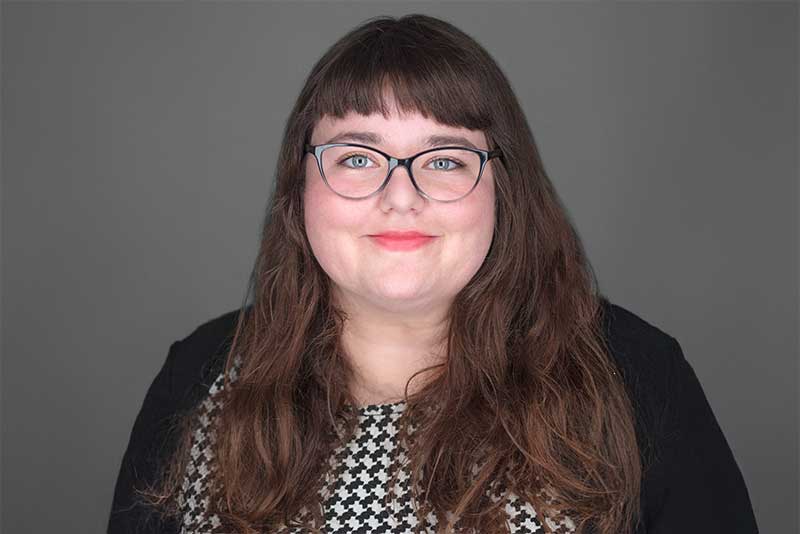
Jackie Beaushaw: One Flyer Changed My Life!
Jackie Beaushaw is now Supervisor of Moffitt's Patient Library, but at just 18 years old, while most young adults were starting college and navigating the challenges of young adulthood, Jackie was diagnosed with mesothelioma and undergoing cancer treatment at Moffitt. For someone so young, this experience could have been incredibly frightening, isolating, and overwhelming. And it was. But Jackie’s journey took a pivotal turn when she came across a flyer for the Adolescent and Young Adult (AYA) program at Moffitt.
Thank you to our Storyteller: Jackie Beaushaw
To our Narrator/Host: Loreen O’Brien
And to our Production Team: Kathi Barden (podcast project leader), Anne Bidelman, Heather Bistesto, Donna DiClementi, Robin Gordon (Patient Advisor), Randy Isaacson (Family Advisor), Loreen O’Brien, Terry Payton, and Cristina Perez
For more stories, search for "Pep Talks with Moffitt" wherever you get your podcasts, or tune in and subscribe via our show page.
Podcast Transcript
My name is Jackie Beaushaw, and I'm the supervisor of Moffitt's patient library.
It was 2010. I was just starting out college. I was 18, and I didn't really know what I wanted to do for a living. And I was still living with my parents, and I got very sick. Looking back, I can see there were other warning signs. But that was the first big, you know, something's wrong. So we go to my local emergency department. Unfortunately, I didn't get the best care at that hospital. Didn't really tell me what was happening. It didn't really have any reason for why I got sick. Um,
And then about a month later, I noticed a lump on the side of my neck. So I went to Urgent Care facility and the doctor there was very nice. And he said, you know, we don't know. You know, it could be nothing. But just in case, I want to do some tests. And so he did blood tests. Um, those blood tests showed that I had some clotting concerns. So they sent me to a hematologist. And so she did a scan of my chest and she saw that I had a pulmonary embolism.
They called me and said that I had to go to the emergency room right away. It could be deadly. So I went back to the same emergency room where I had previously gone. They were doing a lot of tests, and we weren't really sure what was going on.
Somebody came from transport to take me to a liver biopsy. And then we asked them, like, why am I getting this biopsy? And the person who is not a doctor, he was there transporting me. He said, oh, they didn't tell you. They think you might have cancer.
So I immediately started crying, and I was on this table just hearing this news that I might have cancer. And the person doing the test said that, um, I need to calm down and stop crying or they're going to mess up the test. Um, so the whole experience I think was very dehumanizing after that. They treat your body like more of an object. I think we were still waiting on pathology results that were taking forever. Um, and I think in the meantime, we got established with a primary care physician, and I think she was the one that referred me to Moffitt.
I think one thing that I noticed coming into Moffitt, too, was that everybody was kind right? Everybody just really cared about me and talked to me and treated me like a person. So it wasn't just, you know, I'm here to draw your blood. There was conversation. Um, you know, and I see that all the time with Moffitt’s culture. They. jump in and say, how can I help you find where you're going? Or how can I support you as a person, which was really empowering, I think.
They eventually realized that I had a rare cancer called peritoneal mesothelioma. Most people don't expect to get diagnosed with cancer at 18. And it, you know really caused a lot of upheaval in my life.
My friends and family were very well-meaning, but they didn't understand what it was like to go through that. Um, there was a lot of concern over whether I would have fertility in the future. Like I was very sick. Um, and so I think more than being worried about fertility at the time, I was more worried about, like, am I going to survive this? Right. Because I really, genuinely didn't think that I would. I hadn't, done much with my life to that point. I was 18, right? Um, my friends were very much in a place of, you know, college life, so being in a place where I suddenly kind of felt like a grandma, right? I had gone to school and I had some friends, and I was a daughter. But like, as far as legacy. If I died, there wasn't anything that I would be leaving behind or any kind of legacy.
I met with Doctor Dessureault and she said we were going to do a surgery. I had a lot of fear going into it that I wasn't going to wake up after that surgery. She took all the time in the world to make sure that I was comfortable and that I understood what the procedure entailed and that I didn't have any questions leaving her office, which, I think really made me feel good.
I had a really hard time after that surgery, I think, both physically and emotionally. I had my parents there, but I didn't have a lot of visitors. You know, we don't live super close to Moffitt. We live about an hour away. And for various reasons, you know, people's lives, they weren't able to visit me. And so it was also very isolating to come out of a surgery and maybe expect people to be there and not have those people there. Um, and I remember one thing that kind of made that surgery a bit better. I remember Lloyd with our arts in medicine program. He stopped by and asked if he could play for me, and he played Lean on Me, and it was really moving. I still get a little teary, um, talking about it, because it was just very like a moment of he was there, you know.
A little less than a year later I had a recurrence. And then I also had chemotherapy and unfortunately I didn't have the best reaction to chemotherapy.
One of the only things that I think made me feel better about coming in and dealing with all that was my mom would drive me to chemo and we would stop for coffee. As I was waiting, I would always look forward to going to the arts in medicine studio. Um, so I think we visited literally any time we were at Moffitt, we would be in the arts and medicine studio, and it was just nice to have a place where we could hang out and paint and just, um, spend some time there. And the people there were always so nice. It also, I think, made me feel seen as a person, too, that, like Moffitt doesn't just have they don't just care about treating me. And me getting better. They care about me being comfortable and they care about me doing something fun while I'm waiting. Which, you know, it seems like such a small thing, but I think when you're so sick and like, everything is awful, having that one bright place where you can go and make a human connection is so important.
Throughout it all, I thought I was coping really well with cancer. Or at least, you know, I wasn't constantly crying. But I still didn't feel like people really understood. Right? But my mom found an AYA meetup flyer in a folder, and so it was a support group for young adults. AYA’s the adolescent young adult group. And so she really wanted me to go, and I was kind of like.I don't think so. I had a lot of misconceptions about what a support group is. So my only knowledge of support groups was like stuff I've seen on TV. So I thought it'd be like in a, you know, dingy, basement with like bad coffee. And I thought everybody would be sobbing because this is what you see on in movies and TV.
But I went because my mom essentially forced me, um, and when I went, what I realized was that I was talking to people who understood. And so I was able to talk to people who got it. And who had been through similar stuff. Maybe not the same diagnosis.
For a group of strangers just meeting. It was very personal because you're talking about even sometimes you know physical symptoms, right? But it was also very, like a very quick bond because you they get it, you know, they get it more than the other people in your life who may feel bad and may care about you, but they don't get it. And so, um, they got it, which was really nice to be able to connect with them.
I don't know if there is a reason why I got diagnosed with cancer, but I feel like there had to be a reason. I couldn't just be sick and that's it. Right? So, I think I was very much still looking for that legacy of maybe doing something and also looking for that Why? And I also think the social worker who facilitated those AYA support groups saw that in me. And she saw that I really cared about connecting with other patients in that AYA support group, too. And I think she understood that I really needed that purpose and that focus. And so she suggested that I might be interested in the Patient and Family Advisory Program.
So I would actually visit the hospital, the patients who are hospitalized that were a young adult aged. And I'd share my story enough so that they felt comfortable sharing their story. I was connecting with people who got it, and it made me feel like I was doing something with this.
Eventually I got invited to be on Moffitt's Patient and Family Advisory Council. What was absolutely wild to me is that they were there to listen to patients. They were there to hear from me. And like, I'm 20, I don't know what I'm doing with my life, dealing with cancer, but they want to hear about what I think could be improved. I think that said a lot about Moffitt's culture, too.
So, ultimately, I think volunteering with the Patient and Family Advisory Program and getting to know that social worker who was, I think everything I would want to be in a career I, uh, actually changed my degree to social work.
But I always knew that it didn't matter what I did, but I wanted to be back at Moffitt. Because I think at that point, I had seen how much of a difference people made here.
I actually started working in the patient library. I think it's ironic that, you know, I wouldn't be here if I hadn't gotten a folder with a flyer in it. And now we, you know, hand out the flyers. So that feels a little bit like a full circle moment.
Something that I've heard from very smart people is that when you share a resource, you're planting a seed. I never would have known the impact one flyer would make on my life. You know, going from a flyer that I almost threw out to, you know, now I work here, um, and my whole life has changed, and I have purpose.
None of that would have happened had somebody not given me that flyer. They literally changed my life. And so even if you don't feel like what you did is big - you might be changing somebody's life.
Music from #Uppbeat (free for Creators!):
https://uppbeat.io/t/ben-johnson/woke-me-at-the-break-of-day
License code: WKFESBO1FPM56MTF
https://uppbeat.io/t/monument-music/a-force-for-good
License code: SO85MQF1Z1CNCNXA
https://uppbeat.io/t/holly-jones/getting-it-right
License code: BO8R9MIYPCJ3MDCC
https://uppbeat.io/t/yeti-music/keep-strong
License code: D25S8RDTQ4KRS5ZG
https://uppbeat.io/t/studiokolomna/miracles
License code: ONU5WWXHCKITG4WL