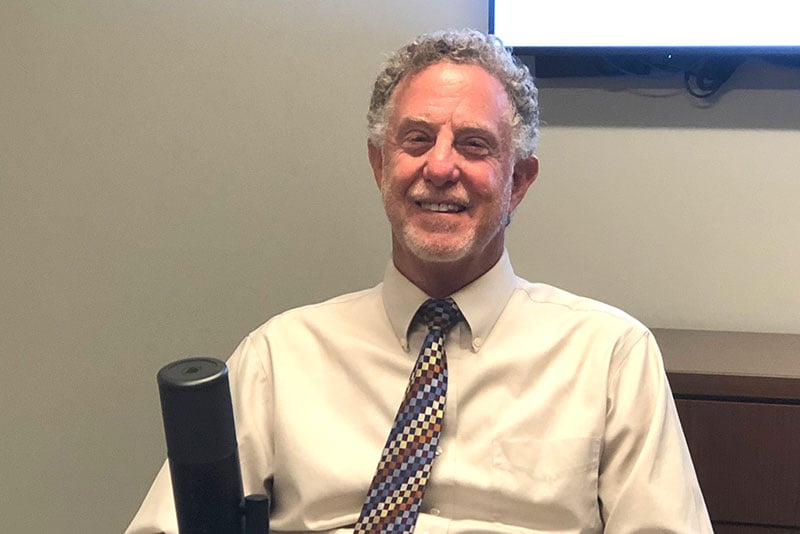
Lloyd Goldstein: I See Music as Transformative
Lloyd Goldstein is a Certified Music Practitioner in our Arts in Medicine Program. Lloyd shares his journey from a professional base violin player in the Florida Orchestra to a Moffitt volunteer, to one of our Artists in Residence.
Lloyd’s approach to his work embodies every element of the Moffitt Promise…Always putting patients and families first, being respectful, demonstrating ownership, showing you care, making a difference, having a service mindset and striving for excellence. Through being present and meeting patients where they are, Lloyd uses his music to help patients transcend their pain and suffering, give their families comfort and a sense of peace, and in the process builds a bridge between hearts.
Thank you to our Storyteller: Lloyd Goldstein
To our Narrator/Host: Loreen O’Brien
And to our Production Team: Kathi Barden (podcast project leader), Anne Bidelman, Heather Bistesto, Donna DiClementi, Robin Gordon (Patient Advisor), Randy Isaacson (Family Advisor), Loreen O’Brien, Terry Payton, and Cristina Perez
Podcast Transcript
Lloyd
I'm Lloyd. Lloyd Goldstein. I'm a certified music practitioner. I play the bass violin. I work for the Arts and Medicine Program at the Moffitt Cancer Center, playing music for patients, families, visitors and staff. I work in the inpatient areas and the outpatient areas. I've been here for 15 years. Before that, I played in the Florida Orchestra for 21 years.
For more stories, search for "Pep Talks with Moffitt" wherever you get your podcasts, or tune in and subscribe via our show page.
When I came here, I was a volunteer. I had no idea there was even a program here. I finally drove down the road. I live only 10 minutes from here and came to Moffitt to offer to play for people. I found out that I couldn't play for inpatients without special training, but I could play in the lobbies, the waiting rooms, and kind of get my feet wet and see if I enjoyed it and I fell in love with it very quickly. Decided to do this training. It was with a program called the Music for Healing and Transition Program, which began in 1995 out of upstate New York, trying to elevate this work from sort of amateur volunteer work to actual professional level vocation.
I have never looked back. The actual interactions with people, the inspiration that I get from working with each individual patient. I cannot tell you how much I've learned from patients. And this has been an incredible journey, amazingly fulfilling. And I've developed as a musician and a human being in ways I would not have had I stayed in the orchestra.
I see music as transformative. I see it doing things, having effects on people that I don't see with almost any other art form or any other activity or interaction. I don't really understand it fully, but it's it seems to transcend normal lines of communication and normal sort of everyday consciousness and just directly impact people in a way that creates what I call a bridge between hearts.
In my job, I'm taught in my training that I am acting not as a performer, but as someone who serves and trying to do a service. And the way to do that in some ways is very simple. It has to do with being present, observing a person's energy and mood as best I can, and then choosing a piece of music that actually validates where they are. If you put all these ingredients together, the craft and the intention, and then the actual technique of being present, learning how to be present, then the music just takes over and does its magic. It can become magic.
I see people transformed.
An example would be coming into a room. Very simply, knocking on the door and saying, Hi, I'm Lloyd. I work for the Arts and Medicine Program. I play the upright bass. It's like a giant cello. It's free. Would you like to hear maybe hear a song? This is my typical introduction. This happens many times that someone might just go, oh, I don't know if you want to go ahead. It doesn't take but a minute, maybe 30 seconds to a minute. And all of a sudden, this person's heart is filling. Their mind is opening. Everything is opening up. They notice the view out the window for the first time. They're taking deeper breaths. Their peripheral things like maybe their breathing is becoming deeper and and better from a health standpoint. Their blood pressure tends to improve. These things have happened a number of times. We don't do research here on this, but I've had techs come running into my room after a visit and said, in the bone marrow unit specifically more than once where they're monitored, saying, I can't I just have to tell you, Lloyd, I can't believe we've been trying to get this person's blood oxygenation level up from 90 has been barely above 90. It's been at 96 to 98 since 5 minutes after you got here, it's still there.
Ann Klein, Moffitt Patient
So during the time that I'm feeling kind of low and down, a gentleman came to my door. His name was Lloyd, and he played the bass violin. And he asked me if he could play a song for me. And I said, sure. And he just said, how are you feeling? I just said, I'm not feeling so great. And he just said, well, if it's okay, I'll just play something that'll make you comfortable. He just stood there, and I closed my eyes. I felt like he was there for hours, which I know he wasn't. I did fall asleep to the sound that he played for me, and it was just beautiful. He again made such a difference in my whole entire hospital stay because after that day, I really didn't feel that miserable anymore.
Lloyd
I usually tell this story because for me it was I don't know, it was just beautiful and transformational.
I knocked on the door and said the same things I just shared with you. So there's there was a lot of space. The patient was lying on his back on the left side of the room, very quiet. Everything was dim, quiet as a mouse. And he spoke very quietly and he said, yes, I would and I would like to do this, but I want to let you know that having experiencing some abdominal pain, you can't really move very much. And I need you to do this without light, you know, without the light on. Absolutely. I stood there for a minute and breathed, took a few breaths, looking for some kind of inspiration as to what took place. I didn't know what I was going to play when I walked in there and I thought of a piece. I just had this intuition play the whole piece at a whisper. I mean, even almost inaudible at times. I play the whole piece that way, never got above what I would call very soft. And then there was silence and I didn't know what to think. I just stood there, took a few more breaths, and then I heard this man start to talk. He said, you have no idea where this music just took me. I went on this incredible journey flying over these different landscapes, and he started to describe in detail these different places that the music took him. And then he stopped for a second and he said, I just realized I've had no pain this whole time and I still don't have any pain right now. I can't thank you enough, so on and so forth. And that was one of those I mean, to be honest with you, there there are many remarkable visits now. That was I don't know why, but that particular story sticks with me and it's a touchstone for me.
This was the very first thing they taught us in the training was you're not a performer anymore. This isn't about you. This is service. This is presence. In the simplest way, presence is wanting to be where you are. But presence, real presence, I think, in the deeper sense of it, has to do with real care, real caring, actual compassion, finding some fulfillment in supporting someone else's journey, in helping to provide comfort or healing or strategies for coping.
It's a privilege to work at Moffitt. I believe that this that somehow, H. Lee Moffitt infused this place with this idea of two really basic things.
Number one, strive for excellence all the time. And number two, each person makes a difference. And I would add to that as a corollary, it's the small things that matter. The smallest things can make that huge difference.
So I would say to team members to cultivate their ability to be present, to be grateful, strive to be part of this excellent place, this excellent service. If you feel under pressure or if you feel stressed or and it's hard to be present or hard to feel compassionate, take a step back and learn. Learn some techniques. Take a mindfulness class, you know, do yoga, ride your bike, whatever it takes to get back to to being able to be present because it's worth the effort.
All the music you heard during today’s podcast was Lloyd’s from his CD
“The Way Back”
Songs used in order of appearance are:
(14) Shenandoah, (02) Kuai Le, (22) Breathing Song, (06) Fantasy on Celia’s Theme and (04) Peace Song