What Types of Cancer Use Proton Therapy Treatment?
As one of today’s most advanced and accurate forms of radiation treatment, proton therapy is an option for several types of cancer. By delivering a highly targeted radiation dose directly to a tumor, this precise treatment approach can minimize exposure to the surrounding healthy tissues, which in turn can reduce the risk of short– and long-term side effects—including secondary tumors—and improve the patient’s quality of life.
Currently, experts estimate that approximately 20% of radiation therapy patients could benefit from proton therapy, potentially improving their well-being and treatment outcome. Proton therapy also provides a source of hope for some patients who are experiencing cancer recurrence and have limited treatment options.
Proton therapy for breast cancer
Radiation therapy is a cornerstone of treatment for many types and stages of breast cancer, including:
- Ductal carcinoma in situ
- Inflammatory breast cancer
- Invasive ductal carcinoma
- Invasive lobular carcinoma
- Triple-negative breast cancer
Because proton therapy can greatly reduce the likelihood of damage to nearby tissues and critical organs, such as the heart and lungs, it may be particularly well-suited for patients with advanced or left-sided breast tumors, heart disease, permanent breast implants or breast reconstruction, as well as those who previously received radiation treatment or require it after undergoing a mastectomy.
Proton therapy for gastrointestinal cancer
Proton therapy has shown promise for certain types of gastrointestinal cancer, including:
- Esophageal cancer
- Unresectable primary liver tumors, such as hepatocellular carcinoma (HCC) and intrahepatic cholangiocarcinoma (IHC)
Because proton beams are more precisely controlled than conventional X-rays, this highly accurate radiation delivery technique can effectively target a difficult-to-access esophageal tumor while sparing the surrounding healthy tissues and vital organs, such as the spinal cord, heart and lungs.
Proton therapy also offers unique advantages in the treatment of primary liver cancer. The special properties of the proton beam allow a physician to safely and effectively treat a liver tumor while minimizing or eliminating the exit dose through the healthy liver. This can be especially important for a patient who has underlying liver damage from cirrhosis or prior treatment.
For the most common types of gastrointestinal cancer, however, radiation therapy of any form is typically not recommended in place of surgical treatment. Newly diagnosed colon, rectal, pancreatic or stomach cancer often require comprehensive treatment that includes surgery to achieve the best possible outcome and quality of life. That said, proton therapy may be considered in some cases due to the nature or location of the tumor.
Proton therapy for gynecological cancer
Proton therapy can match the exact shape and depth of a gynecological tumor, limiting its impact on the bladder, kidneys, bowel, pelvic bone marrow and other critical nearby structures. For this reason, it may be considered for:
Proton therapy may be a particularly good option for treating:
- A localized recurrence of gynecological cancer
- A recurrence of gynecological cancer that is not suitable for other treatments, including surgery
- A patient who has previously received radiation therapy
- An adolescent or young adult who wishes to preserve her fertility
Proton therapy for head and neck cancer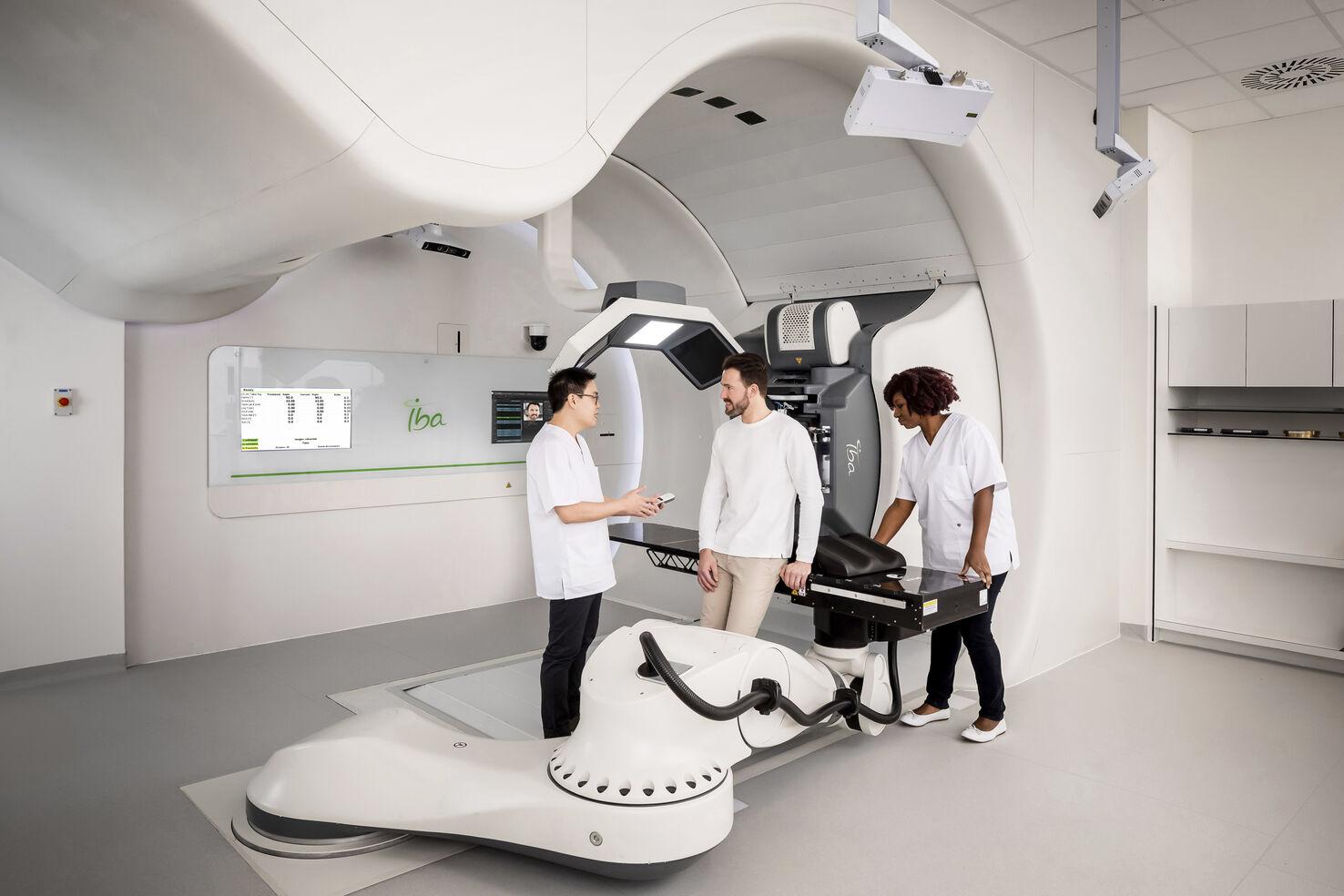
Proton therapy allows for the effective treatment of complex head and neck tumors while minimizing any exposure to vital nearby structures, such as the brain, eyes and mouth. As a result, critical physical functions—including vision, smell, taste and swallowing—can be preserved and unaffected.
Intensity-modulated proton therapy (IMPT) is a highly accurate radiation delivery technique in which a physician uses a narrow proton beam to “paint” the radiation dose onto the tumor one ultrafine layer at a time. The beam approaches the tumor from multiple angles, sparing critical structures by forming a “U” shape around them. By avoiding collateral damage to the oral cavity, IMPT can eliminate the need to implant a feeding tube during head and neck cancer treatment.
When used to treat certain types of head and neck cancer, IMPT has been shown in research studies to be superior to conventional intensity-modulated radiation therapy (IMRT) in terms of both tumor control and quality of life. These cancers include:
- Oral cavity tumors affecting the salivary glands, tongue or tonsils
- Laryngeal cancer
- Nasal cavity cancer
- Ocular (eye)melanoma
- Ocular tumors near the optic nerve or macula
- Paranasal sinus cancer
- Skull base tumors
- Spinal tumors
Proton therapy for lung cancer
Proton therapy, such as pencil beam scanning (PBS), can be used to treat various types of lung cancer, including:
- Non-small cell lung cancer (NSCLC)
- Small cell lung cancer (SCLC)
- Recurrent lung cancer
This highly precise treatment technique can be particularly effective for early-stage, localized lung tumors situated near critical organs in the chest cavity. When used with motion mitigation and plan optimization, PBS can maximize the delivery of proton energy directly into a lung tumor. Compared to conventional photon radiation therapy, this approach allows for better conformality and greater avoidance of neighboring structures, such as the heart, esophagus, spinal cord and brachial plexus. It can also reduce the risk of radiation-induced toxicity, such as esophagitis, pneumonitis or cardiopulmonary impairment, while improving local cancer control by allowing for the delivery of a higher radiation dose.
Proton therapy for lymphoma
Lymphoma is a cancer of the lymphatic system, which extends throughout the body. The two main types are Hodgkin lymphoma and non-Hodgkin lymphoma. Usually, lymphoma treatment involves systemic chemotherapy followed by radiation therapy. However, it can be challenging to treat lymphoma in the chest—particularly in the space between the sternum and heart (anterior mediastinum)—with the necessary dose of radiation without damaging critical nearby structures, such as the heart, lungs and esophagus.
With proton therapy, a physician can precisely target a difficult-to-reach area of the chest with a concentrated dose of radiation while minimizing any exposure to healthy tissues and vital organs. For patients with chemotherapy-resistant tumors that require concentrated doses of radiation, proton therapy may offer a potential cure.
Proton therapy for prostate cancer
Prostate cancer is the most common type of cancer among men worldwide. While surgery and radiation therapy can have similar outcomes for early-stage tumors, radiation therapy is the primary treatment approach for locally advanced prostate cancer. For a large or aggressive tumor, radiation therapy may be used in combination with hormone therapy.
Compared to conventional radiation therapy, proton therapy allows for a higher dose of radiation to be delivered to the tumor without damaging the surrounding healthy tissues and organs. Therefore, it can reduce the risk of short- and long-term side effects and minimize the impact on urinary and bowel function.
Proton therapy for sarcoma
There are more than 70 distinct types of sarcoma, which are generally classified as bone sarcoma or soft tissue sarcoma. Treatment often involves a high dose of radiation, which can potentially be curative. For this reason, proton therapy may be the preferred treatment approach for certain sarcomas, such as those located in a difficult-to-access area of the body, such as the head, neck, spine or pelvis, and those situated close to major blood vessels, essential organs or healthy bones, soft tissues or joints.
Benefit from world-class care at Moffitt Cancer Center

Moffitt Speros Outpatient Center and Richard M. Schulze Family Foundation Proton Center
16370 Wilton Way, Land O'Lakes, Florida 34638
Moffitt is firmly positioned on the leading edge of radiation oncology, and we are committed to offering our patients a full array of advanced treatment options. In partnership with Ion Beam Applications S.A., EURONEXT (IBA)—the world leader in particle accelerator technology—we are pleased to bring proton therapy to our 775-acre Global Innovation Center in Speros. We are incorporating IBA’s Proteus®ONE compact proton therapy system into our ongoing expansion.
Our goal is to help our patients achieve the best possible outcome and quality of life. To accomplish this, our radiation oncologists work closely with each patient to develop an optimal treatment plan, drawing from a full portfolio of tools ranging from conventional radiation therapy to groundbreaking proton therapy. We emphasize patient education, fully explaining the potential benefits and risks of each option to help our patients make fully informed treatment decisions with confidence.
Additionally, our radiation oncologists participate in weekly peer review meetings. In a collaborative academic setting, these experienced specialists can connect with other radiation oncologists, advanced practice professionals and physicists to discuss proposed treatment plans, request feedback and exchange ideas.
 Medically reviewed by Lorraine Portelance, MD, Radiation Oncology Program.
If you would like to learn more about proton therapy, you can request a consultation with a radiation oncologist at Moffitt by calling 1-888-663-3488 or submitting a new patient registration form online. We do not require referrals.