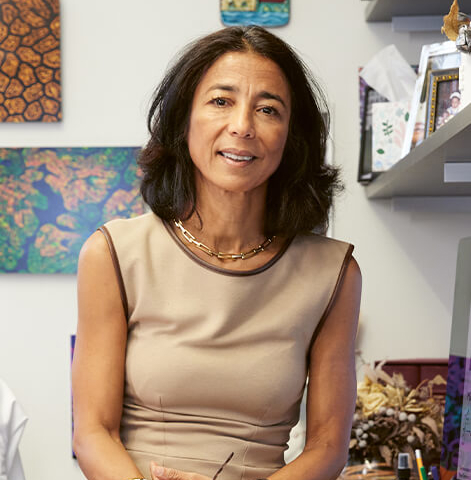
Reprogramming Macrophages: From Tissue Repair to Cancer Immunotherapy, ft. Dr. Miriam Merad
Dr. Patrick Hwu speaks with Dr. Miriam Merad, a leading physician-scientist in dendritic cell and macrophage biology at the Icahn School of Medicine at Mount Sinai. Dr. Merad reflects on her path from medicine to immunology and discusses how tissue-resident macrophages help maintain organ health but can also be fooled by tumors into supporting cancer growth. The conversation explores ways to reprogram macrophages for cancer treatment, the link between aging, inflammation and cancer risk, and the importance of multidisciplinary collaboration, data science and sustained research investment in advancing future cures.
What You’ll Learn with Dr. Miriam Merad
- The role of macrophages in cancer, inflammation and tissue repair
- Why cancer can exploit the body's natural wound-healing processes
- New immunotherapy approaches that target and reprogram macrophages
- The connection between aging, chronic inflammation and cancer risk
- The future of macrophage-based cancer treatments
- Mentorship strategies for developing the next generation of immunology leaders
Podcast Transcript
Dr. Patrick Hwu:
Welcome to The ImmunoVerse, a podcast that brings the ever-expanding universe of immunotherapy to life through the voices of those advancing this groundbreaking field. I’m Dr. Patrick Hwu, president and CEO of Moffitt Cancer Center and a career immunologist.
In each episode, I sit down with pioneering experts who have shaped the past, present and future of immunotherapy, uncovering the breakthroughs, challenges and science driving this lifesaving innovation.
Today, I’m honored to welcome Dr. Miriam Merad, Dean for Translational Research and Therapeutic Innovation at the Icahn School of Medicine at Mount Sinai. She is the chair of the Department of Immunology and Immunotherapy, and the director of both the Precision Immunology Institute and the Human Immune Monitoring Center at Mount Sinai.
Dr. Merad is an internationally acclaimed physician-scientist and one of the world’s foremost experts in dendritic cell and macrophage biology. Her discoveries have redefined our understanding of tissue-resident macrophages, revealing their crucial role in organ function, inflammation and cancer progression.
She is also a leader in translating immunology discoveries into clinical innovation, building one of the world’s most advanced immune monitoring centers and spearheading large-scale collaborations that bring together biologists, clinicians and computational scientists to decode the immune system. Dr. Merad has authored more than 200 primary papers and reviews in high-profile journals, and her work has been cited tens of thousands of times.
Dr. Merad, welcome to The ImmunoVerse.
Dr. Miriam Merad:
Thank you for having me, Patrick.
Dr. Patrick Hwu:
You have made so many foundational contributions to our understanding of macrophages and dendritic cells. But first, let’s talk about how you got into science in the first place.
Dr. Miriam Merad:
In fact, I never thought I would end up in science. I was always interested in it, but I was mostly interested in being a physician. I was raised in a family of physicians. My father is a cardiologist. My mother is a toxicologist. My uncles are surgeons and dermatologists. Medicine was part of the family, and I was very interested in it.
I wanted to treat very severe diseases. I was very interested in oncology very early on, and it was really through the treatment of patients that I became interested in immunotherapy and the science of immunology.
There were two things that really brought me to think about the scientific problem. One was when I trained as a bone marrow transplanter. Bone marrow transplant is really the first successful immunotherapy against cancer. At that time, we were realizing that the reason bone marrow transplant was curing severe leukemia or severe lymphoma was not because of the high-dose chemotherapy, which had been the initial hypothesis. You can give a lot of chemotherapy and then do a bone marrow transplant, but the cure comes from this immune response against cancer cells.
Bone marrow transplant is really the first successful immunotherapy against cancer.
So the area was very new to me, and I became very interested in the immune system.
Then, later on, when I started looking at the histology — the slices of tumor tissue from solid tumors — I observed all these immune cells. In some tumor lesions, you have more immune cells than cancer cells. Realizing that there was an immune response we could potentially harness made me very interested in this field.
At some point, I decided to do more research. I was in France and trained in France, but I decided to pursue a PhD in immunology at Stanford. Then I never went back to practicing medicine full time. Medicine is still very present in my work, but there is this scientific quest that is extraordinary and extremely addictive, and I have been following it for many years now.
Dr. Patrick Hwu:
One of your major discoveries was identifying tissue-resident macrophages. So what are macrophages, what are tissue-resident macrophages, and why are they important?
Dr. Miriam Merad:
The story of macrophages is an interesting one. I went to Stanford to learn immunology, but also to work on making a dendritic cell vaccine against cancer. Dendritic cells had been discovered decades earlier by Ralph Steinman, and I wanted to make a vaccine. But I thought that in order to make a successful vaccine, you had to understand where these cells come from so that you could potentially mobilize them, arm them and so on.
Dendritic cells were thought to be cousins of macrophages, so I decided I was going to learn everything about macrophages — which had been discovered much earlier — and apply that knowledge to dendritic cells.
So let’s talk about macrophages for a minute. What are they? They are a very interesting cell type. In fact, they are among the most conserved immune cell types, from small organisms to mammals. Every organism, every living organism, has macrophage-like cells, and their main role is to clear debris and repair tissue.
They do two things. They clear debris because debris always accumulates when cells are damaged. They act like vacuum cleaners, but at the same time, they know how to repair and how to detect threats. They were shaped during evolution and became more and more sophisticated. But if you go to the smallest organisms, you can find cells that clear damage and detect threats. So they are fascinating cells.
They [macrophages] act like vacuum cleaners, but at the same time, they know how to repair and how to detect threats. They were shaped during evolution and became more and more sophisticated. But if you go to the smallest organisms, you can find cells that clear damage and detect threats. So they are fascinating cells.
Macrophages are present in every organ of our body. In humans, they constantly survey tissue for potential threats and damage. When there is significant damage, they clear it. That turns out to be a very important way of maintaining organ health — in your heart, kidney, spleen and other tissues.
I became very interested in understanding how these cells populate organs if they are that important and conserved. If something is conserved, it means it is very important. So I spent a lot of time trying to understand where they come from, again with the idea of going back to dendritic cells.
The reason this is important is that it helped us realize there is a whole lineage of cells that are self-renewing in tissues and present in key niches in every organ. For example, they line our vessels, they line our neurons, and they are often close to stem cells, where they help ensure that tissues function properly.
In the nervous system, for example, they clear small pieces of neurons at the synapse. Neurons function through synapses, and those synapses have to be cleared properly to function well. Macrophages specialize in this. They do similar things when they are close to vessels. They also produce metabolites and growth factors.
I think there is a whole world still to discover with tissue-resident macrophages and how we can harness them.
Dr. Patrick Hwu:
That is fascinating. It used to be thought that all of our blood cells, including macrophages, came from the bone marrow, circulated in the blood and then infiltrated into tissues. But what you’re saying is that there is a macrophage population that is already present in tissues. These tissue-resident macrophages are very important for keeping tissues orderly, helping them heal and toning down inflammation.
These are very important cells because they help control inflammation so we don’t have too much of it, which can sometimes be life-threatening. But you’re also finding that, in some cases, macrophages can actually inhibit the body’s ability to fight cancer, right?
Dr. Miriam Merad:
That’s correct. This is again the story of the immune system. These tissue-resident macrophages can be fooled by tumor cells. Because they want tissue to heal, they may see the tumor as a wound that needs to be repaired.
What we found in a study we published — and what many others are also finding — is that in their desire to do good, to repair, they can end up repairing the tumor. They nourish the tumor and give it the ability to invade because they think it is part of a wound. They reorganize the matrix and the tissue, thinking the tissue will heal. But in doing that, the tumor progresses.
Their [macrophages] desire to do good, to repair, they can end up repairing the tumor. They nourish the tumor and give it the ability to invade because they think it is part of a wound. They reorganize the matrix and the tissue, thinking the tissue will heal. But in doing that, the tumor progresses.
We are also finding that they can be beneficial. There is a whole new literature on tissue-resident macrophages contributing to immunosurveillance. It is possible that early on, they can still detect that something is going wrong and eliminate damaged cells. But at some point, they are fooled by tumor cues and contribute to tumor progression.
This is the biology we are now focusing on in the lab: how we can harness tissue-resident macrophages in early lesions. When tumors are very established, we are finding that these macrophages are often excluded from the lesions. The lesions become dominated by monocyte-derived macrophage populations. Our understanding has already evolved so much.
Dr. Patrick Hwu:
So the tumor fools macrophages into thinking it is a wound, and by helping that “wound” heal, the macrophages can actually help the tumor grow.
The tumor fools macrophages into thinking it is a wound, and by helping that “wound” heal, the macrophages can actually help the tumor grow.
Dr. Miriam Merad:
That’s exactly right. Interfering with the repair mechanism could be helpful. That is what we are finding now: we need to tell them, “Don’t repair.”
We know how to target repair programs because many immunologists have been working on inducing repair systems. So we think this is an exciting path to explore further, and we are exploring it by targeting IL-4 receptor signaling, for example, among other pathways.
Dr. Patrick Hwu:
So IL-4 is one pathway. What about VEGF targeting?
Dr. Miriam Merad:
Yes, exactly. Macrophages are also a good source of VEGF. These macrophages are very good at promoting the growth of small vessels that nourish the tumor — again, because of the same desire to repair. They are promoting vascularization so the tumor will have nutrients, thinking it is a wound that needs to be well nourished so the tissue can repair.
VEGF, which is now being revisited with all the bispecific antibodies, is very interesting. IL-4, IL-33 and several other repair pathways are also pathways we are looking at.
Dr. Patrick Hwu:
You also mentioned that macrophages can directly kill cancer cells. In fact, the first lab I worked in as a medical student was a macrophage lab, where they were trying to kill cancers with macrophages. So how do we enhance the ability of macrophages to kill cancer cells?
Dr. Miriam Merad:
There is a lot of excitement about using macrophages to kill cancer because, in contrast to T cells, they are not dependent on recognizing one specific antigen. They recognize damaged molecules, including damage-associated molecular patterns, and those damage signals are often present in cancer cells.
Several groups are trying to see how we can enhance this clearing function. I often describe macrophages as vacuum cleaners. We want to let them clear the tumor, and you can see that they can do this quite well.
In fact, we have some very interesting studies in the lab right now with extraordinarily promising results. We are developing CAR T cells that target macrophages — particularly some of the harmful macrophage populations. These approaches can deplete some of the suppressive macrophages, but we are also producing payloads that make the remaining macrophage populations much more potent. So we reduce the suppressive population and then reeducate the rest of the macrophage population.
Those macrophages can become extremely powerful at eliminating cancer cells. We know this capacity exists because, in critical viral illnesses such as COVID-19, patients can die because inflammatory macrophages become so powerful that they destroy lung tissue. They want to get rid of virally infected cells, but they can become so powerful that they also eliminate normal cells.
So macrophages can be extremely good at eliminating damaged epithelial cells.
Those macrophages can become extremely powerful at eliminating cancer cells.
Dr. Patrick Hwu:
So the key is to block the pathways macrophages use to inhibit the immune system and enhance the pathways that allow macrophages to kill cancer directly. There are many ways we can manipulate macrophages to kill cancer cells.
Dr. Miriam Merad:
Yes, absolutely. You reduce their ability to repair and enhance their ability to clear. You also enhance their ability to activate other cells.
Macrophages are quite good at antigen presentation. This is something important to emphasize: they do all of this, but in addition, they can present antigen to the effector arm of the immune system. They are a very resourceful cell type that we can fully exploit in cancer treatment.
Dr. Patrick Hwu:
So macrophages can actually enhance the ability of T cells to kill cancer, too?
Dr. Miriam Merad:
Yes.
Dr. Patrick Hwu:
Very exciting. Cancer is a disease of aging, and a few months ago you had a really exciting paper discussing some of the mechanisms that may explain why we are more likely to develop cancer as we age.
Dr. Miriam Merad:
Yes. I am very excited about aging because I think aging is really a disease of inflammation. We are all realizing that with age, we somehow increase this inflammatory response, likely because of damaged cells.
There are two things that happen with age that would really benefit from immunologists thinking about how to repurpose many of the therapeutics we developed for inflammatory diseases to focus on aging.
First, there is an expansion of myeloid cells. For example, macrophages accumulate more in tissues because they are seeing more damage accumulating in organs. They are trying to determine whether they can get rid of that damage.
At the same time, we know there is a reduction in the effector arm of the immune system. T cells do not function as well at older ages as they do when we are younger. So you have a less effective immune arm and more macrophages that are responding to excessive damage that occurs with age. They are trying to get rid of the damage, but they themselves are also aging.
What we are realizing is that in every organ, these macrophages are not as helpful as they once were. They themselves are not as good at clearing damaged cells as they were when they were young because they are also aging.
This is part of a multidisciplinary group that we built at Sinai, and similar efforts are now being built across the aging research community. We realize that inflammation is, in fact, the cause of many age-associated diseases. At the center of all age-associated diseases, there is this excessive inflammation.
We realize that inflammation is, in fact, the cause of many age-associated diseases. At the center of all age-associated diseases, there is this excessive inflammation.
I would argue that this is potentially the most druggable system. This is the system we can interfere with the most. I think immuno-oncologists can again contribute to the field of aging by manipulating the immune system.
What I am studying most is how inflammation contributes to cancer and how we can interfere with it to prevent cancer. We have very exciting results right now.
Dr. Patrick Hwu:
Exciting. So what you’re saying is that many of the negative effects of aging are driven by inflammation. You’re identifying the pathways, cytokines and proteins that induce myeloid cells and macrophages to create this inflammation and contribute to some of the negative effects of aging, including the development of cancer. If we can understand this, we may be able to block those pathways and potentially prevent cancers from developing as we age.
Dr. Miriam Merad:
Absolutely.
Dr. Patrick Hwu:
That’s great. Now, how have you organized your work at Mount Sinai? You have an immune monitoring center and a multidisciplinary team with many different kinds of scientists. Tell us about your approach there.
Dr. Miriam Merad:
We recognized that in order to really treat cancer or prevent cancer, we had to understand the organization of these lesions. You have to understand, with granularity, the molecular composition and cellular composition.
To do that, we needed different types of scientists and different groups of clinicians. For example, it was very important for us to work closely with pathologists to have access to informative pipelines. We had to work with surgeons who could give us access to tumor tissue at different time points during treatment, including prior to treatment. We also had to work with interventional radiologists who could help us follow what happens in tumor regions during treatment.
This is something we need to learn: how a tumor is organized and how it responds to treatment. That knowledge base is what will lead to cures.
How a tumor is organized and how it responds to treatment. That knowledge base is what will lead to cures.
So we organized an extraordinary multidisciplinary team that brings together many different clinicians — surgeons, interventional radiologists, pathologists and medical oncologists — as well as scientists, including basic immunologists, mouse modelers, organoid experts, and computational and AI experts who help us understand the data we are generating.
Our goal is to accelerate knowledge from the basic science side to the clinic. We have a whole team constantly looking at technologies that could help us better understand human biology.
Everything we do in the immunology institute and department I lead begins with human biology. Before you hypothesize anything, go and study human lesions seriously. Hypothesize as much as you can, and then test causality in the model of choice — animal models, organoids, ex vivo cultures, all of it. But the important thing is to look at the database of knowledge we have created and that the field is creating.
We also spend a lot of time downloading datasets that have been published. There is a whole group that constantly downloads datasets. We should really take advantage of the explosion of data being generated. There is nothing sadder than not analyzing datasets that are already out there, published and potentially extremely useful.
This is where our computational, mathematics and AI colleagues work very closely with us. I think the future is very bright if we continue to have the funding this field deserves. I think the limitation for progress now is funding and the ability to test all these different permutations based on the knowledge we have generated.
We are so close, I think, to finding many cures. What we need is an influx of resources to test these ideas and continue generating the right datasets.
Dr. Patrick Hwu:
It’s a really exciting world. When we bring together datasets and different kinds of scientists, that’s where the magic happens — from decreasing the effects of aging to eliminating cancer and preventing it in the first place. There is so much potential.
You have also mentored many people in the field. Some of your mentees are becoming leaders themselves in immunology and immunotherapy. What is your philosophy about mentorship?
Dr. Miriam Merad:
I think it is always a privilege to be able to mentor. Nothing we do in science can be learned alone. It is always a privilege to have all these talented people come to you, and I have been shaped by them as much as I have shaped them.
They come with their enthusiasm, ambition, knowledge and intellectual power. The thing I like most is interacting with all these extraordinary minds and then seeing them influence the field. I think it is a privilege to be able to mentor.
I think it is always a privilege to be able to mentor. Nothing we do in science can be learned alone. It is always a privilege to have all these talented people come to you, and I have been shaped by them as much as I have shaped them.
Dr. Patrick Hwu:
Wonderful. It is evident that you are passionate about mentorship, and you have truly mentored some of the leaders in the field.
We want to thank our guest, Dr. Miriam Merad, for joining us today. And thank you for going on this journey with us through the ever-expanding universe of immunotherapy. To hear more episodes of The ImmunoVerse, make sure to subscribe on your favorite podcast platform.