

Expanding Breast-Conserving Options for Complex Breast Cancer Through Oncoplastic Breast Surgery
For select breast cancer patients, oncoplastic surgery can expand breast-conserving options when tumor size, disease distribution or the extent of tissue removal needed makes conventional lumpectomy less suitable. By combining oncologic resection with reconstructive techniques, surgeons can remove the necessary tissue while preserving breast form when clinically appropriate. While not everyone is candidate for oncoplastic surgery up to 90% of patients can be offered the procedure if desired.
Early identification and referral can help preserve the full range of breast-conserving and reconstructive options before definitive surgery.
Key Takeaways for Referring Providers
- Disease distribution matters alongside tumor size. A large tumor-to-breast ratio, multifocal or multicentric disease, DCIS and invasive lobular carcinoma may warrant oncoplastic evaluation when an adequate resection is expected to create a significant breast defect.
- Neoadjuvant response may change surgical candidacy. Patients who initially appear more likely to require mastectomy may warrant reassessment for breast conservation following a favorable response to systemic therapy.
- Oncoplastic techniques can facilitate wider excision. Volume displacement and replacement techniques allow the surgical defect to be addressed as part of the oncologic operation.
- Evidence supports favorable surgical outcomes. A 2024 meta-analysis involving 46,835 patients found lower risks of positive margins, re-excision and mastectomy with oncoplastic versus conventional breast-conserving surgery.¹
When Oncoplastic Surgery May Change the Surgical Approach
The clinical value of oncoplastic surgery is particularly relevant when the location or volume of tissue required for an adequate oncologic resection is expected to leave a significant breast defect.
Depending on breast anatomy, tumor location and anticipated resection volume, the operative approach may incorporate local tissue rearrangement, therapeutic breast reduction, mastopexy or rotational or advancement flaps. These techniques allow the defect created by tumor removal to be incorporated into the surgical plan rather than addressed as a separate consideration.
Patient selection remains individualized. Disease extent and biology, breast anatomy, anticipated resection volume, systemic treatment response, radiation considerations and patient preferences all influence whether an oncoplastic approach is appropriate.
Disease Characteristics That Can Influence Breast Conservation
Tumor size is only one factor in determining whether breast conservation is an option. The location and extent of disease within the breast can also influence the surgical approach.
For patients with DCIS or invasive lobular carcinoma, disease may involve a larger area of the breast and require more extensive tissue removal than initially anticipated. Oncoplastic techniques can help surgeons address the resulting defect while maintaining breast conservation when clinically appropriate.
Patients with multifocal or multicentric disease may also have breast-conserving options depending on the location of the tumors, breast anatomy and ability to achieve appropriate margins.
Treatment response can further change the surgical plan. For patients with larger tumors who respond well to neoadjuvant therapy, breast conservation may become an option even when mastectomy was initially anticipated.
Oncoplastic breast surgery is more than simply offering patients an exciting new spectrum of surgical options; it is a paradigm shift: a new way of thinking about how we as surgeons approach tumors in the breast.
-Nicholas Champion, MD
Timing Can Preserve Surgical Options
The initial operation can influence which breast-conserving and reconstructive options remain available. When there is uncertainty about whether conventional lumpectomy can achieve an appropriate oncologic resection without creating a significant breast defect, evaluation before definitive surgery allows additional approaches to be considered.
This is particularly relevant when disease extent or distribution complicates conventional breast conservation, when the anticipated resection is likely to result in significant deformity, or when response to neoadjuvant therapy has changed surgical candidacy.
Early evaluation does not commit a patient to an oncoplastic procedure. It allows the surgical team and patient to consider the available options before the first operation potentially narrows them.
Evidence, Outcomes and Clinical Considerations
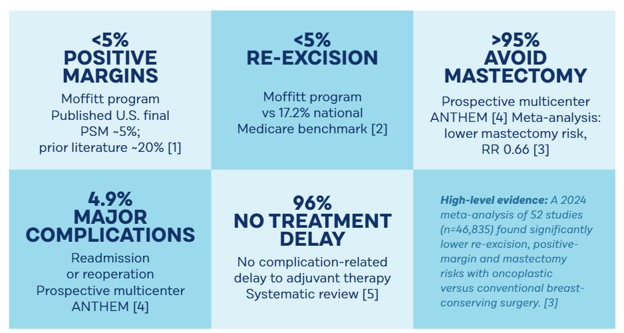
Evidence supporting oncoplastic breast-conserving surgery continues to mature.
A 2024 meta-analysis of 52 studies involving 46,835 patients found significantly lower risks of positive margins, re-excision and mastectomy with oncoplastic breast-conserving surgery compared with conventional breast-conserving surgery.¹
Prospective multicenter findings from the ANTHEM study provide additional data. Among women offered oncoplastic breast-conserving surgery as an alternative to mastectomy, more than 95% avoided mastectomy. Major complications requiring readmission or reoperation occurred in 4.9% of patients.²
Procedure-specific morbidity remains an important consideration. Potential complications can include wound dehiscence, infection, seroma, changes in nipple sensation and, less commonly, nipple necrosis. Of particular relevance when coordinating multimodality treatment, a systematic review of oncoplastic breast reduction found that 96% of patients experienced no complication-related delay in adjuvant therapy.³
These outcomes underscore the importance of patient selection and matching the operative technique to the extent of disease, breast anatomy and anticipated treatment course.
Advanced Expertise for Complex Breast-Conserving Surgery
Complex breast-conserving surgery requires experience in both oncologic decision-making and advanced oncoplastic techniques. Moffitt's high-volume breast surgical program offers a full spectrum of oncoplastic approaches and has achieved program positive-margin and re-excision rates below 5%.
Moffitt's oncoplastic breast surgery experts include:
- Brian Czerniecki, MD, PhD, department chair, Reconstructive Oncology
- Nicholas Champion, MD, assistant member, Surgical Oncology
Together, they provide advanced surgical care for patients with complex breast cancers.
For cases requiring broader treatment planning, surgical decisions can be coordinated with experts in medical oncology, radiation oncology, radiology, pathology, plastic surgery and genetic counseling. This is particularly relevant when breast-conserving candidacy depends on disease extent, response to systemic therapy, anticipated radiation or reconstructive considerations.
Connect With a Physician Relations Liaison
For consultation or referral, Moffitt's Physician Relations liaisons can connect referring providers with our breast oncology experts and assist with referral coordination.
Email PhysicianRelations@Moffitt.org or complete our patient referral form.
Selected Evidence
Tian R, et al. Efficacy and safety of oncoplastic breast-conserving surgery versus conventional breast-conserving surgery: an updated meta-analysis. Breast. 2024;77:103784. PMID: 39126920.
Davies C, et al. Clinical and patient-reported outcomes in women offered oncoplastic breast-conserving surgery as an alternative to mastectomy: ANTHEM multicentre prospective cohort study. BJS. 2025;112(1). PMID: 39718969.
Benedict KC, et al. Oncoplastic Breast Reduction: A Systematic Review of Postoperative Complications. Plast Reconstr Surg Glob Open. 2023;11(10). PMID: 37850204.
Hotsinpiller WJ, et al. Rates of margin positive resection with breast conservation for invasive breast cancer using the NCDB. Breast. 2021. PMID: 34520952.
Kaczmarski K, et al. Surgeon Re-Excision Rates after Breast-Conserving Surgery: A Measure of Low-Value Care. J Am Coll Surg. 2019;228(4):504-512.e2. PMID: 30703538.
Published outcomes reflect study-specific patient selection, procedures and outcome definitions.
 Medically reviewed by Brian Czerniecki, MD, PhD, Breast Oncology Department