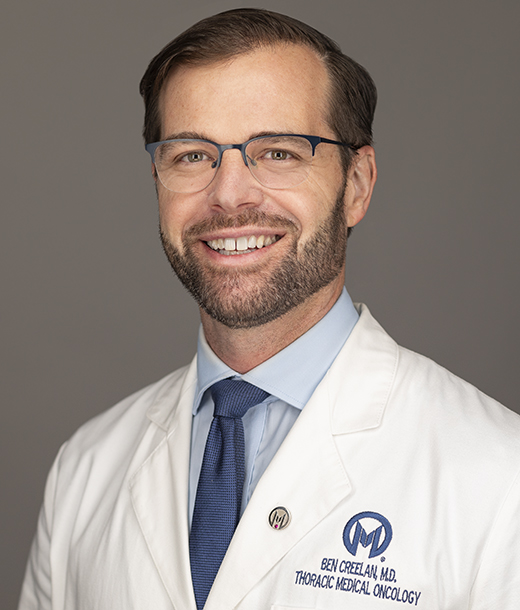
Beyond Checkpoint Inhibitors in Lung Cancer, ft. Dr. Ben Creelan
Dr. Patrick Hwu sits down with Dr. Ben Creelan, a medical oncologist and researcher at Moffitt Cancer Center, to explore how cell therapy could help patients with lung cancer whose tumors stop responding to immunotherapy.
They discuss Dr. Creelan’s early clinical trial using immune cells taken from patients’ own tumors. Some patients’ tumors shrank, and a few had lasting complete responses. They also explore how tumors can escape treatment by losing the targets immune cells recognize and how researchers are designing cell therapies to recognize more than one target.
Dr. Creelan also shares how his father’s experience with an early cell therapy trial inspired his interest in cancer research and why he encourages young scientists to take risks and learn from experiments that don’t go as planned.
What You'll Learn from Dr. Ben Creelan
-
Moffitt's tumor-infiltrating lymphocyte (TIL) trial produced lasting responses in some patients with metastatic non-small cell lung cancer.
-
How CAR T, TCR and TIL cell therapies may help patients who don't respond to PD-1 checkpoint inhibitors.
-
Why cancer-testis antigens like MAGE, plus TROP-2 and DLL3, are promising targets for EGFR-mutant and low-mutation lung cancers.
-
His 2025 Nature Cancer study on tumor antigen loss, and why combining CAR T with TILs may prevent escape.
-
New IL-15, natural killer (NK) cell and in vivo CAR T approaches, plus his advice on embracing failure.
Podcast Transcript
Dr. Hwu: Welcome to The ImmunoVerse, a podcast that brings the ever-expanding universe of immunotherapy to life through the voices of those advancing this groundbreaking field. I’m Dr. Patrick Hwu, president and CEO of Moffitt Cancer Center and a career immunologist. In each episode, I sit down with pioneering experts who have shaped the past, present, and future of immunotherapy. We explore the breakthroughs, challenges, and science driving this lifesaving innovation.
Today, I’m pleased to welcome Dr. Ben Creelan, a medical oncologist and physician-scientist at Moffitt Cancer Center whose work focuses on developing new immune-based therapies for patients with lung cancer. Dr. Creelan earned his medical degree from Jefferson Medical College and completed his residency in internal medicine at Thomas Jefferson University. He went on to complete a fellowship in hematology and oncology through the University of South Florida at Moffitt Cancer Center and earned a master’s degree in clinical and translational research from USF. His research sits at the intersection of the laboratory and the clinic. He uses new insights into the biology of lung cancer and the immune system to develop more effective and personalized treatments.
Welcome to The ImmunoVerse, Dr. Creelan.
Dr. Creelan: So happy to be on the show today, Patrick.
Dr. Hwu: So tell me, where did you grow up, Ben, and what got you interested in medicine, the immune system, and lung cancer?
Dr. Creelan: I grew up in the middle of nowhere in rural Oregon, 10 miles from anything and maybe 30 minutes from the nearest big town. The crazy thing is that my dad got kidney cancer and received cell therapy right off the bat in a trial. It worked for a while, and I think that’s one of the things that got me interested in medicine and in cancer.
Dr. Hwu: Wow, that was early for cell therapy. Where did he get that?
Dr. Creelan: He had a tumor removed at the hospital where we lived, and it was shipped to Harper Hospital in Detroit. He was 50 years old and flew across the country with metastatic kidney cancer. This was around 2002. He almost died. I think there may have been bacterial contamination of the cell product, but he survived, and somehow the cancer cleared for a time.
Dr. Hwu: Wow. That was in the early days of cell therapy.
Dr. Creelan: Very early.
Dr. Hwu: That’s really inspiring. Is that what got you interested in the immune system?
Dr. Creelan: Yeah. My twin brother was also working in mouse immunology at the time, and he was always telling me how often he got bitten by mice. That steered me away from lab research. I ended up focusing more on clinical medicine.
Dr. Hwu: Yeah, mice can bite. Certain strains bite more than others.
Dr. Creelan: Is that right? If people in my family were mice, some of them would definitely bite more than others.
Dr. Hwu: That’s great. When did you decide you wanted to be a doctor? And when did you decide you wanted to be a lung cancer doctor?
Dr. Creelan: I held off on saying it because it seemed like everyone who said they were going to be a doctor ended up doing something else. So I kept that to myself. I went to medical school in Philadelphia the year after I graduated. It was a long way from Oregon. A lot more cheesesteaks, a lot more subways. It was an eye-opening experience.
Dr. Hwu: A lot of the immunotherapy field grew out of work in kidney cancer and melanoma. Decades ago, when we were first trying to get the immune system to attack cancer, many of us were melanoma doctors. In melanomas that start in the skin, UV exposure can damage the DNA in melanocytes. Some of those changes can create targets the immune system recognizes. Why did it take longer for the field to see that lung cancer could also respond to immunotherapy?
Dr. Creelan: We had clues that the immune system mattered. For example, transplant recipients who take drugs to suppress the immune system have a higher risk of certain cancers, including some lung and skin cancers. But it took the checkpoint inhibitor revolution to show us just how dramatically some lung tumors could shrink when the brakes on the patient’s own T cells were released. I remember the early days of PD-1 inhibitors, around 2010, and how much excitement there was. All of a sudden, people were going into immunology and immunotherapy for lung cancer, and that changed things for a subset of patients. Some patients have lasting responses, but many still see their cancer progress. We still have a long way to go.
Dr. Hwu: Some patients can really benefit from immune checkpoint inhibitors, which take the brakes off immune cells so they can attack the cancer. They’re FDA-approved for some lung cancers. What’s the next step for patients who don’t respond? You’ve focused on cell therapy. What is it, and how might it help?
Dr. Creelan: Checkpoint inhibitors help a subset of patients. But if there aren’t enough tumor-reactive immune cells there to begin with, how do we get more into the tumor? That’s where cell therapy comes in. We infuse live cells into the patient. It’s a living drug that can travel to the tumor and recognize targets on cancer cells. Sometimes those targets come from mutations that create abnormal proteins. There are tumor-infiltrating lymphocytes, or TILs, which were one of the earliest approaches, and there are also CAR T cells and T-cell receptor therapies.
We infuse live cells into the patient. It’s a living drug that can travel to the tumor and recognize targets on cancer cells.
In 2014, I wrote a review about how cumbersome TIL therapy could be. You have to remove a piece of tumor, grow the immune cells from it in the lab using cytokines such as IL-2, and expand them into an army of billions of cells before infusing them back into the patient.
In our trial, we gave chemotherapy beforehand to make room for the infused cells to expand. We also gave IL-2 afterward, which can cause fever and low blood pressure. At the time, I thought TIL therapy would be hard to pull off in lung cancer. And what were we doing a few years later? With support from Stand Up To Cancer, we were testing it right here at Moffitt.
I don’t think anyone expected to see anything dramatic. Yet in that early trial, we saw tumors shrink in some patients and saw complete responses that lasted.
Dr. Hwu: It’s really exciting. Your team led an early clinical trial of tumor-infiltrating lymphocyte therapy in patients with metastatic non-small cell lung cancer. You take a piece of tumor, grow the immune cells from it into billions of cells in the lab, and infuse them back into the patient. What stood out to you about the responses you saw?
Dr. Creelan: We saw signs of activity even in some cancers driven by specific genetic alterations. We see some of these alterations in people who’ve never smoked. A single driver alteration can fuel the growth of the cancer, and checkpoint inhibitors alone often have limited activity in some of these tumors.
Dr. Hwu: Some of these cancers occur in younger people and in women who’ve never smoked, and we still have questions about why they develop. Some tumors driven by a single genetic alteration carry fewer mutations, which can mean fewer mutation-derived targets for the immune system. Yet you saw that TIL therapy could work in some patients. If there were relatively few mutations, what were the T cells recognizing?
Dr. Creelan: Cancer cells can express unusual proteins, including when they’re under stress from treatment. Some of these targets are called cancer-testis antigens. The MAGE family is one example. MAGE stands for melanoma-associated antigen, and these proteins can also be found in cancers beyond melanoma. We were able to identify and track some of the T cells that recognized tumor antigens. What’s interesting is that we might be able to go after drug-tolerant persister cells by looking for the proteins they express under stress. That may be their Achilles’ heel.
Dr. Hwu: What kinds of antigens are you finding on these resistant cells? And how might you modify T cells to recognize and kill cancer cells that carry those antigens?
Dr. Creelan: I think cancer-testis antigens are attractive targets. TROP-2 is another potential target, although there’s a risk of what we call on-target, off-tumor toxicity because some normal cells also express it. We also sometimes see EGFR-mutant lung cancers change into small cell lung cancer, a process called small cell transformation.
Dr. Hwu: Right, in some of those EGFR-mutant cancers.
Dr. Creelan: DLL3-targeted CAR T cells are being studied in small cell lung cancer. Whether they’ll help patients whose tumors have undergone small cell transformation is still a research question. There’s one really beautiful thing about CAR T cells. They can recognize a target directly on the cancer cell’s surface. Conventional T cells rely on proteins called HLA to show them pieces of what’s inside a cell. Think of those as ID tags. Some lung cancers lose or reduce that HLA signal, which can make them harder for conventional T cells to recognize. A CAR T cell or a T-cell-engaging bispecific antibody can recognize a surface target directly.
I think the real revolution could come when we combine these technologies. In 2025, we published a study in Nature Cancer looking at what happened when some of the tumors from our earlier TIL trial progressed. In some samples, tumors had lost antigens that the infused T cells previously recognized. We also found that some tumor-reactive T cells declined over time or showed signs of dysfunction. Cancer can change its spots. If you rely on a single target, the tumor may escape by losing it.
Cancer can change its spots. If you rely on a single target, the tumor may escape by losing it.
Dr. Hwu: So you’re saying that if you combine approaches like CAR T cells, engineered T-cell receptors, and TILs, you could give the immune system more ways to recognize the tumor and make it harder for the cancer to escape.
Dr. Creelan: Yeah. We’re even looking at putting CARs into TILs. That might sound bonkers, because it’s hard enough to make TILs or CAR T cells on their own. But doing both in the same cell could change things. Another idea we’re exploring, and it’s still very early, is designing CARs that turn on in response to conditions in the tumor, such as acidity or low oxygen. If you can control those receptors like a dimmer switch, I think you can move the ball down the field. With checkpoint inhibitors, we’ve made progress, but in lung cancer we still have a long way to go before we can reliably achieve lasting remissions.
Another idea we’re exploring, and it’s still very early, is designing CARs that turn on in response to conditions in the tumor, such as acidity or low oxygen. If you can control those receptors like a dimmer switch, I think you can move the ball down the field.
Dr. Hwu: We have to find ways to attack the cancer while protecting healthy tissue. Very few targets are found exclusively on cancer cells. The idea is to turn the receptors on once the cells reach the tumor neighborhood, with the hope of limiting damage to healthy organs. That’s an exciting direction for cell therapy in lung cancer.
Dr. Creelan: Another exciting strategy is activating natural killer cells, or NK cells. I’d say 2025 was the year of IL-15. It’s a protein that can support both T cells and NK cells. NK cells can respond when cells are missing normal HLA signals, those ID tags we were talking about.
One example that comes to mind is OBX-115, an investigational TIL therapy from Obsidian Therapeutics. The cells are designed so that an oral drug can regulate IL-15 on their surface. At ASCO in 2025, the researchers reported responses in four of six patients at the selected dose level and in four of 11 patients overall. Those were early results in patients with advanced melanoma whose cancer had resisted checkpoint inhibitors.
Dr. Hwu: Would you say we’re just at the tip of the iceberg for cell therapy in lung cancer and other diseases? There’s so much to explore with T cells and with other types of immune cells, like the natural killer cells you mentioned. Could combining those approaches make it harder for the tumor to escape? We can also explore ways to help these cells recognize tumors, give them the signals they need to persist, and recruit other immune cells. The future is exciting.
Dr. Creelan: For the doubting Thomases out there who ask whether we can make a separate cell product for every patient, there’s an approach called in vivo CAR T-cell therapy. The idea is to give a vector that delivers instructions to a patient’s immune cells so they can make the targeting receptor inside the body. It could simplify treatment and potentially lower costs. That’s still being studied.
Dr. Hwu: People ask whether cell therapy can be scaled up. There are already ways to expand cells outside the body, and generating CAR T cells inside the body could make it easier to treat more patients. It’s still early, but it’s exciting to see that approach being tested.
Dr. Creelan: We have early trials at Moffitt exploring that approach, including one in multiple myeloma.
Dr. Hwu: The future is bright for cell therapy in cancer. You trained here as a fellow and went on to build a successful career. What advice do you have for young people just entering the field?
Dr. Creelan: I think we need to be more willing to fail. When you’re starting out, it’s tempting to go for what’s easy or safe. But you’re never going to get into the end zone, like I said earlier, if you keep making the same running plays. You’ve got to take some risks. As institutions and as leaders, we need to encourage that. We need to be able to say, “Your study didn’t work. Okay, let’s move on to the next one.” The effort it takes to get a project off the ground, have it fail, and start again scares a lot of younger scientists and doctors. We need to change that culture.
Dr. Hwu: You’re right. Many of the experiments we try in the lab and in the clinic don’t work initially. We have to embrace that if we’re going to take the risks that lead to real advances in medicine. That’s great advice, Ben.
Thank you to our guest, Dr. Ben Creelan, for joining us today. And thank you for coming on this journey with us through the ever-expanding universe of immunotherapy. To hear more episodes of The ImmunoVerse, subscribe on your favorite podcast platform.