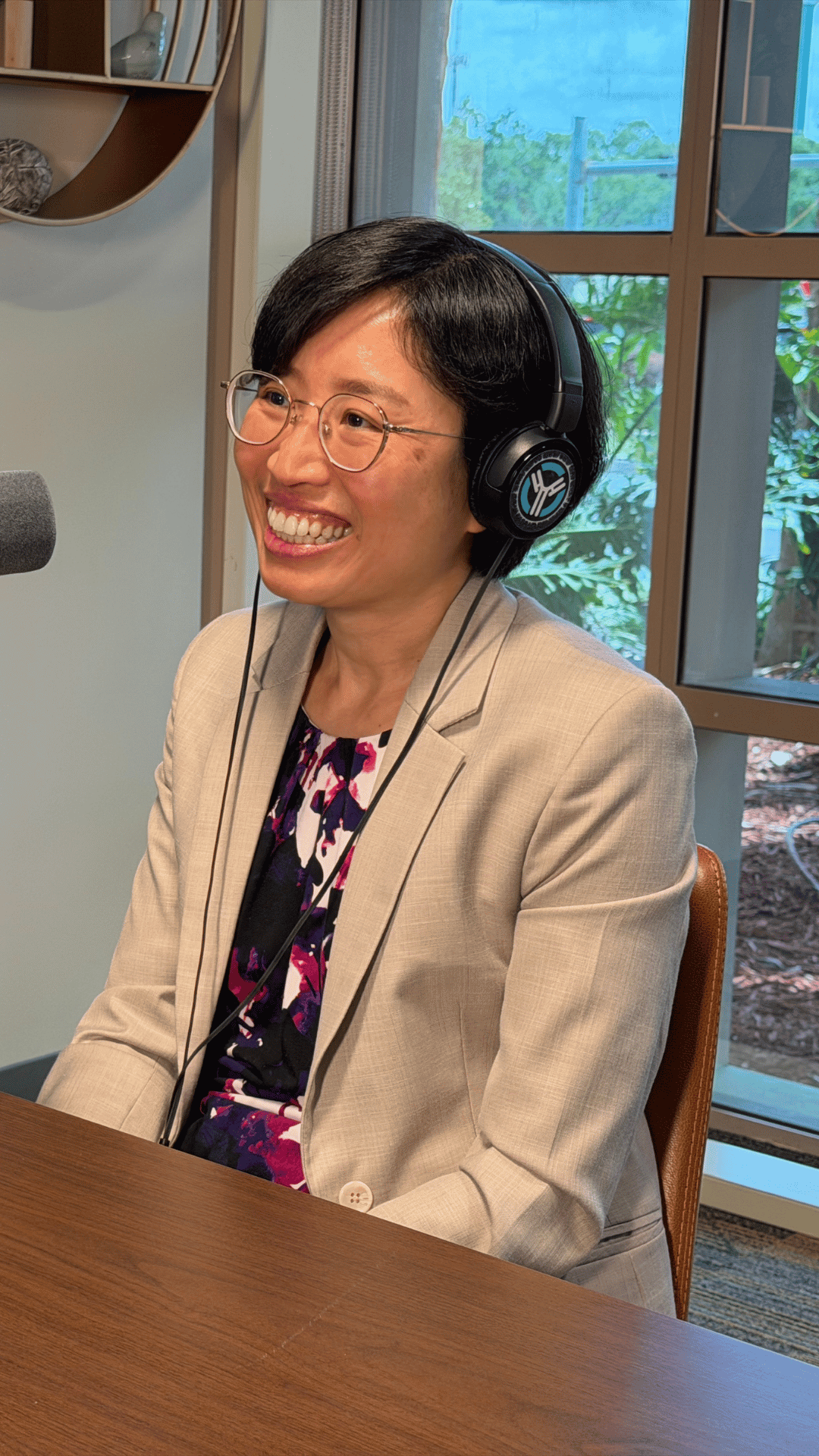
Reengineering CAR T Cells for Solid Tumors, ft. Dr. Yvonne Chen
Dr. Patrick Hwu speaks with Dr. Yvonne Chen about how engineering is shaping the future of CAR T-cell therapy. They discuss logic-gated CAR T-cells, strategies to prevent tumor escape, and new approaches for treating solid tumors such as glioblastoma. Dr. Chen also shares how her engineering background influences both her research and mentorship style.
What You’ll Learn with Dr. Yvonne Chen
- How engineering principles are helping advance the design of safer, more effective CAR T-cell therapies
- Logic-gated CAR T-cells can improve precision and help prevent tumors from escaping treatment
- Why recruiting the body’s own immune cells may be key to overcoming the challenges of treating solid tumors
- Engineered CAR T-cells are being designed to reshape the tumor microenvironment and enhance antitumor responses
- New approaches being explored to improve CAR T-cell therapy for glioblastoma and other difficult-to-treat cancers
Podcast Transcript
Dr. Hwu:
Welcome to The ImmunoVerse, a podcast that brings the ever-expanding universe of immunotherapy to life through the voices of those advancing this groundbreaking field. I'm Dr. Patrick Hwu, president and CEO of Moffitt Cancer Center and a career immunologist. In each episode, I sit down with pioneering experts who have shaped the past, present, and future of immunotherapy, uncovering breakthroughs, challenges, and the science driving this lifesaving innovation. Today we have with us Dr. Yvonne Chen, professor of microbiology, immunology, and molecular genetics at University of California, Los Angeles, and co-director of the Tumor Immunology and Immunotherapy Program at the UCLA Health Jonsson Comprehensive Cancer Center. Dr. Chen is a leader in the field of engineered immune cell therapies with a focus on advancing chimeric antigen receptor or CAR T-cell design to improve safety, precision, and effectiveness against cancer. Her work explores how to program immune cells with greater control, enabling therapies that can better distinguish between healthy and cancerous tissues and respond more dynamically within the tumor environment.
Through her innovative research, Dr. Chen is helping to push the boundaries of what cell-based immunotherapies can achieve and expanding their potential to benefit more patients. Welcome to The ImmunoVerse, Dr. Chen.
Dr. Chen:
Thank you.
Dr. Hwu:
So tell me, how did you get into science?
Dr. Chen:
Oh.
Dr. Hwu:
Because you're an engineer. You were trained as a chemical engineer, right?
Dr. Chen:
Right. Yeah.
Dr. Hwu:
So how did you get into biology?
Dr. Chen:
So I think I've always, among the sciences, I've always been the most interested in biology. And when I got to college, I actually told my mom I wanted to be a history major, and that did not go over well. And then I actually said I wanted to be a biology major and she asked, "Are you going to go to medical school?" And I said, "No." And then she said, "Then you're not going to be a biology major." Very practically minded and chemical engineering was sort of an acceptable major and it was the closest to biology at the time. Bioengineering wasn't really a thing yet when I was an undergrad. And so I majored in chemical engineering, but sought out sort of research opportunities in the bio side of things. And so I worked in a lab that worked on cell-free protein synthesis. And I just thought I can do this all day.
I really enjoyed being in the lab. And so I decided to go to graduate school and eventually ended up in CAR T-cell engineering.
Dr. Hwu:
Wonderful. And do you feel that that engineering background has helped you in your biology?
Dr. Chen:
Yeah. I mean, I think as an engineer, you're trained to sort of break down the problem, right? Understand what is the problem? What are your parameters? What are the knowns? What are the unknowns? And then you try to find a solution that is practical, that can actually be implemented. And I think we try to apply that in our research. I think a lot of times it's actually easier to come up with a very complicated solution to a problem, but if it doesn't actually work in the real world, then its impact is limited. So I think the engineering training comes into play in terms of thinking about how do you come up with a practical solution that solves the problem. I think the other part where it comes into play is sort of because I wasn't trained as an immunologist, sometimes there were things that we tried that perhaps a trained immunologist wouldn't have tried because it wouldn't have made a whole lot of sense, but we didn't know any better.
So we just tried it and sometimes it works. And so I think we also benefited in some ways from not having as many constraints that one would've learned from formal training.
I think as an engineer, you’re trained to sort of break down the problem.
Dr. Hwu:
So that engineering background and being an outsider to immunology has really helped you.
Dr. Chen:
I think so.
Dr. Hwu:
Yeah. Well, you have your practical parents to thank for everything.
Dr. Chen:
Yes. Very practical parents.
Dr. Hwu:
I get it. I get it. You should have seen in eighth grade when I told my Asian parents I wanted to be a music major.
Dr. Chen:
You need to practice your piano and your violin, but not become a musician.
Dr. Hwu:
Yes. There was quite a reaction to that. Consequently, I didn't become a music major.
Dr. Chen:
Well, thankfully, I never had the talent for it. Yeah.
Dr. Hwu:
Yeah. Wonderful. Well, tell us, how did you get into immunology and T-cell therapy?
Dr. Chen:
Between undergrad and grad school, I actually deferred graduate school for a year and I worked at Merck, the pharma company. And I worked on what eventually became Gardasil, which is the HPV vaccine. And that was my first exposure to any immunology at all. And I loved the idea of vaccines. Why not prevent the disease from happening instead of waiting until the disease happened and then fixing it? And so when I got to graduate school, I joined the lab where there was already sort of discussions about collaboration between our group, which focused on RNA engineering with the group of Dr. Michael Jensen, who was at City of Hope at the time, and he's a CAR T-cell person. And my project was to actually engineer these ribozyme switches. And so that's how I sort of first got exposed to CAR T-cells and T-cell therapy, but I was the RNA engineer, not the T-cell engineer.
And as I was finishing up graduate school, I applied for various positions and was selected as a junior fellow for the Harvard Society of Fellows, which starts in the fall. And I defended in December, so I had an eight-month gap. And Dr. Jensen was kind enough to say, "Why don't you come up to Seattle Children's where he had moved and help him start up his new lab?" And so I was there for eight months. And during that time, Dr. Carl June's group published their two CD19 CAR T-cell papers. And that's when I decided this CAR T-cell thing sounds pretty cool. It seems cooler than RNA engineering—famous last words. And that's when I started working on these logic-gated CAR T-cells. I was lucky to get my first NIH grant when I was in Boston and sort of went from there. Yeah.
Dr. Hwu:
Wow. Well, let's remind everybody what a CAR T is first and foremost.
Dr. Chen:
Sure. So CAR stands for chimeric antigen receptor, C-A-R. And it's essentially a fusion protein that allows CAR T-cells to recognize a programmable antigen. So for example, the first FDA-approved CAR T-cell therapies targeted CD19, which is a protein on B-cells. And CD19 CAR T-cells can then be used to treat B-cell malignancies, leukemias, lymphomas. And basically what the CAR does is it redirects T-cell specificity toward target cells that express the antigen you ask the CAR to recognize. And that allows us to essentially commandeer what is naturally occurring in the patient against the tumor cell. And the way we do it is we, or at least traditionally the way we do it is we take the T-cells out of the patient. We genetically modify them usually with the virus to introduce the DNA that encodes for the CAR. We then expand the engineered T-cells ex vivo in the lab, freeze them, and then infuse them back into the same patient.
So it's autologous. Nowadays, people are working on both allogeneic, meaning donor-derived CAR T-cells, as well as in vivo CAR T-cells where instead of taking the T-cells out for modification and then putting them back in, you just directly inject either a lipid nanoparticle or a viral vector to generate the CAR T-cells inside the patient.
Dr. Hwu:
Yeah, it's a very exciting progress that's being made. So in general, chimeric means it's a fusion of a chimera of an antibody fused to T-cell receptor. So when you put that gene into an immune cell, it then redirects and educates that immune cell to go and kill the cancer cell. And we've had some really good results and FDA-approved agents in lymphoma. And the challenge is the receptor recognizes a surface protein. And out of our 20,000 genes, there's only a small percentage that are surface proteins. And sometimes it's hard to find a surface protein that's on the cancer, but not on normal tissues. And so that's why you've done some logicating. So why don't you explain what that logicating is so that we can direct a T cell to kill the cancer without harming normal tissues? Yeah,
Dr. Chen:
Excellent. So there are several challenges with sort of the idea of engineering T-cells to target an antigen. So the ideal antigen is something that is highly expressed on tumor cells, uniformly expressed on tumor cells, meaning every copy of the tumor cell expresses it, and not expressed on healthy tissue you do not wish to harm. And those three criteria eliminate just about everything that we know. And so usually we end up having to target something that is non-ideal. Very often we end up targeting something that is present not only on tumor cells, but also on healthy tissue. CD19, for example, as I mentioned earlier, is a B-cell marker. It's on cancerous B-cells as well as all healthy B-cells. And so patients who respond to CD19 CAR T-cell therapy end up with B-cell aplasia or the depletion of healthy B-cells. Now it turns out B-cell aplasia is a manageable condition.
You can give patients antibody injections, IVIG, to make up for the fact that they don't have B-cells to produce antibodies for them. So that's a situation where it's a tolerable side effect. But there are other antigens, for example, HER2 or CEA where the CAR T-cells end up attacking the lung or the GI tract where the side effect is not tolerable. And so to address that particular issue, you can use logic gates that are one we call AND gates or AND-NOT gates. So an AND gate is something that would only react to a target when the target presents both antigen A and antigen B. So you now need two different inputs simultaneously present or sequentially present depending on how you design it in order to trigger a response. And the idea is this would increase specificity because hopefully the healthy tissue would not have both of those signals and only the tumor would trigger the T-cell reaction.
And various groups have come up with very clever ways to execute something like an AND gate. For example, a very famous system is called synNotch where you have a synthetic notch receptor as the initial trigger. So you see antigen A by the synNotch and then the synNotch releases a transcription factor that then drives the expression of a CAR that responds to antigen B. And so now you need to see both A and B before the target cell gets killed. The tricky thing about using something like an AND gate or an AND-NOT gate is you make it easier for the tumors to escape. Because now as long as the tumor loses either A or B, it can become invisible to the CAR T-cells. And so antigen escape is sort of the flip side of the coin and you can actually address antigen escape also with a logic gate, but a different kind of logic gate.
So here you would use what's called an OR gate. You want a CAR that can recognize the tumor as long as it has either antigen A or antigen B. Just one or the other is sufficient. If you have both, that's fine as well, but you just need one. And this makes it harder for the tumor to escape because you have two shots on goal. And even if the tumor cell lost one of those, you would still be able to capture it. And that's actually an OR-gated CAR was actually one of the first CARs that we built in our group targeting CD19 and CD20, because it had become clear through clinical data that many patients who were treated with CD19 CAR T-cell therapy ended up relapsing with tumor cells that did not express CD19. And so by treating them with a CD19/CD20 bispecific CAR T-cell, we reduced the probability of antigen escape.
And that therapy actually turned out to be highly efficacious and we're very glad to see it now in two different registration trials for large B-cell lymphoma.
You make it easier for the tumors to escape. Because now as long as the tumor loses either A or B, it can become invisible to the CAR T-cells. And so antigen escape is sort of the flip side of the coin and you can actually address antigen escape also with a logic gate, but a different kind of logic gate.
Dr. Hwu:
Well, that's very exciting. So to summarize, an AND gate is to try to kill cancer cells without harming normal tissues. It works by requiring the presence of two different antigens before the T-cell will kill the cell. The OR gate works towards decreasing escape. So if the tumor cell has either A or B, the T-cell will still kill it. And that's what is now it's very exciting that you have something from your lab going to a registration trial to go for FDA approval. And this is because some patients with lymphoma, when you're targeting CD19 CAR T, their lymphoma was either not responding or coming back because they lost the CD19. So now by also targeting CD20 at the same time, those cells are killed as well. And so that's a very exciting OR-gated receptor that came out of your lab, but now is going forward with studies towards FDA approval.
Well, that must be very fulfilling to see that.
Dr. Chen:
Yes, yes, for sure. I mean, probably the best thing I've done so far in the career is to see these patients actually responding very well and having durable responses. Our longest patient is now six years cancer-free since receiving the therapy.
Our longest patient is now six years cancer-free since receiving the therapy.
Dr. Hwu:
Well, that must be extremely fulfilling. Yes.
Dr. Chen:
Yeah.
Dr. Hwu:
And so it is hard because if a lot of these original therapies were designed for the lymphoid malignancies, and you're right, I was surprised at how well patients can do without any B-cells. In immunology class, we always thought B-cells were important, but apparently you can live pretty well without your B-cells. Yes,
Dr. Chen:
At least
Dr. Hwu:
For a
Dr. Chen:
While.
Dr. Hwu:
Yeah. But that doesn't work in a lot of the solid tumors like colon cancer, liver cancer, lung cancer. I mean, you need your lungs. You can't blow away your whole lungs. And so it is very hard to find surface proteins for these solid tumors. So how do you think the AND gates, the OR gates, the logic gating that you're doing will help us specifically kill solid tumors? The real common cancers like lung cancer, colon cancer, breast cancer without harming normal tissues. The solid cancers kill 90% of cancer patients. That's right. So very important. So how are we going to get to solid tumors?
Dr. Chen:
Yeah, excellent question. So we've been thinking about this a lot, not just us, I think the field as a whole. As mentioned earlier, these ideal antigens just don't exist. And I think my personal sort of inclination is that we have, for many years now, have relied on or expected CAR T-cells to do everything on their own. But I think that basic expectation is just not true for most solid tumors. And I think an effective therapy for solid tumors, instead of having logic gates, actually probably should rely on recruiting endogenous immune cells. So our endogenous immune cells have a very wide diversity of antigen specificities because our immune cells don't know what's going to hit us tomorrow. It takes a strategy of having the ability to recognize a lot of different things in the hopes that when something does hit us, at least one of the immune cells in our body can recognize and do something about it.
And so my thought is, what if we can engineer our CAR T-cells to not be the end-all and be-all, but be just the frontline attack? You put the CAR T-cells in, they initiate the response, and then they pull in reinforcement from endogenous immune cells to mop up the cells that the CAR T-cells cannot see. And this, I think, would be a much more effective way of getting rid of these very antigen heterogeneous tumors or tumors that simply do not express antigens that are not present on healthy tissue. The question is, how do you do that? Obviously, if a tumor has already formed, that means the immune system has decided this is not something we should be attacking. Otherwise, it wouldn't have formed into a tumor. And so number one, do you actually have endogenous immune cells that can recognize the tumor is question number one?
And number two, if you had them, how do you wake them up so that they start attacking these tumors that they didn't used to attack? And the way we do this is by engineering these CAR T-cells to secrete various cytokines and chemokines that can attract endogenous immune cells and very importantly, activate them in the tumor microenvironment. So we're turning the environment around the solid tumor from one that is very suppressive to immune cells into one where the immune cells are encouraged to actually do something about what they're seeing. Now what's very important is endogenous immune cells are now not limited to just surface antigens. They can recognize intracellular antigens that are presented on MHCs. So they can now start to attack antigens that CAR T-cells do not usually recognize. And with the hope that you can now, again, having a much more diverse response and now you are also, for example, not limited to T-cells.
You can also engage other kinds of endogenous immune cells in this antitumor activity. And so these strategies I think could be very useful. I think the one thing I always think about is the fact that we need to make sure it's not too complicated because very complicated systems are somewhat non-robust. The more moving parts you have, the more ways the system can break.
And so my thought is, what if we can engineer our CAR T-cells to not be the end-all and be-all, but be just the frontline attack? You put the CAR T-cells in, they initiate the response, and then they pull in reinforcement from endogenous immune cells to mop up the cells that the CAR T-cells cannot see. And this, I think, would be a much more effective way of getting rid of these very antigen heterogeneous tumors or tumors that simply do not express antigens that are not present on healthy tissue.
Dr. Hwu:
And that comes from your engineering background.
Dr. Chen:
I think so, yes.
Dr. Hwu:
Well, that's very unique. So what you're saying is that the CAR T doesn't have to be the whole army, that the CAR T just has to be the first wave of infantry going in there causing damage, which in and of itself could be immunogenic, but doing some killing initially. But then the CAR T could send in the signals that will activate the local army to come in, the local T-cells to come in and recognize even other antigens. And if we can do that, that's how you think we can attack solid cancers. And you're trying that right now in glioblastoma, right? That's right.
Dr. Chen:
Yes.
Dr. Hwu:
Tell us about your glioblastoma studies.
Dr. Chen:
Yeah. So we first started working in glioblastoma after we figured out how to engineer CARs that can respond to soluble antigens. So CARs are usually designed to target a surface-bound antigen. But we thought, well, there are a lot of soluble antigens in the tumor microenvironment that would be interesting targets for the CAR. And we started focusing on TGF-beta. TGF-beta is known to be overproduced in a lot of solid tumors, including glioblastoma, and it's known to be a very immunosuppressive factor. And so we first engineered these bispecific CARs that can simultaneously target a surface-bound antigen, in this case, IL-13 receptor alpha-2, and a soluble antigen TGF-beta. And we see that by using this bispecific CAR, we can actually improve antitumor efficacy because not only are we attacking the tumor, we're also sequestering the TGF-beta because we can bind the TGF-beta. And furthermore, because it's a CAR, we actually converted TGF-beta from an immunosuppressive cytokine into an activating cytokine.
But what we found was this bispecific CAR, even though it's better than the conventional CAR, it wasn't very good. Most of the animals still died. And so we kept thinking, what else can we be doing? Another thing we engineered into our CAR T-cells was the ability to modify the tumor vasculature. We, together with Dr. Han-Chung Wu at Academia Sinica in Taiwan, developed an anti-VEGF that cross-recognizes human and mouse VEGF-A. It's an scFv. And if you engineer the CAR T-cells to secrete this anti-VEGF scFv, you can actually negate some of the negative side effects of CAR T-cells. So usually when we think about CAR T-cells, we think of all the great things that they do in terms of how they get rid of the tumor. But there's a flip side: when you start inducing all this inflammatory response, there can be negative side effects to on-target CAR T-cell therapy.
And one of those negative side effects is it makes the tumor vasculature even more abnormal than it already was. And it turned out if you engineer CAR T-cells to secrete anti-VEGF, you can actually mitigate that adverse side effect from CAR T-cells and boost antitumor efficacy. So this was great. It actually increased efficacy against not only glioblastoma, but also ovarian cancer. But then we weren't quite satisfied because it turned out even this therapy wasn't good enough to target antigen heterogeneous tumor. So if the tumor did not express the antigen that the CAR was engineered to recognize, then this therapy was not particularly effective. So then we thought, well, you need to bring out bigger guns. And so my student, Justin Clubb, actually he did two really large in vivo screens, one in melanoma, one in orthotopic glioma—testing different combinations of soluble factors engineered into these CAR T-cells.
And he found that if you engineer these T-cells to secrete IL-12 and decoy-resistant IL-18, you can attract massive amounts of endogenous immune cells into the tumor-bearing brain, and you can actually wipe out even antigen-negative tumor cells. And so we've been working very hard on trying to figure out how do you make this work, not only in terms of ability to get rid of the tumor, but also ability to mitigate the toxicities that are very well known to be associated with IL-12. And it turned out one of the contributions to the toxicity is the worsening of the tumor vasculature. When you armor these CAR T-cells with cytokines, it really blows up the tumor vasculature to the point that they're very, very leaky. And it turned out if you combine the anti-VEGF scFv with the cytokines in your CAR T-cell therapy, you can actually retain the efficacy while mitigating the toxicity.
And so that was actually quite an interesting and exciting finding because anti-VEGF therapy is actually routinely used for the treatment of patients with glioblastoma. It does not extend survival. It has mostly been used to mitigate the symptoms associated with brain edema in patients with glioblastoma. But we think this could be a very exciting new way of treating glioblastoma where we can see very profound efficacy while sort of keeping the safety profile within acceptable limits.
Dr. Hwu:
Wow. So you're really engineering the immune cell to be like a little robot with so many different functionalities. That's right. So you're recognizing the antigen IL-13 receptor alpha-2, which is on a lot of glioblastomas. You're absorbing the TGF-beta, which is a bad cytokine that can affect T-cells adversely, but you're also converting that into a positive signal. You're producing cytokines like IL-12 and IL-18, and you're also helping the vasculature by putting out an antibody to VEGF. So that's quite a system. I mean, it is complicated.
Dr. Chen:
It's a little bit complicated, yes. We ask all of our guests, what is your mentorship style? You've obviously had a very successful lab. You have a lot of successful trainees. Tell us your mentorship style.
Dr. Chen:
Yeah. So I would say I am fairly hands-on. I don't go into the lab and watch over people's shoulders because it doesn't help anybody. I think at the end of the day, I've been very fortunate that I had really good students who are sort of self-motivated, who care a lot about what we're doing. And for our clinical trials, I've had very, very good staff members who genuinely care about what we're doing in the lab. I think something that I'm trying to learn actually is just get out of the way. Get out of their way. It's not something that comes intuitively to me, to be perfectly honest. I'm the kind of person who really wants to make sure everything is going the right way at the right speed. But I think I'm learning that I really need to just learn to get out of the way and let people do what they're good at.
I think something that I'm trying to learn actually is just get out of the way.
Dr. Hwu:
That's wonderful. So hiring great people, supporting them, and then getting out of the way so that they can thrive. Yeah. Wonderful philosophy. Well, it's been fun talking to you and seeing how you've combined engineering and your background with engineering with your molecular approach to CAR T-cell therapy to treat even the hardest of cancers like glioblastoma. So we want to thank our guest, Dr. Yvonne Chen, for joining us today. And thank you for going on this journey with us through the ever-expanding universe of immunotherapy. To hear more episodes of ImmunoVerse, make sure to subscribe on your favorite podcast platforms.