25 Years After 9/11, a First Responder Faces Cancer
Key Takeaways:
- Hillsborough County Commissioner Chris Boles spent more than three weeks working in the dust and debris after 9/11
- A seemingly harmless lump on his neck turned out to be oropharyngeal cancer
- After six weeks of radiation, Boles completed treatment and received reassuring PET scan results
Three days after Sept. 11, 2001, Chris Boles arrived in New York City.
Then a 32-year-old firefighter, Boles drove roughly 17 hours north with his captain to Ground Zero. One of his fellow firefighters’ brother and FDNY firefighter was missing after the attacks.
His friend joined Boles at Ground Zero the first day but couldn’t bring himself to return.
“He said, ‘I can’t go again. But would you go for me?’” Boles recalled.
For more than three weeks, they joined recovery crews searching through what first responders called “the pile.”
“We would just dig and dig through the pile,” Boles said. “There’s dust everywhere, asbestos, concrete, jet fuel.”
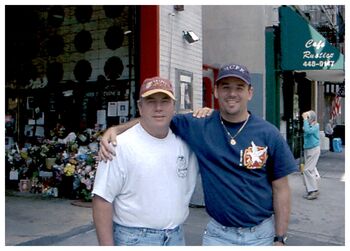
Boles, right, and his captain spend time in New York City during recovery efforts following 9/11.
Boles remembers few respirators being available to protect responders from the dust and debris. Still 25 years later, he says there is no question he would make the same decision again.
“Oh, absolutely,” Boles said. “I wasn’t there for glory or anything like that. I was there to support my friend and do my part, whatever that would be.”
Today, Boles is a Hillsborough County commissioner, retired battalion chief and now a cancer survivor.
A Small Lump Raises a Red Flag
After 28 years as a firefighter, Boles knew his career had exposed him to carcinogens, and that cancer was a possibility.
In late 2025, Boles noticed a small lump on the side of his neck while shaving. He assumed it was a lipoma, a benign lump of fatty tissue similar to one he had experienced before. He had no other obvious symptoms and routine blood work did not raise concerns.
During a physical with his primary care physician, his doctor felt the lump and recommended a CT scan. Boles initially questioned whether the scan and the associated costs were necessary.
“He goes, ‘I don’t care how much it is. I’m your doctor. Do it," Boles recalled with a smile.
The scan revealed a necrotic lymph node. Additional testing and a biopsy followed, and Boles eventually came to Moffitt Cancer Center, where he was diagnosed with oropharyngeal cancer, a cancer that develops in the middle part of the throat. The cancer had spread to a lymph node in his neck.
“Knowing it happened, it was kind of like, here we go. I’ve been waiting 28 years, and it happened,” he said.
More than two decades later, the health effects of 9/11 are still being felt. As of March 2026, nearly 55,000 cancer cases among responders and survivors have been documented by the World Trade Center Health Program as 9/11-related, with prostate cancer among the most common.
-

55,000
Documented number of cancer cases among responders and survivors
Coming Back to Moffitt
Boles is no stranger to Moffitt.
In the early 1990s, he worked at Moffitt’s pharmacy. More than three decades later, he found himself walking through the same familiar halls, but this time as a patient.
“It was like coming back home in a way. A full-circle moment,” Boles said.
What stood out to him was the level of care he saw throughout the cancer center.
Boles says he didn’t identify himself as an elected official or expect to be treated because of his position.
“No one knew who I was,” he said. “It was just, ‘How are we going to help you?’ Everyone’s been empowered to help everybody, no matter where their station is, whether they are cleaning something or they’re a doctor.”
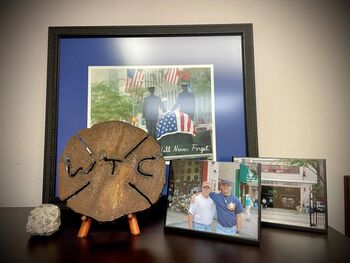
A piece of the World Trade Center and photos from ground zero are displayed in Boles’ office.
Boles underwent an accelerated course of radiation therapy, receiving treatments twice a day for roughly six weeks.
He would wake up around 5 a.m. and drive from his home in Lutz to Moffitt for treatment. Afterward, he would return home, take his daughter to school and head downtown to his office. Around 4 p.m., he would leave work, return to Moffitt for his second treatment, then head home.
“That level of service, that level of care I received was fantastic,” Boles said.
A New Perspective
Boles completed treatment and rang the bell at Moffitt in June. But the self-described pragmatist wasn’t quite ready to celebrate publicly.
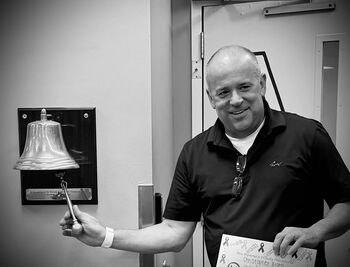
Boles rings the bell at Moffitt to mark the end of his cancer treatment.
“I said to the doctors, ‘Can you guarantee I’m cancer-free?’ Of course, you can’t make any guarantees,” Boles said. “I wanted to wait until we had the results from my PET scan.”
After receiving the results, Boles shared his experience publicly. Messages of support poured in from friends, fellow firefighters and community members.
Cancer also changed the way he thinks about the future. The father of three says the diagnosis made him think differently about his family and the plans he had made for them.
“It was a reminder that it is not always so far away. It could be right around the corner,” he said.
Twenty-five years after he traveled to New York to help others in the aftermath of Sept. 11, Boles is grateful to the people who helped him through his own crisis.
“I’m just very blessed,” Boles said. “I believe between my doctors, the care I got and certainly the therapy I received, they saved my life.”