


Battling Leptomeningeal Disease With Dendritic Cell Therapy
Key Takeaways:
-
Heather Curley’s leptomeningeal disease improved significantly after she received experimental dendritic cell therapy in a first-in-human clinical trial
-
Diagnosed with an aggressive complication of Stage 4 breast cancer, Curley was initially given four months to live
-
A $22.4 million federal grant will fund two new clinical trials exploring dendritic cell therapies for patients with leptomeningeal disease
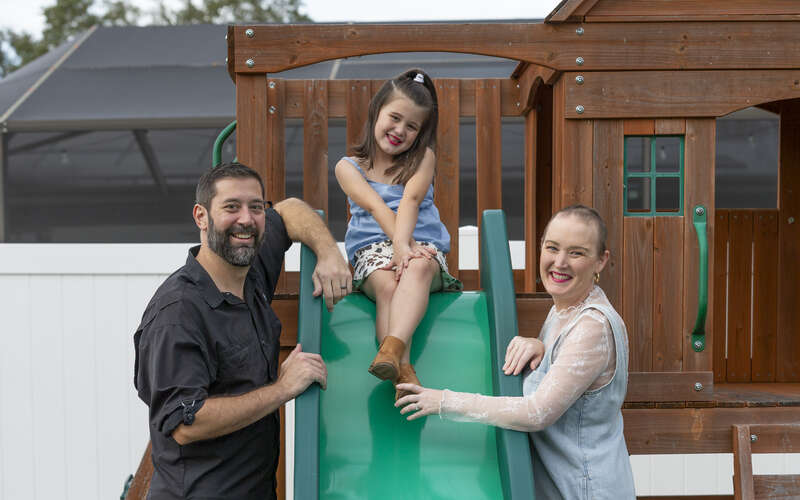
Heather Curley was sitting on the couch with her 3-year-old daughter, Palmer, getting the precocious preschooler ready for the day, when the phone rang. The call was from her doctor at Moffitt Cancer Center. The news, not good.
Nine months earlier, in December 2022, Heather had been diagnosed with breast cancer, specifically Stage 4 HER2-positive invasive ductal carcinoma. She had completed 12 weeks of chemotherapy and settled into a regimen of immunotherapy and hormone suppressants. Her scans had been looking good. The 32-year-old hairdresser and her husband, Dennis, were finally beginning to breathe again.
Then came the call.
An MRI showed the cancer had metastasized to the spinal cord fluid around her brain, a condition known as leptomeningeal disease (LMD). She needed to come into Moffitt immediately to decide on treatment.
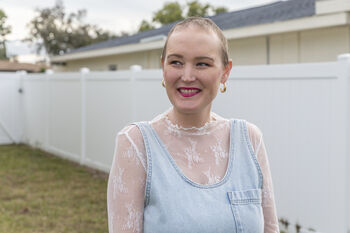
Heather Curley, a breast cancer patient with leptomeningeal disease, joined a dendritic cell therapy trial at Moffitt in October 2023.
The young mom did a quick internet search to see what she was up against.
“It said two weeks if you don’t treat it, a couple months if treated,” she remembered.
“I immediately went into fight or flight.”
Aggressive and Poorly Understood
Leptomeningeal disease is an aggressive and poorly understood complication of cancer in which tumor cells spread to the coverings of the brain and spinal cord fluid. The disease most commonly stems from breast cancer, lung cancer and melanoma.
Women who are diagnosed with leptomeningeal disease are typically young, like Heather. Treatment options are limited, and the prognosis is poor.
It’s a heartbreaking situation that neuro-oncologist Peter Forsyth, MD, sees all too often.
“For reasons that aren’t understood, breast cancer really likes the brain and tends to go there. It’s like a sanctuary site where the tumor cells can hide,” said Forsyth, a world-renowned expert in the field. “It usually happens when everything else in the body is quiet. So you went to see your oncologist, the bone metastases are fine, the tumor in the breast is gone. You have a clean bill of health. And then you start getting headaches. It’s particularly heartbreaking because once it gets in the brain, that’s usually what kills patients.”
The standard treatment for LMD is radiation and intrathecal chemotherapy, which is delivered directly through a port in the skull. However, Forsyth is pioneering groundbreaking research into dendritic cell therapy, a type of treatment that uses a person’s own immune cells to fight the disease.
In October 2023, Heather joined his first-in-human Phase 1 clinical trial.
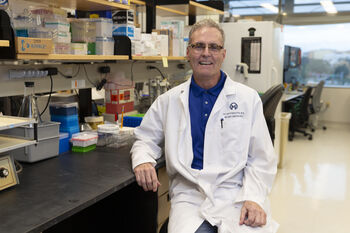
Peter Forsyth, MD, is leading groundbreaking research into dendritic cell therapy for leptomeningeal disease at Moffitt.
She started by having surgery to install the intrathecal port toward the top of her skull, which would allow the dendritic cell treatment to be injected directly into her spinal fluid. Next, she went in for apheresis, where blood was collected to extract white blood cells that would be used to develop her own personalized dendritic cell therapy. During the production of the therapy, the dendritic cells were grown in a lab and trained to recognize, remember and attack cancer cells, specifically with HER2 and HER3 proteins, which can drive aggressive forms of the disease.
Forsyth likens dendritic cells to a familiar historical figure.
“The dendritic cells are the Paul Revere of the immune system. We’re growing them in a dish and training them to recognize the enemy,” he explained. “So all the Paul Revere cells are like, OK, this is what the enemy looks like. If you see these proteins, get really angry and really excited. The dendritic cells run around and say, the cancer is coming, the cancer is coming. So it’s just educating our immune system, making it angry and turning it on.”
Once her personalized dendritic cell therapy was ready, Heather came to Moffitt weekly from her home in Clearwater for treatment. Being on a first-in-human trial, she didn’t know what to expect. Initially, she experienced migraines, back pain and vomiting after the injection.
Forsyth explains that the dendritic cell therapy triggers a type of aseptic meningitis, causing these side effects.
“We used to think that leptomeningeal disease was a whole bunch of tumor cells floating around in this watery spinal fluid. But when we look at all the cells in people with leptomeningeal disease, 90% of them are immune cells. So it turns out it’s an inflammatory disease. These immune cells are fighting it just a little bit, but not enough,” he explained. “That raises the obvious strategy of helping the good cells to fight it better and trying to fight the bad cells that might interfere. This dendritic cell therapy gives a helping hand to your body to fight that.”
The meningitis inflammation indicates the dendritic cells are doing their job. They are fighting back.
'Uncharted Territory'
As part of the trial, Heather came to Moffitt every Monday for 12 weeks to receive her dendritic cell doses. At the end of her 12 weeks on the trial, her care team informed her she had enough personalized therapy left for four more rounds of treatment. She decided to continue.
“As hard as the treatment was, I was like, if I say no, I’m going to regret it,” she recalled.
After completing the dendritic cell treatment, Heather’s scans showed significant signs of improvement in the leptomeningeal disease. She also had no evidence of disease in her body from the neck down.

Heather Curley and her daughter, Palmer, enjoy reading together at their home in Clearwater.
Three years later, Heather is on another clinical trial led by radiation oncologist Kamran Ahmed, MD, and Forsyth that aims to improve survival for patients with HER2 positive breast cancer that has led to leptomeningeal disease. She continues to receive chemotherapy and radiation to treat spots of cancer that had spread to the brain itself.
She sees Forsyth regularly to decide on next steps.
At best, Heather had originally been told in 2023, she had four months to live. Now, she is in what she calls “uncharted territory.”
The Next Phase
Meanwhile, Forsyth is pushing the research forward to reach more patients. In October 2025, he was awarded a $22.4 million grant from the U.S. Department of War to open two new trials targeting LMD. The first, which opened in fall 2026, will be the phase 2 trial for the dendritic cell therapy Heather received. It will combine the dendritic cells with targeted antibody therapy and checkpoint inhibitors to treat patients with LMD stemming from HER2- positive and triple-negative breast cancer.
The second trial funded by the grant will combine the dendritic cells with a sugary protein called alpha-galactosylceramide to boost and expand the immune response to LMD.
“Leptomeningeal disease is a major unmet need, and it’s a real problem. The puzzle is that nobody really understands leptomeningeal disease in terms of the biology,” Forsyth said. “This grant is important because it allows us to quickly open clinical trials that we think are going to give meaningful results to change that as well as tons of basic research so we can understand the disease better and try to find better treatments. This accelerates our ability to get clinical trials for LMD patients so we always have options for them.”
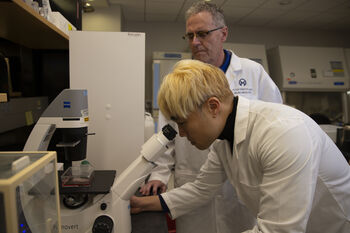
Peter Forsyth, MD (back) and senior research specialist Vincent Law examine samples as part of their team’s research into immune-based therapies for patients with leptomeningeal disease.
Moffitt has one of the top programs in the world for researching and treating LMD, Forsyth explained. He credits that to the collaborative mission of its physicians and scientists such as Brian Czerniecki, MD, chair of Moffitt’s Breast Oncology Department, who made the foundational discovery of the usefulness of dendritic cell therapy in treating metastatic breast cancer.
“In order to make discoveries and improve care, you need a team,” Forsyth said. “Nobody has the full view of the elephant. We’re all working in the dark. Moffitt’s great because everybody gets it — we need each other to succeed.”
At the forefront of it all, for Forsyth, is Heather.
“I always want to have an option for Heather. I never ever want to look her in the eye and say, oh, we don’t have anything for you,” he said. “I can’t see these young women without having another option.”
In turn, Heather is holding on to that hope, both for herself and for the more than 110,000 people who are diagnosed with LMD each year in the United States.
“It’s just such a miracle that he’s my doctor, and he is the leading expert in this ultra-rare disease. He just really cares, and he’s so hopeful that he is going to cure this,” she said. “We’re just two peas in a pod, just breaking statistics, going forward, spreading awareness and letting people know that these statistics aren’t the normal anymore. There is hope.”
 Medically reviewed by Peter Forsyth, MD, Neuro-Oncology Program.
