
Close Calls
Key Takeaways:
• A father and son underwent cancer treatment together at Moffitt Cancer Center after separate diagnoses just two months apart
• Rob Higgins’ first colonoscopy at 45 revealed a 4-centimeter tumor despite no apparent symptoms
• Doctors say delaying colorectal cancer screening can reduce early detection and limit less invasive treatment options
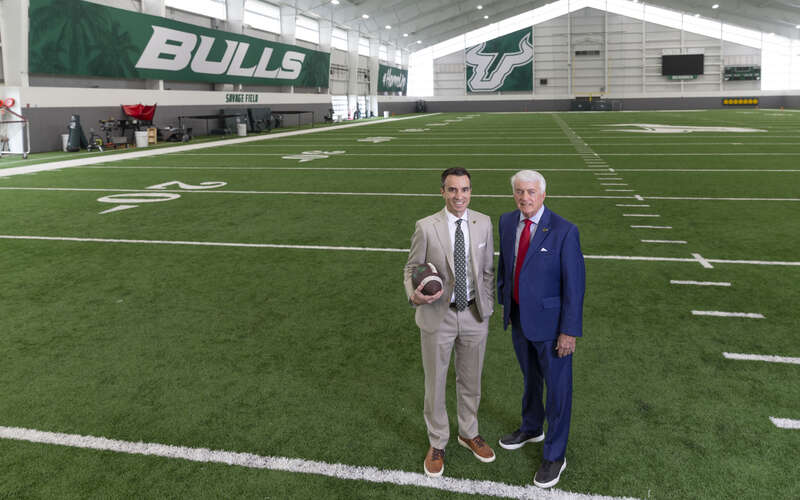
A week before Christmas, Rob Higgins was in Orlando preparing for his first football bowl game as the University of South Florida CEO of Athletics. Kickoff was in a few hours.
His dad, Jack, was just miles away, en route from his home in Dade City. Jack hadn’t missed a home football game the entire season.
When USF’s basketball season began a month later, Jack was a fixture in the stands. In fact, the 76-year-old had rarely missed one of Rob’s sporting events his entire life. Jack was often just a glance away whether Rob was a player, event organizer, director or CEO.
When Rob began cancer treatment in the fall of 2024, Jack was once again by his side — but in an unimaginable way. Jack was diagnosed with cancer just two months before Rob, and the father and son began fighting their toughest opponents at the same time.
A Red Flag
Jack was on vacation in Greece with his family when he noticed blood in his urine. Doctors there told him to see a specialist when he returned home. Rob accompanied him to appointments at Moffitt Cancer Center after Jack was diagnosed with stage 2 bladder cancer. A discussion at one appointment about their family history of cancer — including Rob’s grandfather’s colorectal cancer diagnosis at a young age — gave Rob a bad feeling.
“I just had this weird premonition and went home and Googled about hereditary cancers,” Rob said.
A week later, Rob, then 45, underwent his first colonoscopy.
“I thought it would be a traditional colonoscopy, but when I woke up I was surrounded by doctors and they shared they had found a 4-centimeter tumor,” he said. “The shock and uncertainty was really tough to deal with. I remember getting back to the car and me and my wife just crying not knowing what exactly to expect.”
Rob hadn’t had any symptoms. His cancer wasn’t a clear-cut case, and it was hard to pinpoint the disease’s stage. After getting multiple opinions, Rob decided to join his dad at Moffitt.
“Since he had a more unique situation, we presented his case to our tumor board and developed a multidisciplinary approach,” explained gastrointestinal surgeon Julian Sanchez, MD, who oversaw Rob’s care. “This was a great example of the benefits of the Moffitt approach to achieve a real win. We had multiple experts in gastrointestinal oncology opine on his treatment options with the goal to create a tailored treatment approach that adequately treated his cancer without overtreatment.”
Rob began six weeks of chemotherapy and daily radiation in November 2024. He and Jack learned to balance being patients and caregivers at the same time. They often did family dinners at Rob’s house and were constantly checking on each other to make sure the other was doing OK.
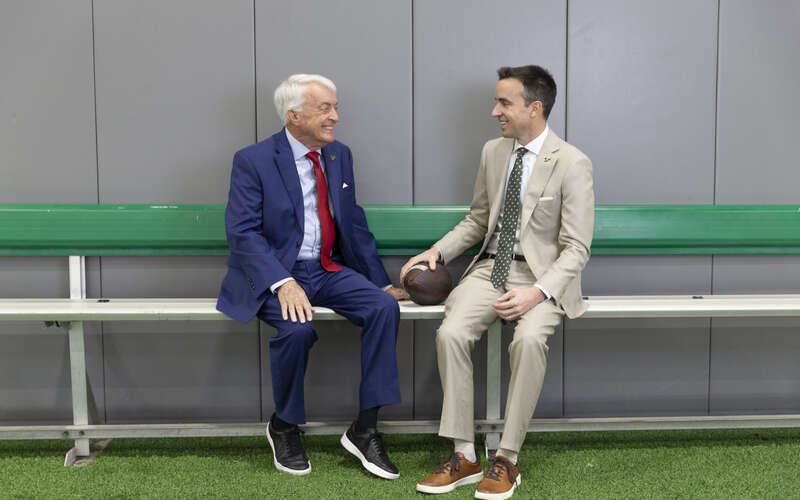
Jack Higgins has been on the sidelines cheering on his son, Rob, for decades. When the duo were diagnosed with cancer around the same time, they were committed to motivating each other.
“It is shocking, and sometimes you just think what kind of coincidence this is. I couldn’t take his place, so there is nothing you can do but pray and hope for the best,” Jack said.
“It was a very surreal journey in terms of going in to get radiation and coming out to the waiting room and seeing my dad waiting for his radiation,” Rob remembered.
Rob also leaned on his wife, Casey, their two children and his sister, Rebecca, for support. As a family, they decided they wouldn’t let cancer affect the things most important to them, which included Rob’s work at the time as the Tampa Bay Sports Commission director.
“I love my work and pouring myself into that, so I kind of refused to let cancer affect me in that way,” Rob said.
And with Jack about a month ahead of him in treatment and doing well, Rob had yet another reason to look up to his dad.
“Rob is so competitive so we jokingly would say, ‘I got through it, so he has to get through it,’” Jack said.
Too Important To Delay
Since the U.S. Preventive Services Task Force lowered the recommended age to start colorectal cancer screening from 50 to 45 in 2021, Sanchez says it has become more common to see younger patients and earlier stage cancers.
“Treatment has changed a lot in the last 10 years, and we have learned over time that we can tailor therapy based on an individual and their tumor. Part of the problem with younger patients getting cancer is that if you overtreat, they are dealing with those effects for the rest of their lives,” Sanchez said.
While there is a lot of apprehension around colonoscopies, Sanchez says it’s important to be your own advocate, like Rob.
“There is nothing easier in the world than putting off a colonoscopy. I want to share what I went through so others won’t put it off,” Rob said. “A lot of people are really busy — me being one of them — but you are never too busy to take care of your personal health.”
Delaying a colonoscopy can make a big difference when it comes to early diagnosis and treatment options.
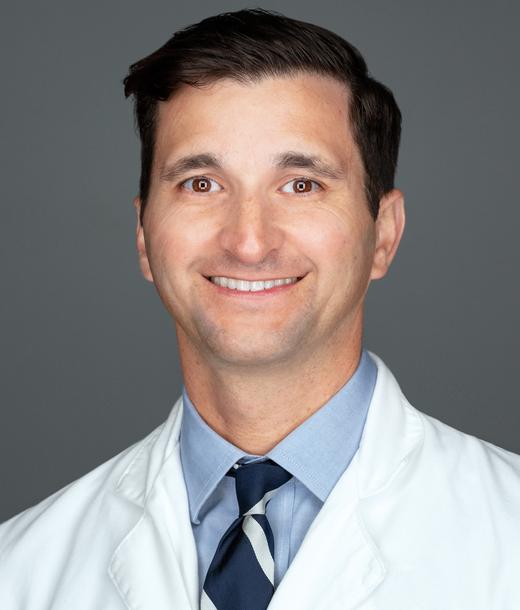
“It’s easy for a one-year delay to become a two-year delay that becomes a five-year delay,” Sanchez said. “Colorectal cancer is a long-term developing disease from mutations that cause normal cells to develop into polyps that eventually transform into cancer, so that means we have 10 to 15 years to catch them.”
Current guidelines recommend people of average risk undergo colorectal cancer screening every 10 years from age 45 to 75. Those at increased risk for the disease, including individuals with a family history of colorectal cancer and those with a personal history of inflammatory bowel disease, should begin screening earlier.
Sanchez recommends those with a first-degree relative (parents, siblings or children) connection begin screening 10 years prior to the age their relative was diagnosed. While Rob’s cancer didn’t have a hereditary genetic link, his children will begin screening at 35.
For those at average risk who don’t feel comfortable with a colonoscopy, there’s an at-home fecal immunochemical test, or FIT. Individuals can self-collect a stool sample and mail it in for testing annually.
“The colonoscopy is the gold standard for detection because if there is a polyp, we can identify and remove it. A stool test will identify it but can’t treat it, so a colonoscopy will be needed as a follow-up,” Sanchez said.
A Double Win
When Rob rang the bell at Moffitt to celebrate the completion of his treatment, there was only one moment he can think of that topped it: watching his dad ring the bell first.
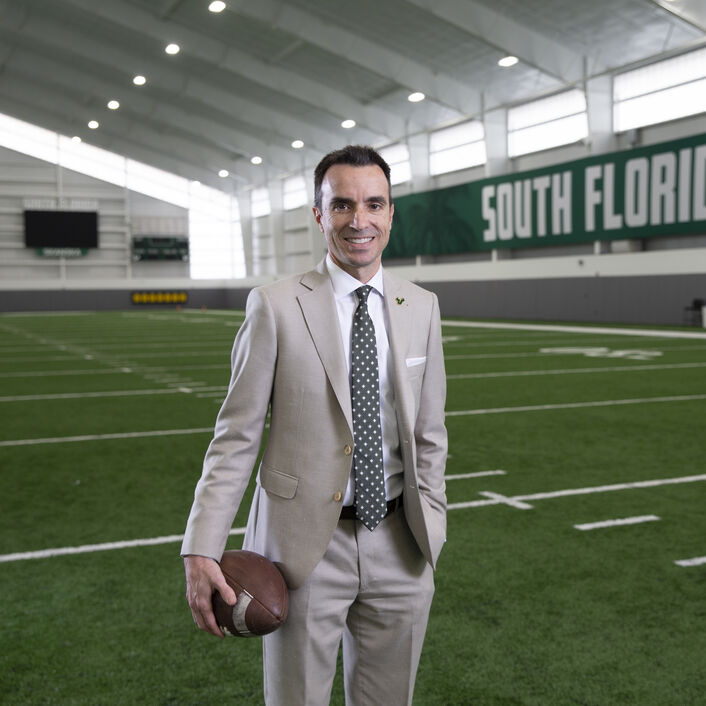
“We were both ultraconcerned with the other person’s diagnosis, and it was so much more impactful and meaningful to see him ring the bell and vice versa,” Rob said.
Reflecting about what the pair just went through, Jack can’t help but get nostalgic. When he thinks about Rob passing him in the radiation waiting room, he sees the 8-year-old ball boy for the USF men’s basketball team. The young adult who broke his nose playing in the Jesuit High School alumni basketball league. The sports director who first brought the Women’s Basketball Final Four to Tampa. The man who now oversees 500 student-athletes in 21 sports.
For Rob, the experience has not only helped him grow even closer with his dad, but it’s also shifted his life perspective. He doesn’t want to take any moments for granted.

Jack rang the bell first at Moffitt, with Rob celebrating the end of treatment soon after. Today, they continue to support each other in their survivorship journey.
“A quote I lean into a lot about my cancer journey that I share with our student-athletes is that adversity doesn’t build character, it reveals it,” he said. “Oftentimes in sports, toughness and character are wrongfully used interchangeably. We will all face adversities in our life where we need to be transparent with ourselves and to not be viewed as tough, and that doesn’t mean we have any less character.”
Moving forward, Rob and Jack will walk in survivorship together, celebrating milestones and holding each other accountable for follow-up screening. And no matter what happens, they know they can lean on each other, on and off the sports field.
This article originally appeared in Moffitt's Momentum magazine.