Could a Urine Test Help Detect Breast Cancer Earlier?
Key Takeaways:
- Moffitt Cancer Center researchers are studying eNose technology, which uses artificial intelligence to identify molecular patterns in urine samples that may detect breast cancer
- The technology could eventually complement mammograms, particularly for women with dense breast tissue, where cancers can be more difficult to detect
- The ongoing validation study includes a diverse patient population, with preliminary data appearing promising but further analysis needed to determine the technology's effectiveness
For decades, scientists have believed that dogs can detect certain diseases through their sense of smell. Now, researchers at Moffitt Cancer Center are exploring whether technology inspired by that ability could help detect breast cancer earlier.
Amir Alishahi Tabriz, MD, PhD, a physician scientist at Moffitt, is leading a study of an experimental technology known as an electronic nose, or eNose, that combines specialized sensors with artificial intelligence to identify molecular patterns associated with breast cancer in urine samples.
The goal is to develop a simple, noninvasive test that could eventually complement mammograms, particularly for women with dense breast tissue, where cancers can be more difficult to detect.
“Some scientists think, ‘How about we design the devices that can track the molecules in the air that the dogs and other animals can sniff,’ but we cannot,” Alishahi Tabriz said.
Finding Cancer’s Molecular Fingerprint

Amir Alishahi Tabriz, MD, PhD
Cancer causes changes throughout the body, including changes in metabolism and the molecules found in bodily fluids. However, identifying a single molecule that reliably distinguishes cancer from healthy tissue has proven difficult.
Alishahi Tabriz’s research takes a different approach.
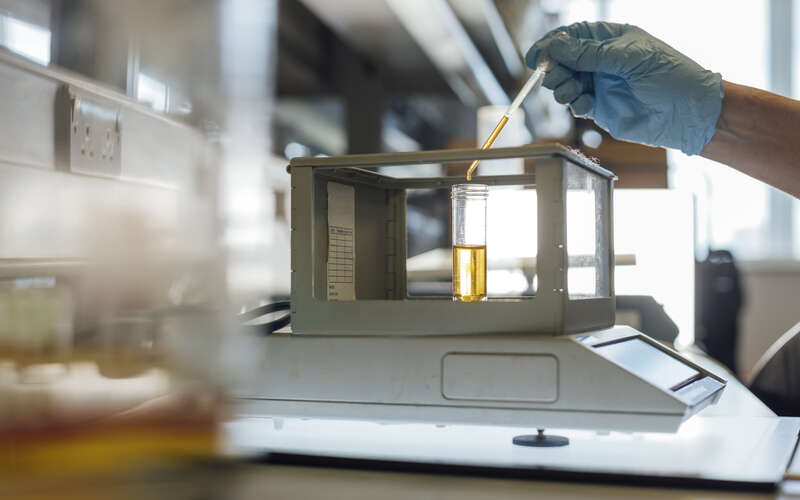
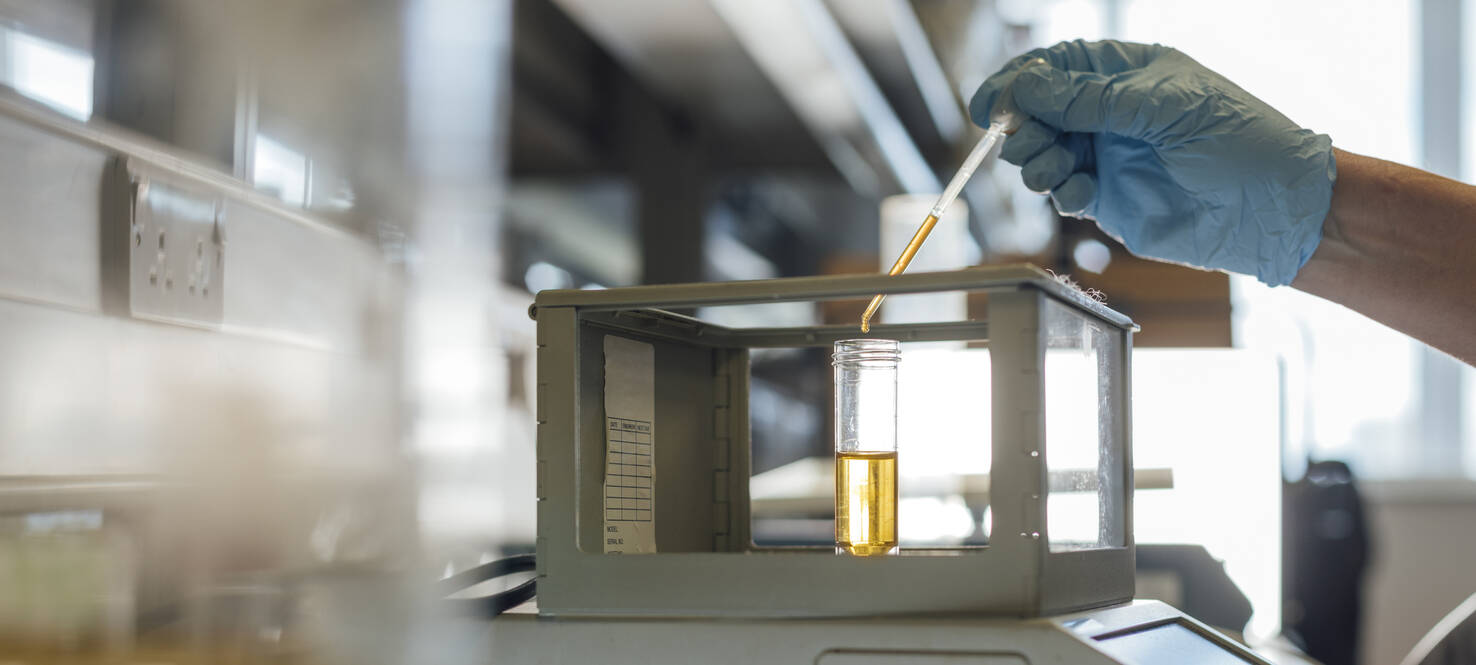
Researchers collect urine samples from women with and without breast cancer and heat them to different temperatures. As the samples warm, various molecules evaporate and are detected by specialized sensors.
The process produces a molecular pattern, or “smell print,” containing millions of data points. An AI model analyzes those patterns to determine whether they more closely resemble samples from women with breast cancer or those without the disease.
“We moved the idea from identifying one, two or three or whatever set of the molecules to recognizing the pattern that came from every sample,” Alishahi Tabriz said.
The approach is part of a growing field investigating whether chemical signatures in urine can help detect cancer. A separate study published in Analytical Chemistry used an electronic sensing system and machine learning to distinguish urine samples from breast cancer patients and healthy controls. Although the technology differs from Moffitt’s eNose, the findings provide additional scientific context for exploring urine-based cancer detection.
Addressing Challenges With Dense Breasts
One of the most promising potential applications of the technology involves women with dense breast tissue.
Approximately half of women have dense breasts, which can make it more difficult for mammograms to identify suspicious abnormalities. Dense breast tissue can also increase breast cancer risk.
Alishahi Tabriz emphasizes that the eNose would not replace mammography. Instead, it could potentially provide additional information to help physicians determine when further testing is needed.
“It’s not going to replace a mammogram. It’s going to be added to the mammogram,” he said.
Mammograms and other imaging methods would still be necessary to locate tumors, assess their size and guide treatment decisions.
If the technology proves effective, a urine sample of approximately 20 milliliters could provide another screening tool without requiring an invasive procedure.
Researchers are particularly interested in detecting early-stage breast cancer, when treatment is often most successful.
“The key is to catch it early,” Alishahi Tabriz said. “Because of that, we have a really good window of opportunity to catch those diseases at a very early stage.”
Testing the Technology in Diverse Populations
Supported by a Florida Department of Health Innovation Award, the project is currently undergoing validation to determine whether the technology can reliably distinguish breast cancer patients from healthy participants.
The research is being conducted in clinical settings and through Moffitt-affiliated mobile mammography outreach events, allowing the team to study the technology in community settings.
An important component of the study is ensuring that the technology works across diverse populations.
Alishahi Tabriz says earlier research involving similar technologies has relied heavily on samples from white European populations. His team is intentionally including Black and Hispanic participants to evaluate how well the approach performs across different demographic groups.
Although the preliminary data appear encouraging, Alishahi Tabriz cautions that researchers have not completed their scientific analysis and cannot yet determine whether the technology is effective.
The study could continue into summer 2027, when the team hopes to have final results. If the findings support the technology’s effectiveness, additional research could help determine whether it can eventually become part of routine breast cancer screening.
For now, Alishahi Tabriz is focused on establishing whether the approach works before making promises about its potential impact.
“We hope if it works, it can change everything,” he said.
 Scientifically reviewed by Amir Alishahi Tabriz, MD, PhD, Health Outcomes & Behavior Program