Dendritic Cell Trial Brings Hope for Young Mom With Leptomeningeal Disease
Key Takeaways:
- Heather Curley was diagnosed with rare leptomeningeal disease after breast cancer spread to her spinal fluid
- The young mother was initially given a two- to four-month prognosis
- She joined an experimental dendritic cell trial, and her latest scans showed no evidence of leptomeningeal disease, offering hope for future patients
Heather Curley started with a stack of 18 birthday cards. Her daughter was 3 at the time, and Heather was planning ahead for all those big milestones. Her first year in kindergarten. Learning to drive. Graduating high school. Heather poured her love for her daughter, Palmer, into those sweet birthday wishes and sealed them for the years to come. Years that Heather feared she wouldn’t be around to see.
Just weeks earlier, Heather had been feeling optimistic. The 32-year-old hairdresser and her husband, Dennis, had taken their daughter on a summertime family vacation to Mexico to mark what she thought was the tail end of her breast cancer journey. She had been diagnosed in December 2022 with stage 4 HER2-positive invasive ductal carcinoma and completed 12 weeks of chemotherapy. Afterward, she had settled into a regimen of immunotherapy and hormone suppressants.
“My scans showed shrinkage of all my tumors and all my metastases in my body,” she said. “I was feeling good. My hair was growing back. We just got back from this amazing vacation.”
Heather was sitting on the couch with Palmer at their Clearwater home on Aug. 10, 2023, getting her precocious preschooler ready for the day, when she got a call from her doctor at Moffitt Cancer Center.
Heather had been to the hospital the day before for a follow-up MRI. The results revealed the worst-case scenario.
The cancer had metastasized to the spinal cord fluid around her brain, a condition known as leptomeningeal disease (LMD). Heather’s doctor asked her to come in immediately and cautioned her: Do not Google it.
“Of course I did. I hung up, I looked it all up,” the young mom said, remembering the shock of the prognosis. “It said two weeks if you don’t treat it, a couple months if treated. I immediately went into fight or flight.”
Out of Nowhere
Leptomeningeal disease is an aggressive and poorly understood complication of cancer in which tumor cells spread to the coverings of the brain and spinal cord fluid. The disease most commonly stems from breast cancer, lung cancer and melanoma.
Women who are diagnosed with leptomeningeal disease are typically young, like Heather. She was 29 and pregnant with Palmer when she first felt a lump in her breast in 2019. Her gynecologist told her it was normal, likely caused by hormones.
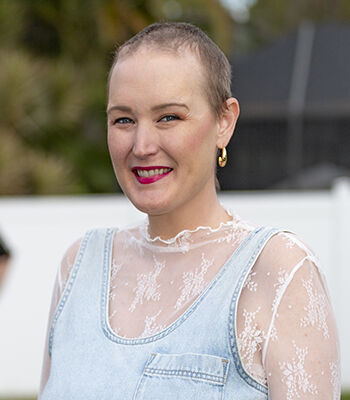
Women who are diagnosed with leptomeningeal disease are typically young, like Heather. She was 29 when she first felt a lump in her breast.
But even after giving birth, she felt odd. Her body felt off. She went to an endocrinologist, a dermatologist and then back to her gynecologist. No one suspected cancer. She had no family history, and she was below the recommended screening age for a mammogram.
Still, she was concerned about the changes in her breast. She had started to notice what looked like rippling, and then in October 2022, she felt the lump again. Her gynecologist sent her for a mammogram. By December, she had her diagnosis.
“The cancer had spread within practically my whole entire body,” she remembered.
The diagnosis was terrifying, but Heather seemed to respond well to treatment. After chemotherapy, her scans painted a positive picture. Her oncologist had also arranged for her to join a brain MRI clinical trial in February 2023 to monitor for potential metastases. That scan was clear.
As she continued on immunotherapy and hormone suppressants, the outlook got better. She was starting to see the light at the end of the tunnel. Then came the follow-up brain scan.
This type of silent progression is common for breast cancer patients diagnosed with LMD, says Peter Forsyth, MD, a neuro-oncologist at Moffitt and a world-renowned expert in the field.
“For reasons that aren’t understood, breast cancer really likes the brain and tends to go there. It’s like a sanctuary site where the tumor cells can hide,” Forsyth said. “It usually happens when everything else in the body is quiet. So you went to see your oncologist, the bone metastases are fine, the tumor in the breast is gone. You have a clean bill of health. And then you start getting headaches. It’s particularly heartbreaking because once it gets in the brain, that’s usually what kills patients.”
‘I Want To Fight This’
Heather knew time was not on her side. She immediately met with her team of doctors at Moffitt, with Forsyth walking her through the treatment options.
She remembers he told her: “This is very serious. There are not a lot of trials or research geared toward leptomeningeal disease, but this is something that’s close to my heart that I’ve been researching.”
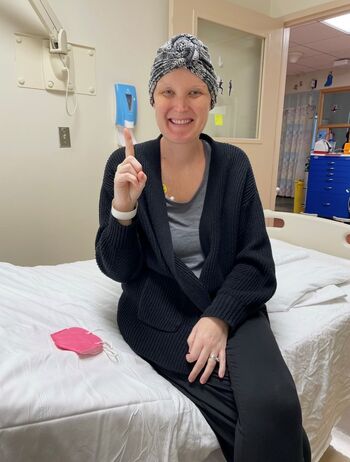
In this photo, Heather marks her first treatment on the dendritic cell therapy, which uses a person’s own dendritic cells, a type of immune cell, to fight the disease.
The standard treatment for LMD is radiation and intrathecal chemotherapy, which is delivered directly through a port in the skull. But even with treatment, the prognosis is only two to four months.
Forsyth recommended that Heather start with proton therapy, a type of precision radiation therapy that targets cancer with minimal damage to surrounding tissue. He also told her about his first-in-human phase 1 clinical trial that uses a person’s own dendritic cells, a type of immune cell, to fight the disease. There was only one person on the trial at the time. Heather would be the second.
“I said yes. I want to do everything and anything that I can do. I want to fight this. I want to try,” she said. “I have a 3-year-old at home, I’m not ready to give up.”
Heather completed 10 rounds of proton therapy at a hospital in Baltimore and then returned to Moffitt to join Forsyth’s dendritic cell trial. She started by having surgery to install the intrathecal port toward the top of her skull, which would allow the dendritic cell treatment to be injected directly into her spinal fluid.
“This was the first surgery I had ever had in my entire life. I had never had anesthesia for anything,” she said. “So brain surgery was my first surgery.”
Next, Heather went in for apheresis, where blood was collected to extract white blood cells that would be used to develop her own personalized dendritic cell vaccine. During the production of the vaccine, the dendritic cells were grown in a lab and trained to recognize, remember and attack cancer cells, specifically with HER2 and HER3 proteins, which can drive aggressive forms of the disease.
Forsyth likens dendritic cells to a familiar historical figure.
“The dendritic cells are the Paul Revere of the immune system. We’re growing them in a dish and training them to recognize the enemy,” he explained. “So all the Paul Revere cells are like, OK, this is what the enemy looks like. If you see these proteins, get really angry and really excited. The dendritic cells run around and say, the cancer is coming, the cancer is coming. So it’s just educating our immune system, making it angry and turning it on.”
‘A Helping Hand’
Once her personalized dendritic cell vaccine was ready, Heather came to Moffitt weekly for treatment. Being patient No. 2 on the trial, she didn’t know what to expect. Initially, she experienced excruciating migraines, back pain and vomiting in the first three days after the injection.
Forsyth explains that the dendritic cell vaccine triggers a type of aseptic meningitis, causing these side effects.
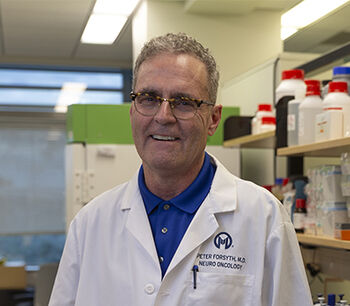
Peter Forsyth, MD, a world-renowned expert in leptomeningeal disease, was recently awarded a $22.4 million federal grant to explore new treatment options for patients like Heather.
“We used to think that leptomeningeal disease was a whole bunch of tumor cells floating around in this watery spinal fluid. But when we look at all the cells in people with leptomeningeal disease, 90% of them are immune cells. So it turns out it’s an inflammatory disease. These immune cells are fighting it just a little bit, but not enough,” he explained. “That raises the obvious strategy of helping the good cells to fight it better and trying to fight the bad cells that might interfere. This dendritic cell vaccine gives a helping hand to your body to fight that. So when we put in the dendritic cells, we get this aseptic meningitis, with headache and neck pain.”
The meningitis inflammation indicates the dendritic cells are doing their job. They are recognizing the cancer cells, getting angry and fighting back.
Heather developed her own routine to temper the side effects. She ate a light breakfast and drank a caffeinated hot tea before the vaccine was administered. Then she would take antinausea and pain medication to control the headache and back pain afterward.
As part of the trial, she came to Moffitt every Monday for 12 weeks to receive her dendritic cell doses. Although the treatment itself took only about 15 minutes, she typically spent the entire day at the cancer center, getting lab work done and waiting for the vaccine to be prepared for that day’s injection.
At the end of her 12 weeks on the trial, her care team informed her she had enough personalized vaccine left for four more rounds of treatment. They gave her the option to continue.
Her daughter drove her decision.
“As hard as the vaccine was, I was like, if I say no, I’m going to regret it,” she recalled. “I just have to say yes. I’ve done it for 12 weeks. What’s a few more?”
‘Uncharted Territory’
After completing the dendritic cell treatment, Heather’s scans showed significant signs of improvement in the leptomeningeal disease. She also had no evidence of disease in her body from the neck down. However, her breast cancer had metastasized to the brain itself. She went back on chemotherapy to target the brain tumors.
With her dendritic cells now supercharged and trained to keep fighting the leptomeningeal disease, Heather also worked with Forsyth to join a phase 1/2 clinical trial led by radiation oncologist Kamran Ahmed, MD. The trial uses intrathecal trastuzumab and pertuzumab, two antibody therapies, to improve survival for patients with HER2-positive breast cancer that has led to leptomeningeal disease. She started on the trial in March 2024, seven months after her LMD diagnosis.
At best, Heather had originally been told, she had four months to live. By this point, she felt like she was in “uncharted territory.”
‘A Major Unmet Need’
Forsyth has now treated 14 patients with the dendritic cell vaccine, and he’s aiming to treat a total of 15 during the phase 1 trial. In October 2025, he was awarded a $22.4 million grant from the U.S. Department of War to open two new trials targeting LMD. The first, expected to open in September, will be the phase 2 trial for the dendritic cell vaccine. It will combine the dendritic cells with targeted antibody therapy and checkpoint inhibitors to treat patients with LMD stemming from HER2-positive and triple-negative breast cancer.
The second trial funded by the grant will combine the dendritic cells with a sugary protein called alpha-galactosylceramide to boost the immune response to LMD.
“The puzzle is that nobody really understands leptomeningeal disease in terms of the biology,” Forsyth said. “This grant is important because it allows us to open clinical trials that we think are going to give meaningful results to change that as well as tons of basic research so we can understand the disease better and try to find better treatments.”

Over the course of the past three years, Heather has focused on building core memories with Palmer, who is now a kindergartener.
Moffitt will also be expanding treatment options for patients with LMD with the opening of its Speros proton therapy center in Pasco County over the summer.
“Leptomeningeal disease is a major unmet need, and it’s a real problem. But Moffitt has one of the top programs in the world,” Forsyth said. “This huge immune component just opens up a universe of new treatments.”
He credits Moffitt’s breakthroughs to the collaborative mission of its physicians and scientists, particularly the work of Brian Czerniecki, MD, PhD, who has pioneered research into dendritic cell vaccines for breast cancer patients.
“In order to make discoveries and improve care, you need a team,” Forsyth said. “Nobody has the full view of the elephant. We’re all working in the dark. Moffitt’s great because everybody gets it — we need each other to succeed.”
Forsyth also works closely with the few other experts in the field from around the world. He points to a promising trial at Memorial Sloan Kettering exploring iron depletion as a means of starving tumor cells in the cerebrospinal fluid. There’s also research into the use of radiopharmaceuticals, which use radioisotopes to deliver radiation directly through the patients’ intrathecal port.
At the forefront of it all, for Forsyth, is Heather.
“I always want to have an option for Heather. I never ever want to look her in the eye and say, oh, we don’t have anything for you,” he said. “I can’t see these young women without having another option.”
‘There Is Hope’
For Heather, she’s happy to be shattering statistics. She is still on weekly chemotherapy and is undergoing radiation for the brain metastases, but her last scan showed no evidence of leptomeningeal disease.
“It’s just such a miracle,” she said. “I just want to spread awareness and let people know that these statistics aren’t the normal anymore, that there is hope.”
Over the course of the past three years, Heather has thought a lot about the core memories she wants to make with her daughter. They’ve gone on family vacations to Disney and taken a cruise. She has written letters and recorded herself reading storybooks. She even made a book with her voice singing the happy birthday song.
Perhaps better than anyone, Heather knows that tomorrow is never promised. So she lives for the hugs and the smiles of today.
In October, Palmer turned 6. The family went to a trampoline park to watch the bubbly kindergartener bounce around in celebration. Back at home, Heather marked the milestone in another way. She took out the birthday card she’d written to Palmer for the occasion so many months ago. She didn’t open it, didn’t read it. Instead, she tore it up, threw it in the trash and held tight to her growing girl.
Monitoring for Metastasis
The National Comprehensive Cancer Network Guidelines do not currently recommend routine brain MRI screening for stage 4 breast cancer patients. However, research suggests brain MRI surveillance could help detect asymptomatic metastasis earlier. Heather Curley’s leptomeningeal disease was diagnosed in the early stage as part of a phase 2 clinical trial using brain MRI surveillance in stage 4 breast cancer patients. The trial, led by Kamran Ahmed, MD, was funded by the Florida Breast Cancer Foundation. Subsequent funding from the Florida Department of Health will support the next phase of the brain MRI surveillance trial. Ahmed hopes this research will shape changes in current guidelines and open the door for routine brain MRI surveillance in late-stage breast cancer patients.