

“Every Minute Is a Gift”: Survivor Highlights Importance of Thyroid Cancer Awareness
Key takeaways:
• A rare thyroid cancer diagnosis left June Perez with potentially months to live, but treatment helped her survive eight years
• Perez credits a clinical trial and multidisciplinary care with helping her overcome anaplastic thyroid cancer
• Anaplastic thyroid cancer is a rare form of thyroid cancer that can grow and spread quickly
For the last eight years and counting, June Perez spends her time with intention.
After a rare cancer diagnosis left her with potentially only months to live, she’s watched her daughter get married and become a mother and recently spent a family vacation at Disney World.
“I would have missed all that, and she would have missed having a mom through all that,” Perez said. “Every minute is a gift.”

June Perez says watching her daughter get married is a memory she doesn't take for granted after treatment.
She recalls a previous doctor telling her that her best hope may be a clinical trial.
“He said, ‘I don’t know how to treat you. I’ve never seen this,’” Perez said.
Perez went home that day and found Moffitt Cancer Center had clinical trials available and expertise in treating thyroid cancers. After making a phone call that afternoon, she had an appointment scheduled for the next morning.
The treatment she received through a clinical trial was successful, and Perez’s experience has since given her a greater sense of purpose in helping others affected by the disease.
What Is Thyroid Cancer?
Thyroid cancer occurs when abnormal cells in the thyroid gland grow out of control.
The gland is located at the base of the throat and produces important hormones that help control the body’s heart rate, blood pressure and metabolism.
Most thyroid cancers grow slowly and are highly treatable, but thyroid cancer remains one of the most common endocrine cancers.

Moffitt experts specialize in different forms of thyroid cancer and treat with a multidisciplinary approach.
The resulting buildup of extra cells can form a mass, or tumor, that can potentially become cancerous. Malignant cells can also break away from the thyroid and travel through the lymph nodes or blood vessels and invade other parts of the body.
Papillary thyroid cancer is the most common type, accounting for about 80% of cases, while follicular thyroid cancer accounts for about 10% to 15% of all cases, and oncocytic thyroid cancer accounts for 3% to 4% of thyroid cancer cases.
Less common types include medullary thyroid cancer, which represents 4% of thyroid cancers and can run in families. Anaplastic thyroid cancer is a rare and very aggressive type of thyroid cancer, representing more than 1% of cases.
Today, Moffitt offers a full spectrum of expertise and multidisciplinary care for patients across the entire range of thyroid cancers and thyroid neoplasms from high-risk, aggressive anaplastic thyroid cancer to low-risk papillary microcarcinomas. The expert team includes high-volume thyroid surgeons and dedicated thyroid cancer specialists.
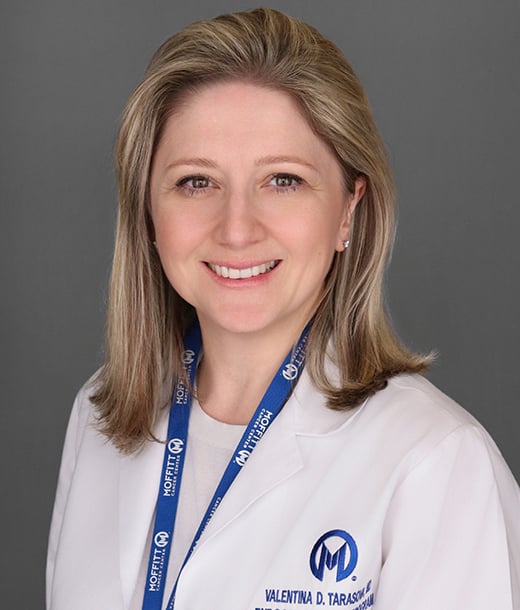
"Together, we provide personalized care grounded in the latest evidence, years of specialized experience and multidisciplinary collaboration, with approaches ranging from advanced treatment for complex disease to active surveillance when appropriate," said Valentina Tarasova, MD, a board-certified endocrinologist at Moffitt.
Treatment options may include surgery, thyroid hormone therapy, radiofrequency ablation, radioactive iodine therapy, radiation therapy and other innovative therapies tailored to each patient’s diagnosis and individual needs.
A Source of Hope
When Perez isn’t at Moffitt every six months for scans, she spends time connecting with other people affected by anaplastic thyroid cancer, offering encouragement and sharing what she has learned through her own experience.
“Because I've been through it, I can actually speak from experience to help other people go through it, too,” Perez said.
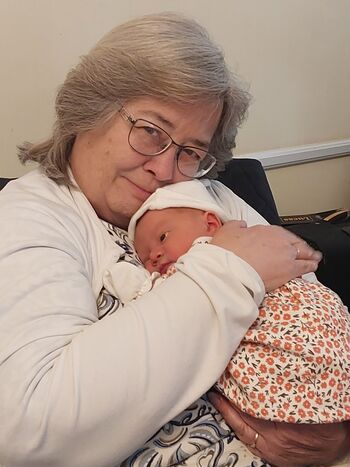
Perez says she's grateful to be alive eight years since her diagnosis so she can look after her grandbaby.
When she was able to meet with Moffitt physicians, Perez said she felt heard throughout her care and never felt dismissed or treated as though her symptoms weren’t real. She credits Moffitt’s rapid evaluation and multidisciplinary approach as important parts of her treatment journey.
“Once I got to Moffitt, everybody listened. Everybody heard what you were saying,” Perez said.
What To Look Out For
The initial sign of thyroid cancer is a noticeable lump (nodule) or swollen area at the front of the neck. These lumps, which are often palpable and sometimes even visible, generally develop near the base of the neck, above the breastbone (sternum).
Since many thyroid nodules are benign, the diagnostic process requires a complete and thorough clinical assessment, along with imaging, biopsy, blood testing and additional imaging.
Symptoms could also include hoarseness or voice changes, difficulty swallowing, neck pain, swollen lymph nodes, as well as difficulty breathing.
For Perez, her experience has reinforced the importance of paying attention to changes in your body, advocating for yourself and finding a medical team that will listen.
Her advice extends beyond treatment. She says people facing cancer should not go through it alone and encourage patients to lean on family, friends and other sources of support throughout their journey.
“People need people around them when they're going through this,” Perez said.
A head and neck cancer education support group is available at Moffitt every third Tuesday of the month from 5:30 p.m. to 7 p.m. For details, email HeadandNeckCancerEvents@Moffitt.org.
 Medically reviewed by Valentina Tarasova, MD, Endocrine Oncology Program