

From Finish Lines to Infusion Chairs: One Athlete's Journey Through Rare Cancer
Key Takeaways:
- Mantle cell lymphoma is a rare blood cancer, but advances in research are expanding treatment options beyond traditional chemotherapy
- After receiving his diagnosis, Dr. Jose Beltran pursued a clinical trial that combined immunotherapy and targeted therapies, helping him achieve remission without chemotherapy
- His experience highlights the importance of expert evaluation, second opinions and access to clinical trials for patients facing rare cancers
For years, Jose Beltran measured his life by finish lines.
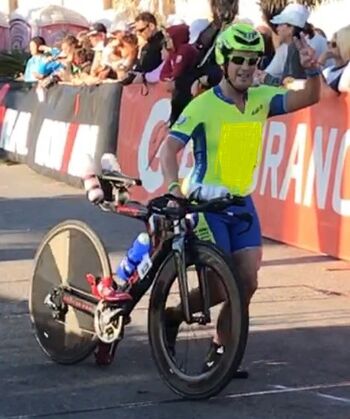
Before his diagnosis, Jose Beltran competed in Ironman races.
The oral surgeon trained for Ironman competitions, spending countless hours swimming, cycling and running. In the summer of 2021, he was preparing for another race when he noticed something unusual.
The night before the event, Beltran, who was 45 at the time, felt a swollen lymph node in his groin.
“At first, I thought it was nothing,” he recalled. “I was probably the healthiest in my age group. I did triathlons. I did Ironmans.”
A few days later, a biopsy revealed a diagnosis he never expected: mantle cell lymphoma, a rare and aggressive form of non-Hodgkin lymphoma.
“I was devastated,” Beltran said. “I thought, what the hell? I’m super healthy.”
The diagnosis marked the beginning of a years-long journey that would test him physically and emotionally, challenge his assumptions about cancer treatment and lead him to a groundbreaking clinical trial at Moffitt Cancer Center.
When Healthy Doesn’t Mean Immune
Mantle cell lymphoma accounts for about 5% to 7% of non-Hodgkin lymphoma cases, making it a relatively rare blood cancer. The disease develops in B lymphocytes, a type of white blood cell that helps the immune system fight infection.
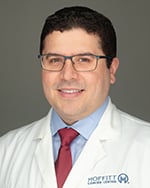
Sameh Gaballa, MD
According to Sameh Gaballa, MD, a hematologist at Moffitt specializing in lymphoma treatment, mantle cell lymphoma can be particularly challenging because patients often feel healthy at the time of diagnosis.
“Many patients are surprised by the diagnosis because symptoms can be subtle or nonspecific,” Gaballa said. “The disease may present with enlarged lymph nodes, fatigue or other symptoms, but some patients discover it incidentally.”
That was the case for Beltran.
Within days of his diagnosis, he met with an oncologist and prepared to begin chemotherapy, the long-standing standard treatment for many mantle cell lymphoma patients.
But something didn’t sit right.
Looking Beyond Chemotherapy
Like many newly diagnosed patients, Beltran wanted treatment immediately.
“My mindset was get this thing out of me as soon as possible,” he said.
Chemotherapy was scheduled to begin within a week. Yet as he researched his diagnosis and spoke with colleagues from his medical school network, he found himself increasingly concerned about the potential side effects.
“I was terrified of chemotherapy,” Beltran said. “I thought I was going to lose my hair. I thought I’d be nauseous all the time and feel terrible.”
A conversation with a friend changed the trajectory of his care.
“He told me, ‘You need to find somebody who does immunotherapy,’” Beltran said. “That completely changed my thinking.”
Beltran sought a second opinion at Moffitt and met Gaballa, who recommended additional testing before deciding on a treatment plan.
“We’re not done diagnosing,” Beltran remembers Gaballa telling him.
Additional biopsies and genetic testing confirmed that Beltran was eligible for a clinical trial investigating a chemotherapy-free treatment approach.
For Beltran, it represented an opportunity to pursue an alternative that aligned with his goals and values.
“It wasn’t even a question,” he said. “Once I started reading about immunotherapy and the research supporting it, I knew that’s what I wanted to do.”
A New Era of Treatment
Historically, treatment for mantle cell lymphoma relied on intensive chemotherapy followed by stem cell transplantation for eligible patients.
In recent years, however, researchers have developed targeted therapies and immunotherapy-based approaches designed to attack cancer cells more precisely while limiting damage to healthy tissues.
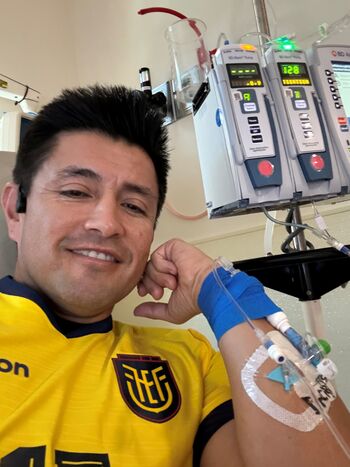
Beltran received monthly infusions at Moffitt as part of his clinical trial.
“These therapies are changing how we treat mantle cell lymphoma,” Gaballa said. “Clinical trials have helped us identify new combinations that can achieve deep and durable remissions while reducing reliance on traditional chemotherapy for some patients.”
Beltran enrolled in a clinical trial that combined targeted and immunotherapy agents, including acalabrutinib, obinutuzumab and lenalidomide.
The treatment required monthly infusions and daily medications. Although he experienced fatigue, skin rashes and other side effects, he continued working throughout treatment and remained active.
Most importantly, he never needed chemotherapy.
Within six months, Beltran had achieved remission.
“They were trying to put me into a deep remission,” he said. “Six months in, I was in remission, but I stayed on the trial treatment for two years because that was part of the plan.”
The Mental Toll of Cancer
While the physical side effects were manageable, Beltran says the emotional impact proved far more difficult.
For a man accustomed to controlling every aspect of his training and performance, cancer introduced uncertainty.
“The hardest part was feeling like I couldn’t control my destiny anymore,” he said. “That was very humbling and overwhelming.”
The disease also affected his family life. His children were just toddlers when he was diagnosed and he deliberately shielded them from much of his treatment experience.
“I never wanted them to see me like that,” he said. “Whenever I came home, I tried to put my best face forward.”
Even so, he often battled exhaustion behind the scenes.
“I’d be playing with my kids and sometimes I’d sit down and fall asleep right away,” he said.
Finding Healing Through Music
During long infusion appointments, Beltran rediscovered a part of his life that had long been pushed aside by the demands of career and family: music.
Before becoming an oral surgeon, he studied music composition in college and spent much of his childhood writing songs. During treatment, he began writing songs that reflected his experience as a cancer patient. When side effects made singing difficult, he embraced artificial intelligence tools to help transform his lyrics into fully produced songs.
“I couldn't always sing the way I wanted to, but I could still create,” Beltran said. “Music gave me an outlet when I needed one most.”
The project became more than a hobby. It offered a creative escape during treatment and a way to process the fear, uncertainty and hope that accompanied his journey with mantle cell lymphoma.
“I felt broken,” Beltran said. “Writing songs became my outlet.”
One song tells the story of his journey through diagnosis and treatment. Encouraged by nurses and physicians who were moved by the lyrics, Beltran eventually began sharing his music with others.
“What surprised me was seeing how much it connected with other people,” he said. “If it helps another patient feel less alone, then it’s worth sharing.”
Today, he has written dozens of songs inspired by his experience.
The Importance of Asking Questions
Beltran completed treatment earlier this year and remains in remission.
Looking back, he believes one decision made all the difference: seeking another opinion.
He is careful not to suggest that every patient should follow the same path. Instead, he encourages patients to learn about their diagnosis, ask questions and understand all available options.
“I wish everybody had access to that information so they could make an educated decision,” he said.
Gaballa agrees.
“Every patient’s disease is unique,” he said. “That’s why comprehensive evaluation, expert consultation and access to clinical trials are so important. Research continues to improve outcomes and expand treatment options for patients with mantle cell lymphoma.”
Five years after discovering that swollen lymph node, Beltran is back to work, back in the gym and preparing for something he once feared he might never do again.
“I feel like I’m 100% again,” he said. “I think I’m going to start racing triathlons again.”
For a man whose life was once defined by endurance, the next finish line is no longer about beating competitors.
It is about moving forward.
 Medically reviewed by Sameh Gaballa, MD, Malignant Hematology Program