

Grief Isn’t Linear: What to Know During the Cancer Journey
Naomi Baldwin still remembers the day she lost her brother Todd to testicular cancer.
She was a senior in high school when her aunt and sister gave her the news one summer day when a cloud could not be found in the sky.
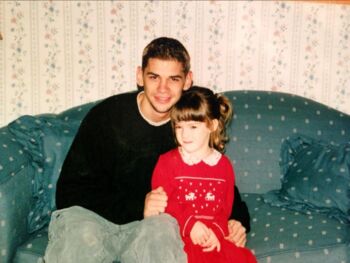
Naomi Baldwin lost her brother Todd to testicular cancer when he was just 32.
“It’s messy, complicated, yet so beautiful that we have the privilege to grieve someone we love so much,” Baldwin said.
Now a social worker at Moffitt Cancer Center, Baldwin says it’s important for others to know that grief can come in waves and can take many forms that aren’t always apparent.
Why Grief Isn’t Linear
One of the biggest misconceptions about grief is that it must follow a series of stages or eventually disappear, Baldwin says.
Instead, it can be fluid and unpredictable. Some days, one may feel fine and overwhelmed the next day. Seemingly small factors like a song, food, or milestone can unexpectedly bring back a rush of emotions.

Naomi Baldwin, who has a master’s in Social Work, draws from her own experience with grief to support patients and loved ones at Moffitt.
“What can happen is that we can lean into the grief, we can honor the grief, we can learn about ourselves and how to navigate grief,” Burke said.
Cancer Can Bring Many Forms of Grief
While grief is often associated with the loss of a loved one, for those facing cancer, it can also take various forms during and after treatment.
For instance, patients may grieve the loss of independence, previous health or routines, changes in appearance, or the future that was once imagined.
Cancer can also change how patients see themselves, leaving some to question their identity, relationships and what remains meaningful to them now that priorities may have changed.
Burke notes these forms of grief are normal and that during tough times, negative and positive emotions can coexist.
“It’s OK to honor your grief and anxiety and fear,” Burke said. “That doesn’t mean that you’re not also being hopeful.”
Making Space for Grief
Burke says there are techniques people may find helpful when navigating waves of grief. For instance, being intentional about making time to process emotions can be helpful.
Creating intentional time to process those emotions can give people a greater sense of control while navigating circumstances that are often beyond their control, Burke says.
For example, someone might set aside 20 minutes to cry, journal or think through their fears before returning to the rest of their day. Other options include counseling, mindfulness, journaling and finding support groups.

How Can You Support Someone Grieving?
Licensed clinical social worker Amy Burke says there are many ways to process and normalize grief.
Loved ones may feel pressure to find the right words or fix the situation but sometimes simply listening during tough times can go a long way, Burke says.
People going through cancer may not have the energy to explain what they need, or they may hesitate to ask for help because they don’t want to feel like a burden.
Instead, loved ones can take the initiative when they are able. Picking up groceries or preparing a meal can be helpful. Simply being present can be more meaningful at times than trying to make someone’s grief go away or attempting to fix a situation.
“It can be a hard thing to do but sometimes it’s just being that safe space can mean a lot. Telling someone, ‘You can unload with me, cry with me, and I’m not going to try to change you,’” Baldwin said.
No Such Thing as a Setback
People may feel as though they aren’t making progress when another wave of emotions suddenly overwhelms them.

Baldwin says grief can show up unexpectedly, and experiencing those emotions again doesn’t mean someone is moving backward.
Her brother Todd would have been 47 this year. While some days can still feel all-consuming and others feel easier, Baldwin says she has learned that both can coexist.
Experts stress grief can take on different forms that are not always apparent throughout life.
“My brother’s death taught me that grief can change without disappearing. The sharpness of the pain may shift but it doesn’t mean we’ve stopped caring,” Baldwin said. “There is no right way to do it. Be patient with yourself and let others walk beside you.”
Grief Support at Moffitt
Moffitt offers several resources for patients and families experiencing grief throughout the cancer journey, including a Day of Remembrance twice a year to honor patients who have passed away.
Moffitt also offers a Bereavement Support Group for people who have lost someone to cancer. To learn more about resources available at Moffitt, visit Counseling and Support.
If you would like to connect with a Moffitt social worker, please contact your clinic, ask a member of your care team both in-patient and out-patient or call the Department of Social Work at 813-745-8407.