Growing With Moffitt: Amy Beightel’s Career Centered on Patients
Key Takeaways:
- Moffitt Cancer Center nurse Amy Beightel has spent 37 years witnessing major advances in nursing and cancer care
- Losing her mother to breast cancer at a young age inspired Beightel’s career in oncology
- Now a wound and ostomy nurse, Beightel emphasizes personal connections and treating patients as people, not diagnoses
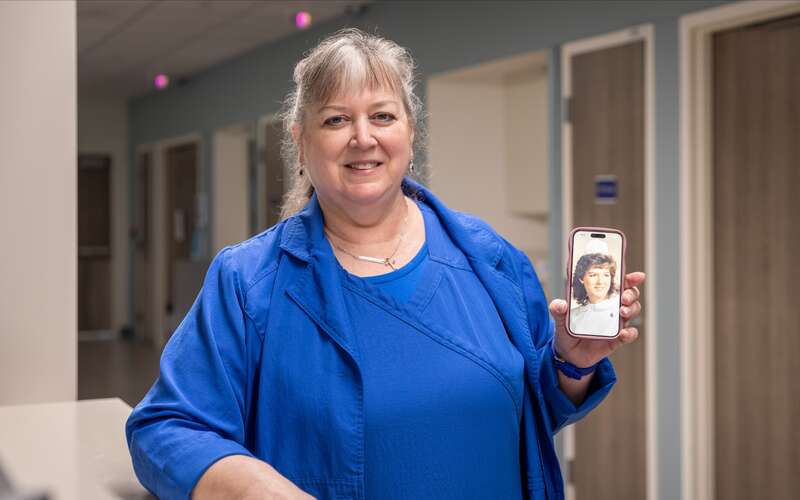
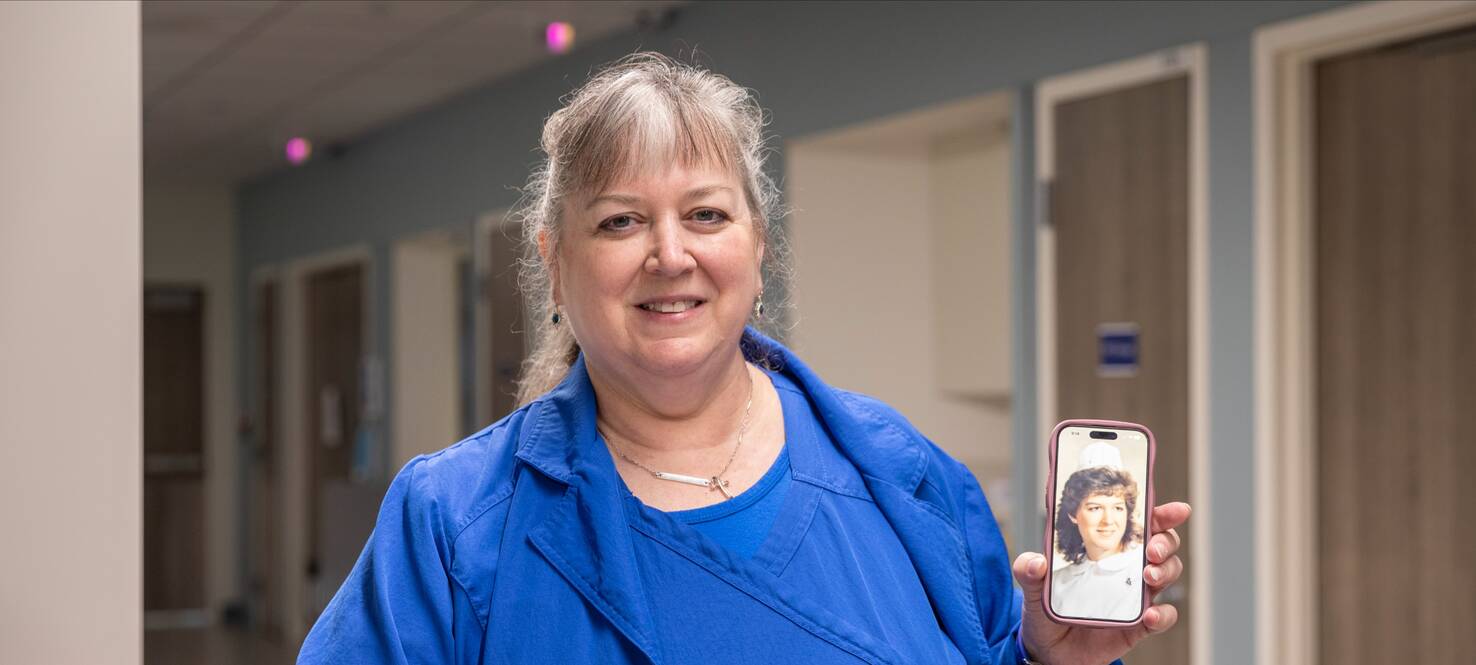
When Amy Beightel, a wound and ostomy nurse, arrived at Moffitt Cancer Center in October 1989, she was a brand-new nurse beginning her first nursing job. Moffitt was just 3 years old, Magnolia was its only campus and cancer care looked very different than it does today.
Over more than three decades, Beightel has been a part of Moffitt’s growth, as well as the evolution of nursing and cancer care. Through it all, her connection with patients has remained constant.
Her nursing career started on 4 South, Moffitt’s post-surgical unit. At the time, the unit cared for a wide variety of surgical patients, rather than the more specialized model of today. Beightel remembers the sense of community that came with working at a much smaller Moffitt, including dinners with colleagues during the 3 to 11 p.m. shift.
“We would go down to dinner together with the respiratory therapists and some physical therapists,” Beightel said. “It was like this little group of different disciplines that would all meet at dinnertime. I don’t know how we always had time for that, but we usually did.”
For Beightel, a career in oncology and the progress she has witnessed in cancer care are deeply personal. Her mother died of breast cancer when she was just 3 ½ years old, an experience that helped inspire her to care for others facing cancer.
“It was something that I wanted to give back, to be able to help other people so that they wouldn’t have to lose their mom,” Beightel said.
A Changing Landscape of Cancer Care
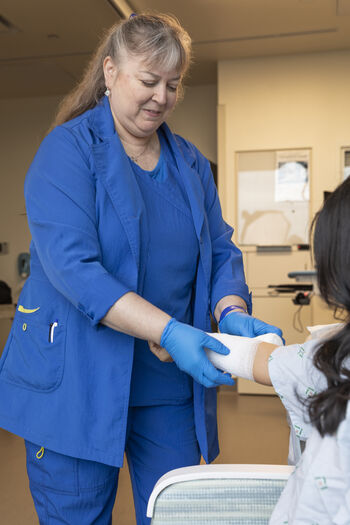
Amy Beightel has worked in the wound ostomy specialty at Moffitt for nearly a decade now.
Over 37 years, Beightel has seen firsthand how drastically patient care has changed. She remembers when patients undergoing prostatectomies had to spend five to six days in the hospital recovering. Today, the same procedure can be done in an outpatient setting.
Shorter hospital stays have also changed how nurses prepare patients for recovery at home. What once had to be taught over several days now has to be covered in a much shorter period of time.
As nursing at Moffitt progressed and changed over the years, so too did Beightel’s career. While working on 4 South, she found herself drawn to caring for patients with wounds and ostomies, as well as the education that came with it. With encouragement and mentorship from Moffitt’s wound ostomy nurses, that interest eventually became her specialty.
After raising her children, Beightel returned to school to earn her bachelor’s degree and later became certified in wound ostomy continence nursing. She has now worked full time in the specialty for nearly a decade.
The Heart Behind the Care
Throughout her career, she has watched advances in breast cancer awareness, detection and treatment that have given patients options that weren’t available to her mother when she was diagnosed.
That personal connection has also guided Beightel’s approach to patient care. She sees each patient as someone’s loved one — a mother, father or sibling — whose story matters just as much as the stories of those in her own family.
Some of her favorite moments have come when patients reach the end of a long hospital stay and finally get to go home following treatment or surgery.
“Each day I pray that I can be a blessing to someone, but with their stories, they are a blessing to me,” Beightel said.
As cancer care continues to advance, Beightel hopes the next generation of Moffitt nurses remembers what matters most: that the heart of their work is not just treating cancer; it’s about caring for the people facing it.
“I hope that they realize patients are people,” Beightel said. “Never get too technical that you don’t sit and talk with your patients. They’re not a number. They’re not a diagnosis. They’re people, just like them.”