Mapping the Storm: Researchers Explore How Hurricanes Disrupt Cancer Care
Key Takeaways
- Researchers from Moffitt Cancer Center and the USF College of Public Health are studying how hurricanes and other severe weather events affect cancer patients, particularly those with blood cancers who rely on tightly scheduled treatments
- Using maps, satellite imagery, weather data and power outage records, the team aims to pinpoint the specific disruptions that interfere with cancer care, moving beyond broad county-level disaster declarations
- The findings could help cancer centers strengthen emergency preparedness by identifying evidence-based strategies to reduce treatment interruptions and better protect patients during future storms
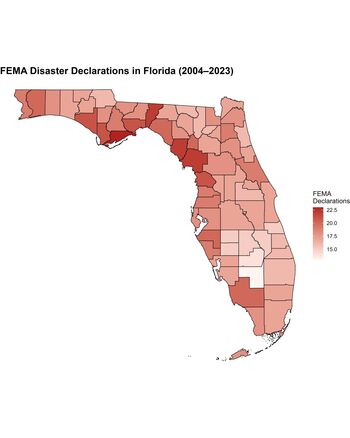
Researchers mapped FEMA disaster declarations across Florida from 2004 to 2023, revealing how frequently communities have experienced federally declared disasters. The maps serve as a foundation for a new study examining how hurricanes and other severe weather events may disrupt cancer care across the state.
When Hurricane Milton swept across Florida in 2024, it left hundreds of thousands without power, damaged homes and disrupted daily life across much of the state. Among those affected were Moffitt Cancer Center researcher Jacob Kresovich, PhD, and the USF College of Public Health environmental epidemiologist Catherine Bulka, PhD, whose family spent several days without electricity after the storm.
The experience sparked a question that has since grown into a new research collaboration.
"What happens when a hurricane disrupts cancer care?"
Together, Kresovich and Bulka are leading a study that aims to better understand how hurricanes and other severe weather events affect cancer patients across Florida. By combining expertise in cancer epidemiology and environmental health, the two hope to identify the specific disruptions that place patients at greatest risk and provide evidence to help health systems better prepare for future storms.
As a first step, they developed a series of maps showing nearly two decades of FEMA disaster declarations across Florida. While the maps provide a broad picture of where disasters have occurred over time, they also highlight why researchers need a more precise way to measure how severe weather affects individual patients.
Looking Beyond Disaster Declarations
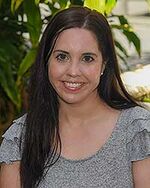
Catherine Bulka, PhD
The maps show that hurricanes and other federally declared disasters have affected communities across Florida, with some counties experiencing repeated declarations over the past 20 years.
County-level disaster declarations tell only part of the story.
"FEMA declarations cluster around major hurricane landfalls, which is helpful for tracking big events," Bulka said. "But they don't tell us what individual patients actually experienced."
Two people living in the same county may have very different experiences during a storm. One may lose power for weeks or find roads to their treatment center impassable, while another may experience little disruption at all.
Those differences matter when researchers are trying to understand why some patients experience interruptions in care while others do not.
To create a clearer picture, the research team plans to combine satellite imagery, weather data and power outage records with patient-level information. Rather than simply asking whether someone lived in a county affected by a hurricane, they hope to measure the actual conditions surrounding each patient's home.
"That's the only way to see the real picture," Kresovich said.
Why Blood Cancer Patients Are Especially Vulnerable
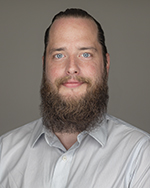
Jacob Kresovich, PhD
While hurricanes can affect anyone receiving cancer treatment, Kresovich became particularly interested in patients with blood cancers such as leukemia, lymphoma and myeloma.
Unlike many other cancers, these diseases often require specialized chemotherapy on carefully timed schedules.
"Patients with these cancers are uniquely vulnerable because their treatment regimens are incredibly intensive," Kresovich said. "They need chemotherapy sometimes twice a week, and even a brief delay can allow their cancer to progress or cause life-threatening complications like infections."
Storm-related flooding may force infusion centers to close. Extended power outages can interrupt chemotherapy delivery, diagnostic imaging and other essential services. Damaged roads, fuel shortages and evacuation orders can also prevent patients from reaching appointments.
For people whose immune systems are already weakened by cancer or its treatment, those disruptions may increase the risk of infection, hospitalization and disease progression.
Building More Resilient Cancer Care
As the project moves forward, the researchers hope to identify which hurricane-related disruptions have the greatest impact on patient outcomes.
Do prolonged power outages pose the greatest threat? Are transportation barriers more disruptive than flooded facilities? How much does delaying chemotherapy affect survival? Which patients are at the highest risk?
The answers could help hospitals and cancer centers make more informed preparedness decisions, from prioritizing backup power for infusion centers to developing agreements that allow patients to continue treatment at alternate facilities after a disaster.
The findings could also help guide broader emergency preparedness efforts across Florida and beyond.
"Ultimately, cancer centers won't be able to prevent storms," Kresovich said. "But they can prevent treatment disruption. We're trying to identify exactly how to do that based on evidence, not guesswork."