

Metastatic Breast Cancer Patient Continues To Watch Family Grow Thanks to Clinical Trial
Key Takeaways:
- Diagnosed with metastatic triple-negative breast cancer at 42, a Florida mother turned to a clinical trial
- More than 10 years later, her disease is in remission while she continues taking a PARP inhibitor
- She now looks ahead to enjoying family milestones and celebrations while planning a family trip to Europe
Tamara Holt lights up when she is talking about her sons. One is pursuing a master’s degree in aerospace engineering; the other is in college and playing semi-professional soccer.
Holt’s feelings go beyond just a mother’s pride. Watching them succeed as adults is something she doubted many times if she would be able to witness. She was diagnosed with triple-negative breast cancer in 2015 at age 42, when her sons were in first and fourth grade.
After initial treatment of chemotherapy and a double mastectomy, her cancer returned a year later. This time, it had spread.
“The scans showed that my cancer had quickly metastasized to many areas of my body, particularly my bones and even to my liver,” Holt said.
A chance at a clinical trial led Holt to Moffitt Cancer Center in 2016. While she knew the trial was her best option, she was shocked to hear the effectiveness of the trial treatment was seemingly 18 months at best for previous patients.
“I was like, wait, what? No one had ever given me a number before. I broke down. It was traumatizing to think that I may only have 18 months left with my kids. My kids are too young for this,” Holt said.
Defying the Odds
Metastatic triple-negative breast cancer is widely considered one of the most aggressive and challenging types of breast cancer to treat. It lacks the three receptors that most treatments target — estrogen receptors, progesterone receptors and high levels of the HER2 protein — which results in fewer treatment options. The disease also grows and spreads faster than other breast cancer subtypes, increasing the chance it will travel to other areas of the body.
According to the National Institutes of Health, the average survival for someone diagnosed with metastatic triple-negative breast cancer is about 12 to 14 months. The five-year survival rate is roughly 12% to 15%.
-

12 to 14
Months of average survival
-
12% to 15%
Five-year survival
At the time Holt joined her trial, there were not a lot of approved treatments for the disease. Her phase 3 trial investigated a PARP inhibitor called veliparib given in combination with two different chemotherapies. PARP inhibitors are a type of targeted oral medication that treats cancer by blocking the PARP enzyme, which helps repair damaged DNA.
Due to her initial response, Holt’s physicians dropped one of the chemotherapies. Over time, they decided to stop the second chemotherapy and give only the PARP inhibitor. Eventually, she was even able to decrease the dose of the single medication.

Tamara Holt attends a Red Sox game with her husband and best friend right after completing treatment in 2016.
“Through all of this, my attitude with the boys was like, I just gotta get the first one through elementary school. Then it was, now I gotta get the second one through. Then it was, I gotta get ‘em to this birthday, get ‘em to that birthday,” Holt said. “We just kept going.”
On Holt’s 100th cycle of treatment, her care team threw her a party at Moffitt.
“When you see other patients ringing the bell at the completion of treatment, you are happy for them, but you also know as a metastatic patient you will never get to ring the bell,” Holt said. “But this party wishing me well was really emotional for me — that I am going through this milestone and it is something to be happy about.”
Planning for the Future
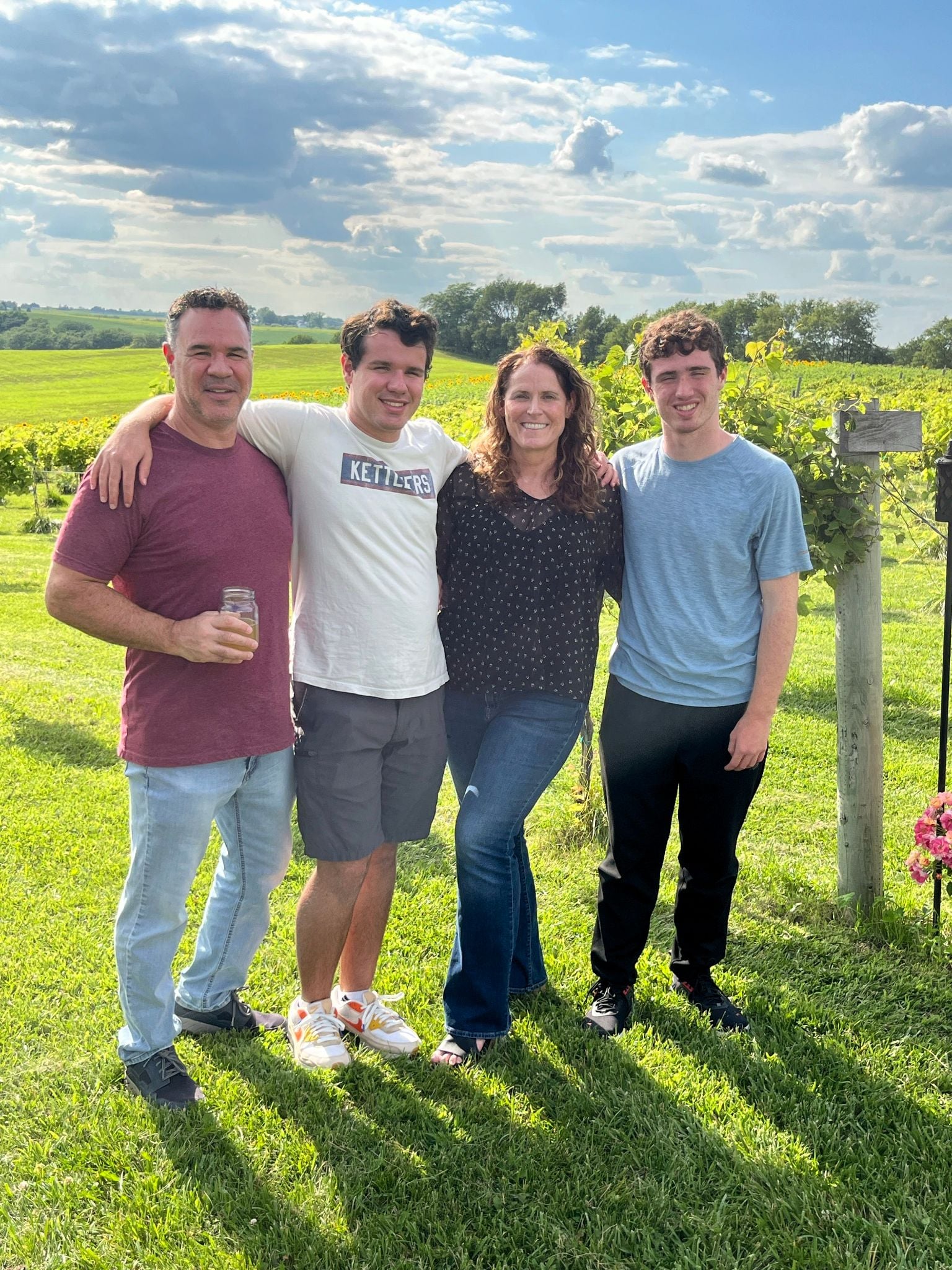
Holt has planned family trips as often as she can since she finished her trial, including this trip with her husband and sons in 2024.
Today, more than 10 years later, Holt is still taking a PARP inhibitor and her disease is stable. She continues to get scans every six months and says each one brings a giant wave of feelings.
“Scans always come with a waiting game. There is a knot in your stomach, a ball in your chest, and it is not a pleasant feeling,” Holt said. “And as soon as you hear it’s stable, it’s cause for celebration. It’s been about 11 years now and I still get anxiety over the thought that, if this happens again, what would we do?”
Luckily, she hasn’t had to answer that question yet. But if she does, the now 56-year-old says she is still going to fight it. She has taken up sports photography and is planning a big family trip to celebrate her 25th wedding anniversary.
Holt’s goals have now moved past seeing her sons finish elementary school and are focused on college graduations and hopefully one day weddings and grandchildren.
“Whatever happens, I plan on being there to see it, and that is all that matters,” Holt said.