Moffitt First in Florida To Offer Treatment Derived from Pineapples for Rare Cancer
Key Takeaways:
- At 82, Ed Meyers has been treated for chronic lymphocytic leukemia and later was diagnosed with pseudomyxoma peritonei, a rare condition linked to mucinous appendix cancer
- Because of his age and medical history, Meyers had no standard treatment options for his rare cancer
- Moffitt gastrointestinal surgical oncologist Michael Wach, MD, treated Meyers with BromAc, a combination of bromelain and acetylcysteine that liquefied and helped remove tumor-associated mucin
Eighty-two-year-old Vietnam veteran and Florida native Ed Meyers has faced two separate cancer diagnoses during his lifetime.
He first came to Moffitt Cancer Center in 2017 for a second opinion on chronic lymphocytic leukemia, a type of blood cancer. Treatment helped him manage the disease over time.
Years later, during hernia surgery, mucinous material was found in his abdomen. Further tests revealed Meyers had pseudomyxoma peritonei, a rare condition caused by cancer of the appendix, where thick mucus containing tumor cells spread throughout the abdomen. When untreated, this condition can cause severe abdominal distension, pain, bowel obstructions and difficulty eating and drinking. Because of his age and medical history, Meyers had no standard treatment options.
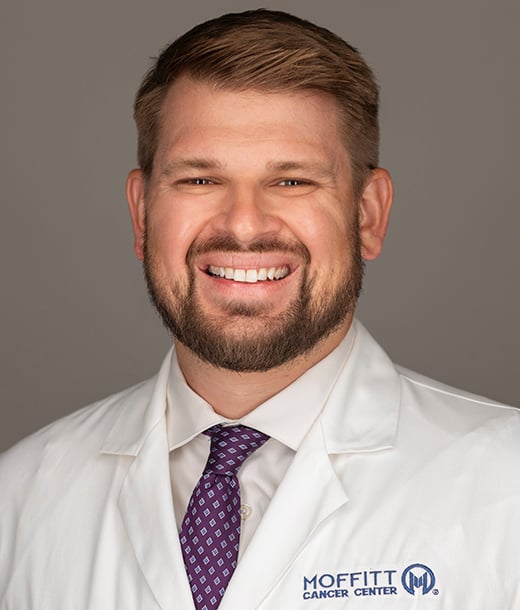
Michael Wach, MD
Investigational BromAc Therapy
Michael Wach, MD, a gastrointestinal surgical oncologist at Moffitt, had an idea for Meyers: an investigational therapy called BromAc. While it would not cure Meyers’ disease, it could help reduce his tumor burden and relieve his symptoms.
BromAc combines bromelain, an enzyme found in pineapples, with N-acetylcysteine, a medication more commonly used to break up mucus in the lungs for patients with chronic obstructive pulmonary disease (COPD) or cystic fibrosis. The combination breaks down the thick mucus produced by the tumor, turning it into a liquid that can then be drained through small tubes. Essentially, it turns jelly material into more of a lemonade.
The procedure has only been performed about 20 times in the United States.
“I talked with Dr. Wach in depth about it and I also did a lot of research. That helped take the mystery away and I knew I wanted to move forward,” Meyers said.
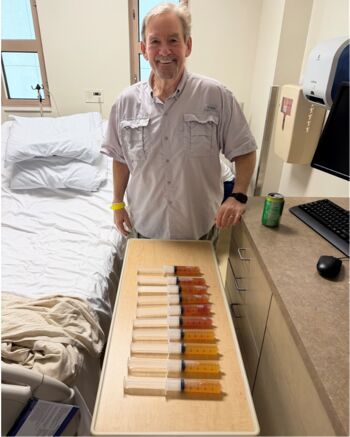
During the procedure, doctors removed 1.5 liters of liquid from Ed Meyers’ abdomen.
Meyers was the first patient in Florida to undergo the procedure.
A mucinous tumor near his stomach had been pressing on the organ for more than two years, causing chronic pain and reducing his appetite. The therapy liquefied large volumes of the thick mucin in his abdomen, allowing 1.5 liters to be removed during the two-week, noninvasive procedure that was performed in an outpatient setting.
Improved Symptoms
Meyers responded well to treatment, and imaging showed a 32% reduction in the size of his tumor.
“Taking someone who did not have any therapy options and being able to remove one-third of his tumor can really make a big difference for these patients,” Wach said.
Now, about two months later, Meyers says his symptoms have subsided.
“For the first time in a long time, I finally have my appetite back,” he said. “I also don’t feel as much pressure in my abdominal area like I used to.”
So far, the therapy has been used as a one-time treatment for selected patients in the United States. Moving forward, Wach hopes to use the treatment more than once for patients like Meyers if their tumors begin to regrow.
“When I go back for my follow-up appointment in a few months, if they think I need to get the procedure done a second time, I will do it because it made me feel much more comfortable,” Meyers said.
 Medically reviewed by Michael Wach, MD, Gastrointestinal Oncology Program