

New Brachytherapy Suite Transforms Patient Experience
Key Takeaways:
-
Moffitt’s Richard Gonzmart Brachytherapy Suite has treated more than 100 patients since opening in October 2025
-
The new suite combines imaging, treatment planning and radiation delivery in one room, cutting treatment time in half
-
A $1 million gift from restaurateur Richard Gonzmart helped make the suite possible, improving comfort and efficiency for cancer patients
Jeff Stulz says his first prostate cancer treatment felt like a battle.
It involved nearly 14 hours in and out of sleep at the hospital. He dealt with nausea from anesthesia, and the procedures had to be completed in different areas of the building.
Weeks later, his experience dramatically improved after Moffitt Cancer Center’s Richard Gonzmart Brachytherapy Suite opened.
This time, there was no nausea. Just six hours of treatment in one room. By noon, he was out the door, cracking jokes with staff and able to enjoy a meal.

For Jeff Stulz, treatment in the Richard Gonzmart Brachytherapy Suite meant less time in the hospital and a faster return to the activities he enjoys with family and friends.
“I went to sleep once and woke up once,” Stulz said. “That was it.”
Impact Since Opening
Since opening in October 2025, the state-of-the-art brachytherapy suite has treated 100 patients and counting, with plans to expand its services and reach even more people.
Brachytherapy is a type of radiation therapy most commonly used to treat prostate cancer, but it can also be used for cervical, breast, sarcoma and rectal cancers.
It uses implants or temporary seeds placed inside the body to deliver radiation to a specific area while avoiding healthy tissue, often requiring fewer sessions than traditional radiation.
“Brachytherapy was actually the first type of radiation therapy,” said Daniel Fernandez, MD, PhD, section head of brachytherapy at Moffitt. “Some of the earliest positive effects of radiation on cancer were seen by putting radioactive material near tumors.”
Brachytherapy for prostate cancer can be delivered in two main ways:
- Low-dose-rate brachytherapy uses radioactive seeds that are implanted permanently and release radiation slowly over weeks or months.
- High-dose-rate brachytherapy uses temporary implants to deliver radiation over a short period of time, often 10 to 20 minutes per treatment. It can be completed under anesthesia in one or two sessions rather than weeks of daily appointments, which is often the case with more common external beam radiotherapy treatments.
Traditionally, the steps involved in high-dose-rate brachytherapy are performed at multiple locations within a hospital. This means patients are moved between imaging rooms, operating areas and radiation treatment spaces.
The process can lead to 12-hour days for some patients, who are being taken in and out of anesthesia multiple times. The complications go beyond just the side effects from the anesthesia.
“Much of that day was spent with a lot of anxiety for patients trying to hold still in an uncomfortable position, worried that if they move too much, they could affect the quality of their treatment,” Fernandez said.
A Transformative Gift
Moffitt’s new brachytherapy suite aims to improve treatment and provide a true outpatient procedure.
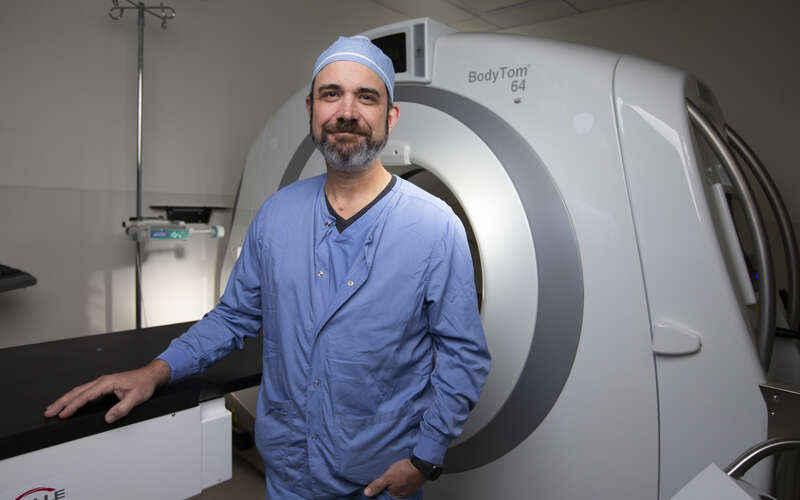
The radiation-shielded room brings advanced ultrasound, diagnostic-quality CT imaging, and high-dose-rate brachytherapy treatment planning and delivery technology into one space. Doctors can plan and deliver radiation without moving the patient or waking them between steps.
The suite also removes many of the variables that once complicated the treatment. Previously, moving patients between rooms sometimes caused implanted needles to shift, requiring additional adjustments.
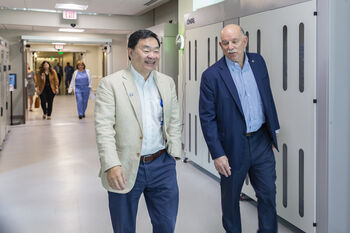
Patrick Hwu, MD, president and CEO, left, and donor Richard Gonzmart both understand the importance of comfort and efficiency for patients.
“With this setup, we eliminate a lot of that uncertainty,” Fernandez said. “That benefits both the patient experience and the quality of care.”
The new suite is treating patients in half the time, which makes it more comfortable and efficient for patients.
The suite would not have been possible without the support of Gonzmart, who pledged to donate $1 million to Moffitt eight years ago to help bring it to life.
Most recognize Gonzmart as the fourth-generation owner and operator of the famed Columbia Restaurant.
Cancer has affected Gonzmart’s family for generations. His grandfather died from prostate cancer, and his father passed from pancreatic cancer. In 2013, Gonzmart was diagnosed with prostate cancer.
Fortunately, his cancer was caught early thanks to an annual prostate-specific antigen (PSA) screening, which made him a good candidate for brachytherapy.
“I’m so proud to be a part of this advancement. For years, I’ve wanted to bring this therapy to more people in need. Now Moffitt Cancer Center has the ability to help more people and save more lives,” Gonzmart said.
A New Normal
For Stulz, life after brachytherapy treatment is now quieter and more routine.
He has regular PSA tests and check-ins with his care team, but cancer no longer fills his calendar. There’s now time to make more memories, including trips with his family.
“It let me get back to living,” Stulz said. “That’s what I wanted all along.”
