
Histotripsy for Liver Tumors: Expanding Treatment Options Through Noninvasive Focused Ultrasound Technology
Key Takeaways for Busy Providers
Histotripsy uses focused ultrasound to mechanically destroy targeted liver tumors without surgery, needles, radiation or heat-based ablation.
Histotripsy offers an additional local therapy for patients with primary or metastatic liver tumors who are not candidates for surgery or other liver-directed treatments.
Physicians can visualize treatment delivery throughout the procedure, and many patients are discharged the same day or after a short observation period.
Moffitt's GI Oncology team is available for histotripsy consultations to determineProviders seeking consultation for patients with primary liver cancers, colorectal liver metastases or other liver tumors can request a consult with Moffitt's Gastrointestinal Oncology Program.
Histotripsy represents a significant advancement in the treatment of select liver tumors, offering a noninvasive, image-guided approach that mechanically destroys tumor tissue without surgery, thermal ablation or ionizing radiation. Moffitt Cancer Center is among the early adopters of this FDA-approved technology, providing access to the HistoSonics Edison® Histotripsy System for patients with primary and metastatic liver malignancies.
Histotripsy expands treatment options for select patients who may not be candidates for surgery or whose tumors are located near critical vascular or biliary structures, where other liver-directed therapies may be more challenging.
FDA-Approved Histotripsy Technology
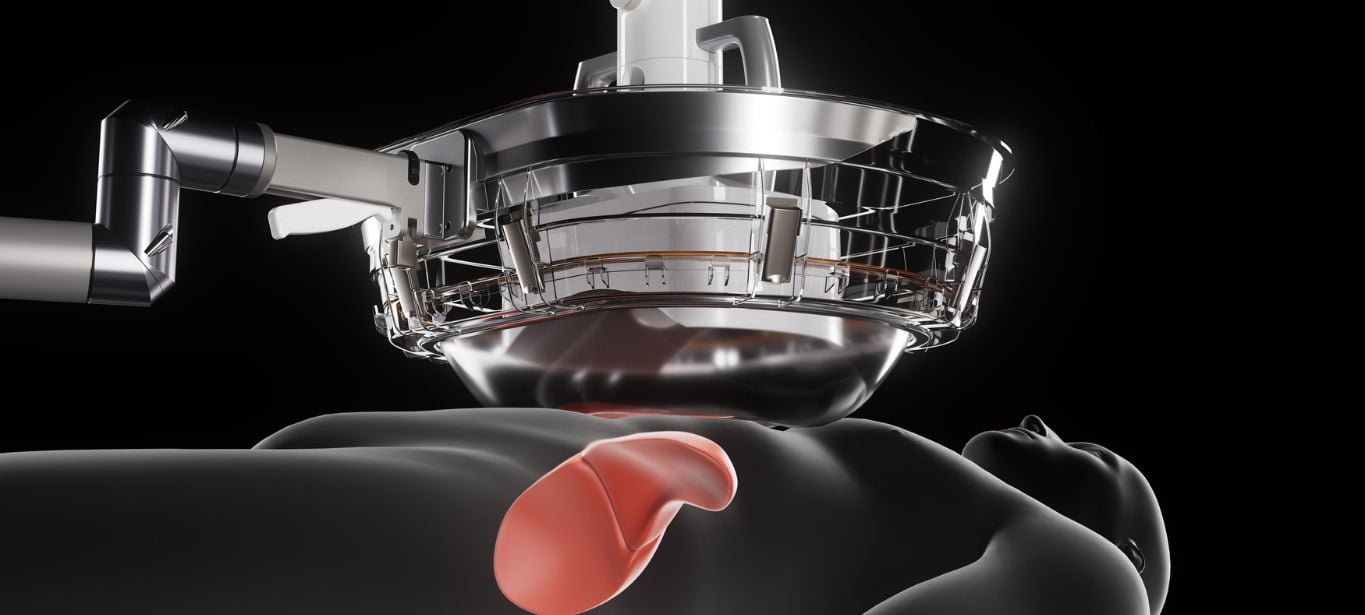
The FDA-approved HistoSonics Edison® Histotripsy System uses high-intensity focused ultrasound to mechanically destroy targeted liver tumor tissue via acoustic cavitation. Unlike radiofrequency ablation, microwave ablation and other heat-based therapies, histotripsy does not rely on thermal energy to achieve tumor destruction.
During treatment, focused ultrasound waves generate microscopic bubbles within the tumor. As these bubbles rapidly expand and collapse, they generate mechanical forces that disrupt cellular structures and break down tumor tissue into acellular debris that the body can naturally clear. Because the mechanism is mechanical rather than thermal, histotripsy minimizes the risk of heat-related injury to surrounding tissues.
The procedure is performed under real-time imaging guidance, allowing physicians to continuously visualize treatment delivery and precisely target tumor tissue while minimizing effects on adjacent healthy structures.
How Histotripsy Differs From Other Liver-Directed Therapies
The primary distinction between histotripsy and many existing liver-directed treatments is its mechanism of action.
Traditional ablative therapies, including radiofrequency and microwave ablation, rely on thermal energy to induce tissue necrosis. While effective in many clinical scenarios, thermal techniques may be limited by proximity to major blood vessels due to the heat sink effect and may present challenges when treating tumors near sensitive biliary structures.
Radiation therapy, including stereotactic body radiation therapy (SBRT), utilizes ionizing radiation to damage tumor DNA and inhibit tumor growth. Although highly effective in many settings, radiation treatment typically requires multiple sessions and must balance tumor control with normal tissue exposure.
Histotripsy differs in that it:
- Uses focused ultrasound rather than heat or radiation
- Requires no incisions, needles or probes
- Avoids thermal injury to surrounding tissues
- Preserves critical vascular and biliary structures
- Provides real-time visualization during treatment
- Offers a completely noninvasive treatment approach
These characteristics may make histotripsy particularly attractive for patients with tumors located near major vessels or bile ducts where thermal ablation may be less desirable.
Potential Benefits of Histotripsy
Histotripsy offers several potential advantages for select patients with liver tumors.
Noninvasive Treatment
Delivered externally through focused ultrasound energy, histotripsy avoids the need for surgical incisions, percutaneous probes or implanted devices. As a result, patients may experience less procedural burden and a shorter recovery period.
Preservation of Surrounding Structures
The liver contains critical anatomy, including major vascular structures and bile ducts. Histotripsy's nonthermal mechanism may reduce the risk of collateral tissue injury while maintaining treatment precision.
Integration Into Multimodality Care
Histotripsy is not intended to replace established therapies but rather expand available treatment options. Depending on disease characteristics and treatment goals, histotripsy may be incorporated alongside surgery, systemic therapy, radiation therapy or other liver-directed interventions.
Recovery Considerations
Many patients can be discharged the same day or after a short observation period. Compared with more invasive approaches, recovery is generally brief, allowing patients to resume normal activities relatively quickly.
When to Consider Histotripsy
Histotripsy may be considered for select patients with primary liver cancers and metastatic liver disease. Clinical applications may include hepatocellular carcinoma, colorectal liver metastases and other liver lesions that are visible on imaging and accessible to ultrasound targeting.
Histotripsy may provide an additional local treatment option for select patients with unresectable liver tumors who are not candidates for surgery or other ablative approaches. It may also be valuable when lesion location, patient comorbidities or prior treatments limit other local treatment options.
Emerging Research and Future Potential
Interest in histotripsy extends beyond local tumor destruction. Early studies suggest that the mechanical disruption of tumor tissue may stimulate an antitumor immune response, a phenomenon referred to as immunomodulation. While additional clinical investigation is needed, this area of research has generated considerable interest regarding the future integration of histotripsy with immunotherapy and other systemic treatment approaches.
Research is also ongoing to evaluate potential applications of histotripsy in tumor types beyond the liver, further expanding interest in this evolving technology.
Histotripsy at Moffitt
At Moffitt’s main hospital, our dedicated Edison Histotripsy System is housed in a special room designed to ensure patient safety and comfort. This advanced treatment uses a filtered, degassed water bath as an acoustic coupling medium to transmit high-intensity focused ultrasound waves, breaking down tumors into liquid without incisions.
As a National Cancer Institute-designated Comprehensive Cancer Center, Moffitt offers histotripsy within a coordinated liver cancer program that brings together expertise across surgical oncology, medical oncology, radiation oncology, interventional radiology, pathology and diagnostic imaging. This collaborative approach helps ensure each patient receives an individualized treatment strategy based on tumor characteristics, overall health and treatment goals.
Patient Selection and Referral Considerations
Not all liver tumors are suitable for histotripsy. Patients with a limited number of lesions that can be clearly visualized and safely targeted may be the most appropriate candidates for consideration. Potential candidates may include patients with:
- Hepatocellular carcinoma
- Intrahepatic cholangiocarcinoma
- Colorectal liver metastases
- Other select metastatic liver lesions
- Unresectable liver tumors
- Tumors located near vascular or biliary structures
- Patients who may benefit from a noninvasive liver-directed treatment approach
Connect with a Moffitt Consult
Providers seeking consultation for patients with primary liver cancers, colorectal liver metastases or other liver tumors can request a consult with Moffitt's Gastrointestinal Oncology Program.
Candidates for histotripsy undergo a comprehensive evaluation by Moffitt's multidisciplinary team. During this evaluation, several factors are assessed, including tumor size, tumor location, number of liver lesions, visibility on imaging, accessibility to ultrasound targeting, liver function, performance status, prior treatment history and overall treatment goals. After review, Moffitt's team can determine whether histotripsy may be an appropriate component of the patient's overall treatment strategy and provide personalized recommendations for the patient.
To refer a patient to Moffitt for evaluation and consideration of histotripsy, physicians can complete our online referral form or contact a physician liaison for assistance.

 Medically reviewed by Betzaira Childers, MD, Gastrointestinal Oncology Program.